
At JAE we’re taking the opportunity to showcase our wonderful Editorial Board by chatting to our Editors about their research, experience as an editor, and their advice to prospective authors.
Associate Editor Profile
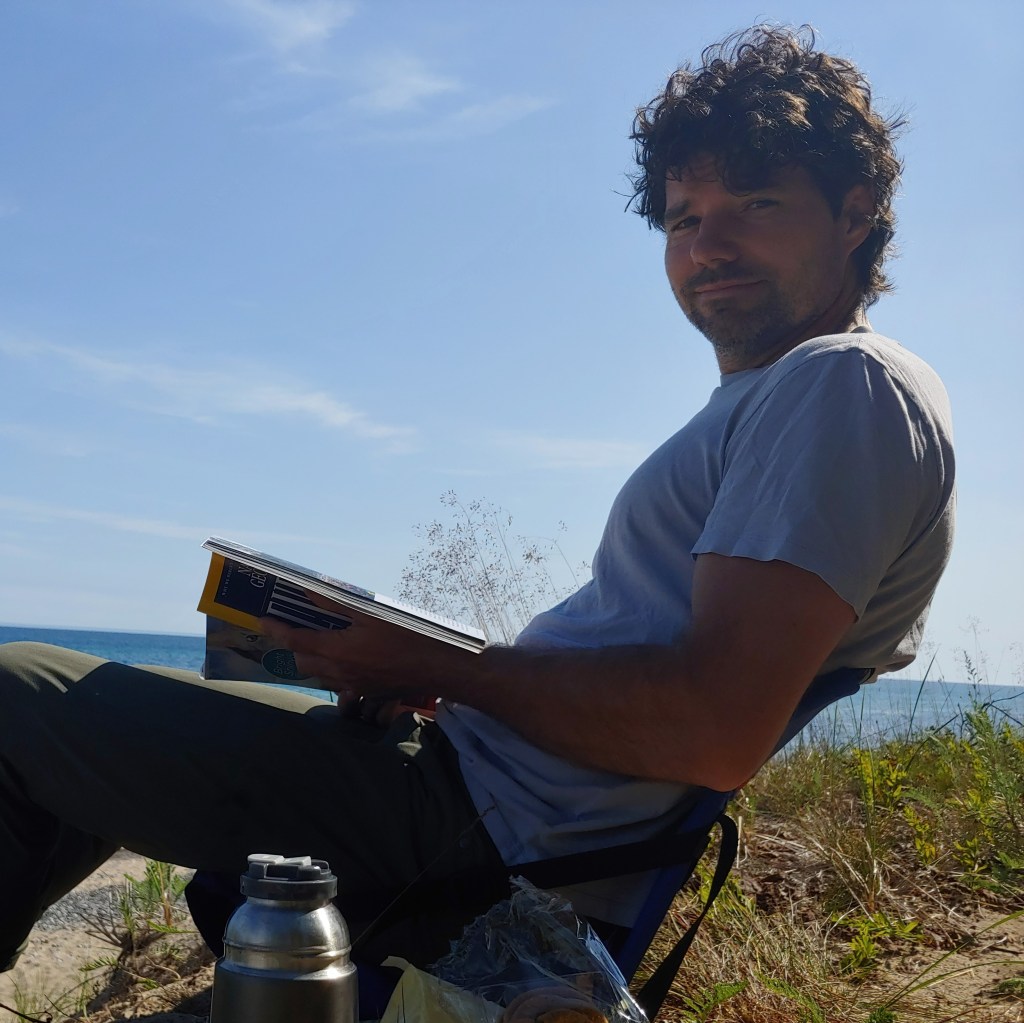
Name: Jacob Allgeier Location: University of Michigan Website: https://www.jacoballgeier.com/ Keywords: Ecosystem ecology, community ecology, Experimentation, field ecology, statistics, movement studies, isotope ecology, aquatic, marine, coastal, coral reefs, mangroves, seagrass beds
Can you describe your research interest?
I study the flow of energy and nutrients through ecosystems. I integrate population, community and ecosystem ecology, and I’m interested in understanding the drivers of production in ecosystems at ecosystem scales – secondary production with respect to things like fisheries, and primary production with respect to things like carbon sequestration. My work is rooted in theory, but it leans towards applied conservation and trying to inform ecosystem management. I mainly work in tropical coastal ecosystems, including seagrass beds, mangroves, and coral reefs. My work also aims to answer questions about how biodiversity in terms of habitat types, species assemblages, and things like how the diversity of behaviour types can feed back to affect the flow of energy and nutrients.
What are the big questions your research addresses?
The big question is all about the drivers of production. I guess my novel contribution has been about the role of consumers – particularly fish mediating nutrient cycling through excretion. I think about the ecosystem as a box – I study the flux of things coming in and out and how that affects the production of the box. I don’t have to care about who’s in the box, but it just so happens that I do! We can then ask questions about species composition and how different compositions might interact with the system to affect the total productivity. If we fish certain species, how does that change the species composition and, by extension, the cycling of the nutrients and seagrass growth? In these systems, fish (or consumers in general) are often the main ‘bank account’ of nutrients – they hold most of the biomass, and so they hold most of the nutrients. When you take them away, it’s harder for the system to rebuild. Despite being really productive systems, it’s harder for them to maintain productivity. We use artificial reefs as a model system – you build structure around which fish aggregate. They excrete nutrients that fuel the growth of seagrass beds and primary production. This creates habitats and provides resources for invertebrates, which then feed back to the fish. Within these cycles, there are many different players and also behavioural factors to account for. For example, if fish display different movement behaviours between or within species, they can mediate nutrients in different ways. If they feed locally compared to feeding far away and bringing more nutrients in, how does that affect the ecological processes at the ecosystem scale? We’re also interested in these systems because seagrasses are really important for carbon sequestration. We’re thinking about ways in which we can help shift perspectives by providing more support for why we need to conserve these systems and how we can better manage them. How do we save these massive pools of carbon, and can we help to restore them? Artificial reefs increase seagrass production, so by building artificial reefs in the seagrass bed, could we enhance the net production of the whole system so that it sequesters and stores more carbon? Or could we build them near seagrass beds and increase the overall size of the beds?
What do you think is the future direction for this area of research?
I am first and foremost an ecosystem ecologist. I love this system, and I’m passionate about it, so I’m trying to make my science more directly useful for policy. Thinking like an ecosystem ecologist, I am interested in figuring out how to make measurements at the box scale instead of worrying about what’s inside it. This approach aims to make large-scale measurements from which we can monitor whole systems. If we can monitor something like net production, then when that measurement goes up or down, it could be an indicator that could direct management. In this approach, the aim is to monitor the system and be a little less hands-on and just watch, and to use fewer variables to get emergent measurements. This is a bit pie in the sky thinking, but maybe that is what we need. A big question for me is trying to figure out what those measurements are.
Why are you an associate editor?
The answer is because it’s an expectation of us as a faculty member! Although I don’t actually have any work published in the journal, I’ve always really liked it, so I’m happy to be part of it. I’ve really enjoyed the role, and I like working with JAE – you’re really good and efficient, and I think there’s good feedback. The main reason for being an AE, though, is to give back and be part of the publishing process. In terms of exposure to research, the role helps in the same way as being a very open reviewer. You learn lots – the role doesn’t help me publish more papers or anything – it’s just interesting. This journal gets really good papers that I can learn from; they’re usually in-depth and high quality.
What are some of the common mistakes in new submissions? Is there anything you’d like to see more of?
Perhaps the most common issue is that people misunderstand what a discussion is and simply rewrite the results. I don’t believe it’s the editor’s responsibility to teach people how to write. Unless it’s an exceptional paper, this makes me less likely to be positive about it.
What we are seeing more of, and which I would like to encourage, is the combined use of empirical data with interesting modelling techniques. That’s the direction which we are and should be going as a field. We’re starting to get better data sets and people are becoming more quantitative in their approach. I like to see people modelling real data, and using those projections to better understand the system. In fact, I’m handling a paper right now which is doing just that in a really interesting way.
Is there any advice which you would like to give to prospective authors?
Be attentive to every detail in your paper. As an Editor, you might come across papers with a good introduction, but the results are really poor, or there are lots of small errors, or the figures are just awful. Having the whole package together is really important. In fact, I recently talked with a student about how his figures were hideous. He’s a brilliant student, but his figures were just terrible! They don’t have to be art, but they need to convey what you want to communicate. When you’re reviewing papers, especially at a higher level, seeing a poorly produced figure does affect your review. The same goes for citations and referenced literature. Those little things matter, and that is something which I stress to my students.
The JAE aims and scope mentions “novel” work – what does this mean for you?
I don’t think we should be charged with “novelty”. Instead, we should be charged with producing high-quality work. Doing something creative and interesting that addresses an important question is what I look for more than something being truly novel, which is very rare. I am currently handling a paper that I don’t think is novel per se. However, I still think it is a really good paper. I love what they’re doing because it’s creative. They’re integrating field data with a cool modelling approach, and there is clearly a lot of thought and effort put into it. So, for me, I look for papers that are interesting, creative, and useful for moving the field of ecology forward. Another thing is that I think is important is that the paper has a broad scope, and anyone interested in the idea should be able to read the paper. For example, I may focus on coral, but a person studying ungulates that’s interested in nutrient cycles should be able to pick up and digest my paper. The first paragraph should be broad, allowing them to understand the concept being dealt with. Papers should have a broad ecological application and should be relevant beyond the specific example that was studied.
You can browse Journal of Animal Ecology’s full editorial board here
 Animal Ecology in Focus