At JAE we’re taking the opportunity to showcase our wonderful Editorial Board by chatting to our Editors about research, what it’s like to be an editor, and their advice to prospective authors.
Editor Profile
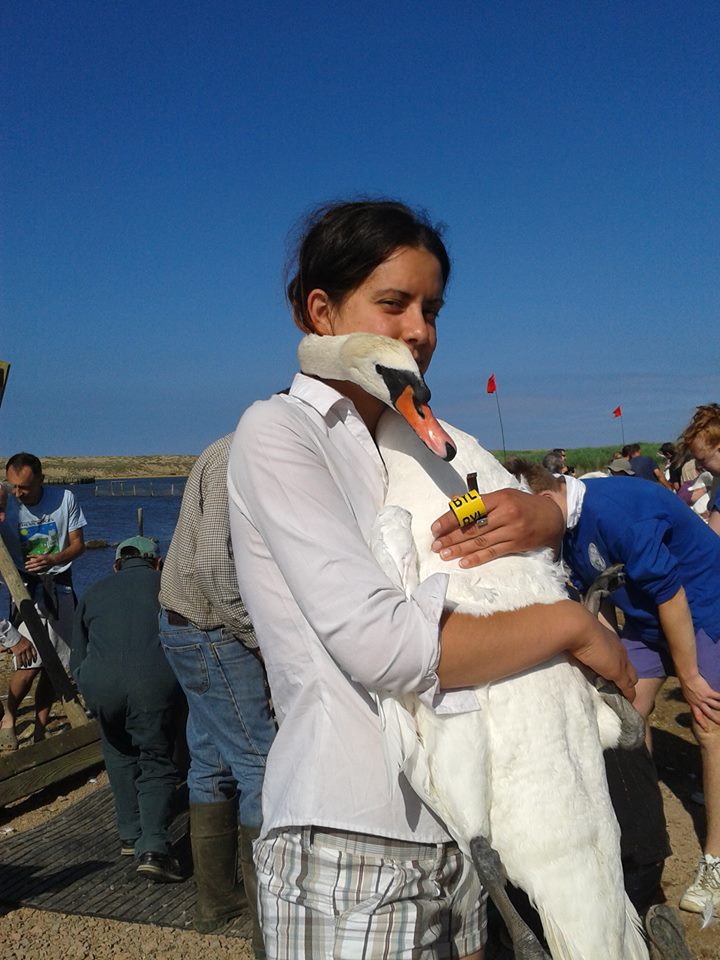
Name: Antica Culina
Current Institution: Ruder Boskovic Institute, Zagreb, Croatia
Keywords: Evolutionary ecology, social monogamy, pair bonds, life-history trade-offs, birds, capture-mark-recapture, meta-analysis, FAIR data, open science, meta-science
Twitter: @antica_c
Website: https://ecoevo.social/@antica_c
Can you briefly describe your research interests?
My expertise covers the evolutionary ecology of bonding, life-history trade-offs, evidence synthesis, and data and code standards. I strive to apply my knowledge of different modelling approaches and Open Science to study and optimize scientific process itself (using an approach called meta-science). In this way, we can enable ecological research to reach its full potential.
Why do you choose study this? What makes it so exciting?
I sometimes feel that the meta-research in ecology was something I have just slowly drifted into, and now I just love it. Looking back at my career, I always had this ‘issue’ of working on something, finishing it, and then along the way finding something completely new that I started to get so curious and passionate about. This happened during my PhD (in evolutionary ecology), where, while doing a literature review for a meta-analysis I realized how many papers are poorly reported (and maybe even conducted) so I could not, for example, get to something as simple as sample size. When I tried to email the authors to check these values, many never replied, and many could not tell me – as their data was who knows where, so they could not check… And this is how I started to work on the topic of open science in ecology, which deals much with the importance of data and analytical code. While doing this, I applied the scientific method (e.g. have a hypothesis or some idea, collect data, analyse the data). I later learned this is called meta-research. Science is our best way to understand the world, but the scientific system is made by humans and thus suffers from many issues. With my work I strive to help ecologists to increase the knowledge gained from their work. I also still sometimes collaborate on topics related to my PhD work (social bonding in birds) and on topics I’ve worked on before doing a PhD (conservation). However, now I do this differently and try to make my research as transparent and thus more useful for others.
What are the current challenges / questions in ecology that you hope to address?
My work revolves around challenges of the research, funding, and publishing in ecology. How much can we trust published articles, given the prevalence of questionable research practices and publication bias? How much important information (such as datasets, unpublished studies) we lose along the way? How much value would this information bring had it been accessible? These challenges are closely linked with the potential solutions. The effectiveness of these solutions has to also be explored. For example, do open data policies increase the quality and quantity of open data? What are financial costs vs benefits of open data?
What is one of the biggest challenges you have faced in your career?
Guilt. Guilt is an internal challenge but exacerbated by external expectations. I felt guilty of not working enough, of not putting enough into the personal life, of not spending enough time with my daughter (especially being a sole carer). I have now finally found my balance. While many imply that you are a good scientist and truly passionate about science only if you work extra hours, and weekends, this is really not true. I am extremely passionate about my work, but I do not want to do it above a certain amount of time. I am passionate about many other things too, but do not want to do them all the time. Being time conservative with different aspects of life is not a sign of a lack of enthusiasm, but a sign of being respectful of the multiplicity of life. After almost 15 years in research, I finally do not feel the (externally and internally) imposed guilt.
What are the future directions of research?
Meta-research has only recently been recognized as a separate research line. Thus, exciting times are ahead, and I hope more ecologists will incorporate at least some exploration of the research landscape they participate in into their work. I’m also always happy to collaborate.
Why are you an Associate Editor? What are the benefits and challenges?
I wanted to learn more about how the editorial process works, to be on that other side. I also felt I have something different to offer, given my open science/data angle (combined with my expertise in meta-analysis and evolutionary ecology). Finally, I wanted to support a society journal. I love the work involved, it has provided me with new skills and knowledge. I also find it easier to act as an associate editor than as a reviewer as I find my role to be more balancing. The most difficult bit is to reject a paper straight away, as I always feel that maybe I am being unjust. However, one must balance this with loading already loaded reviewers with more unnecessary work. This challenge is becoming easier with time, and there is always a senior editor to help out. Also, sometimes is very challenging to find reviewers. This is something I was not aware of prior to this role.
What are some common mistakes in new submissions?
Two main bits of advice here: Firstly, spell out your predictions and hypothesis (or research questions if there is no hypothesis). If these are clearly outlined and labeled (e.g. prediction 1: females have more social connections than males) in the intro, and then referred to in the methods (e.g. to test prediction 1, we xxx) and results (our prediction 1 was not supported by…) it would be so much easier to follow and understand the work. Second, the review process would be much easier if data and code were submitted for a review. Often methods are not precisely described, and then if one has a code to look at, it suddenly becomes much clearer what has been done.
What submissions would you like to see more of?
I would love to see more work done on under-represented species groups. But I also understand many of these species are much more difficult to collect data on. Before I did my PhD, I attended a talk by someone from BirdLife International, and he presented the number of papers published per species. At the top was, I think, the Great tit, and somewhere at the bottom (one paper) was the Western rock nuthatch (Sitta neumayer). As we have the latter species in Croatia, I told myself that I will do a PhD on it! Yet, I ended up doing a PhD on Great tits…..
How does being an associate editor benefit your career?
The highest benefit was to understand what the process looks on the other side. This makes my own writing of papers better. Second, I like to have a better influence on the changes at the journal level, which I try to connect with my open science advocacy. For example, I am now advocating for the introduction of data editors (end then I will move on to Registered Reports).
What would you say are some of the current / biggest challenges in wider ecological research?
I think it’s a lack of a broader perspective of the impact your research can have. Its not just about that paper you have published. It is much more. Open science practices can elevate the societal and environmental impact of our research. They have to become a norm in science. I would also like to see more involvement of trained statisticians in our work. We often approach statistical analysis by learning along the way, which is sometimes not doing the best for the robustness of our results.
What advice would you give to early career researchers in ecology / prospective authors?
I never feel placed to give advice, as I often think that what worked for me will not work for someone else. What worked for me is to hear the advice, but to follow what I enjoyed researching. Even when this went against the advice, which was often. Also, I always kept other passions alive, like playing piano or singing in a band. Now is being a mum. It does not have to be a trade-off.
Do you have any advice for prospective authors on meeting the aims and scope of the journal?
I actually do not support only ‘novel’ research as this is one of the reasons why we have a problem in the research and publishing ecosystem. We need more robust and trustworthy research, and research that advances our knowledge.
 Animal Ecology in Focus