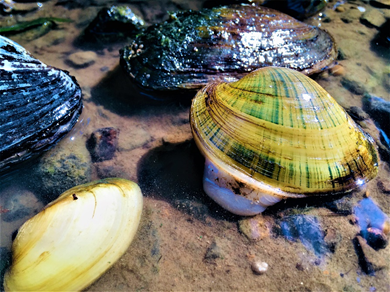
This blog post is provided by Garrett Hopper and Carla Atkinson and tells the #StoryBehindthePaper for the paper “A test of the loose-equilibrium concept with long-lived organisms: evaluating temporal change in freshwater mussel communities”, which was recently published in Journal of Animal Ecology. In their study, they used long-term monitoring datasets for mussel beds from rivers in the USA to assess the stability of mussels to determine whether mussel beds are stable or in constant flux as the environment shifts around them.
If you go to the same place and sample the same group of animals the same way many times over a long time, do you find the same species with roughly the same population sizes over-and-over again? This is the basis for “stability” over time for a group of taxonomically similar animals occurring in the same place.
Animal groups must constantly contend with environmental changes and disturbances, whether natural or man-made, and therefore the presence of species and population sizes fluctuate. The amount of change, or lack of change, of different species’ populations over time, can tell us something about the stability of the group of animals to changes in their environment. Long-term monitoring programs are a good way to keep track of animal populations and can provide important insights into the fluctuating nature of animal groups like grassland birds, stream fish and small mammals over time.
Some animals grow slowly, mature late in life and outlive the scientists that study them (or at least their career!). This makes understanding the stability of groups of long-lived animals difficult.

Freshwater mussels are some of the longest-lived animals inhabiting rivers, with many species’ lifespans exceeding 50 years. Slow growth and late maturation coincide with their long lives making them particularly slow to respond to environmental changes. Mussels live buried in the stream bottom in dense aggregations known as mussel beds that often have many species. Like other animals living in rivers, mussels constantly deal with fluctuating water levels, water temperatures, predators, and food availability among other environmental factors. These “mussel beds” can persist for decades in the same location. Does this mean that mussel beds are stable, though?

In a recent paper in Journal of Animal Ecology, we used long-term monitoring datasets for 31 mussel beds that spanned 10-40 years from seven rivers in the USA to assess the stability of mussels in the context of the “loose-equilibrium concept”. This concept states that animal groups are not necessarily stable, but instead are in constant flux as the environment shifts around them. So, we shouldn’t expect to find the same species with the same population size again and again—a little bit of seemingly random change (non-directional change) is to be expected. On the other hand, groups might change in response to a specific environmental disturbance that causes a large increase or decrease in the population sizes of species, or a loss of a species present in the mussel bed would cause a “directional change”.
Our analysis showed a continuum of mussel bed change from non-directional to directional change was common. Mussel beds that had more non-directional change often had more species, but those species had small population sizes and were inconsistently found in the surveys through time. The directionally changing mussel beds showed changes in the identity of the most abundant species over time. These changes have been linked to environmental disturbances, like stream drying in some systems. However, the causes of change in most mussel beds are still not known.
So, what does this mean for mussels and other animals with long lives? The non-directional and directionally changing mussel beds made it clear that stability is not common for these animals. This constant change should be acknowledged by conservation workers who attempt to maintain or reintroduce these animals and others with slow life histories. Because of the slow generation times of these animals, we have probably only witnessed a generation or two of change for these mussel beds. It will likely take another few careers worth of monitoring data to completely capture change over time for mussels.
Read the full paper
Read the full paper here: Hopper, G. W., Miller, E. J., Haag, W. R., Vaughn, C. C., Hornbach, D. J., Jones, J. W., & Atkinson, C. L. (2024). A test of the loose-equilibrium concept with long- lived organisms: Evaluating temporal change in freshwater mussel assemblages. Journal of Animal Ecology, 00, 1–1 3 . https://doi.org/10.1111/1365-2656.14046
 Animal Ecology in Focus