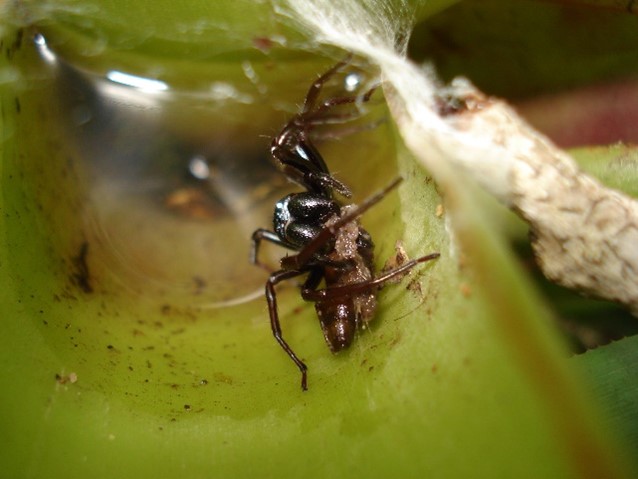
This blog post is provided by Pablo Augusto P. Antiqueira and tells the #StoryBehindthePaper for the paper “Trophic cascades within and across ecosystems: the role of anti-predatory defences, predator type, and detritus quality”, which was recently published in Journal of Animal Ecology. Using tank-bromeliad as a model system, Antiqueira and colleagues investigate the effects of cross-ecosystem predators (diving spiders) on prey, other predators and the ecosystems they utilise.
Charismatic predators, such as lions, bears, leopards, crocodiles and sharks, have often captivated people, including ecologists. Predators play a key role in structuring ecological communities and ecosystems. For example, predators can cause changes in food webs and ecosystems, with alternating positive and negative effects on lower trophic levels, a phenomenon called trophic cascade. However, depending on behavioural characteristics and foraging location, predators can affect ecosystems differently. For instance, among the predators mentioned above, some forage almost exclusively in one type of ecosystem, such as lions and leopards in terrestrial ecosystems and sharks in aquatic ecosystems. On the other hand, some predators utilize multiple ecosystems in search of prey, such as bears that consume both terrestrial animals and riverine fish and crocodiles that consume fish in aquatic environments but also occasionally terrestrial mammals, like wildebeest, on riverbanks. Despite aquatic, terrestrial, or cross-ecosystem predators sharing foraging areas, little is known about how the combined action of these predators affect prey and the ecosystems shared by both. In particular, we do not know if the presence of one predator can influence the behaviour of another predator and, consequently, their direct and indirect effects on the ecosystem.
The response of prey, such as herbivores and detritivores, and the resources they consume (e.g., plants and detritus) to the impact of multiple predators can also be affected by prey defence attributes and detritus quality. However, it is unknown how the co-occurrence of predators with distinct habitat domains, such as aquatic predators and predators foraging across aquatic and terrestrial ecosystems, affects the survival of prey with different anti-predator defence strategies and ecosystem functioning. A substantial limitation to empirically investigating predator effects within and across ecosystems is the difficulty of conducting these studies in nature. Natural microcosms, such as tank bromeliads (Bromeliaceae), are suitable systems for studying the dynamics of ecological interactions between ecosystems. The tank bromeliad phytotelmata (i.e., water-filled compartments formed by leaves) and the above-water portion of their leaves provide, respectively, an aquatic and terrestrial environment. Terrestrial predators (e.g., spiders) and aquatic predators (e.g., damselfly larvae) occupy this natural microcosm, often sharing the same set of prey (Figure 1). This microenvironment comprises a complex detritus-based food web that depends mainly on the accumulated detritus that has fallen from the tree canopy (Figure 1). Macroinvertebrate detritivores (e.g., insects, crustaceans, and annelids) participate in a series of facilitating interactions in the breakdown of this detritus. The bromeliads absorb nutrients released by this decomposition process and those released by animal activities using specialized trichomes at the base of their leaves. Thus, components of the tank bromeliad food chain can influence plant nutrition and growth. The processing of detritus by macroinvertebrates and the related flow of nutrients are, therefore, important ecosystem processes within the bromeliad microecosystem. These features, in addition to the ease of replication and manipulation, make this micro-ecosystem an excellent model to investigate how the trophic cascades caused by predators from different ecosystems affect biodiversity and ecosystem functioning components.

We conducted a fieldwork experiment using tank-bromeliad as a model system in an Atlantic Rainforest biome in the Cardoso Island State Park, Brazil (Figure 2A-B). We manipulated the presence of a predator with both terrestrial and aquatic habitats (diving spiders – cross-ecosystem predator, Figure 2C-D) and a strictly aquatic predator (damselfly larvae – Figure 2E) and examined the effects on prey survival (groups of detritivores with different anti-predator defence strategies), leaf litter decomposition (of two plant species differing in leaf quality – Figure 2F), nitrogen flux, and host plant growth (Figure 1). Aquatic predators and cross-ecosystem predators directly decreased detritivore survival and caused multiple indirect negative effects on leaf litter decomposition, nutrient cycling, and host plant growth. However, when predators co-occurred, the spider caused a non-consumptive negative effect on damselfly larvae (i.e., changing its behaviour), diminishing net direct and indirect effects on the aquatic detritivore community and ecosystem functioning. Both detritivore anti-predatory traits and detritus quality modulated the strength and mechanism of these trophic cascades. Undefended or partially defended detritivores mediated predator interference. However, detritivores with anti-predator defences escaped consumption by damselfly larvae but not by spiders. Predators and detritivores affected ecosystem decomposition and nutrient cycling only in high-quality detritus, as microbes consumed more low-quality detritus than invertebrates.

Despite the importance of top predators to ecosystems, many are at risk of extinction, being heavily impacted by human-induced environmental changes such as deforestation, hunting, and climate change. These multiple impacts have caused trophic downgrading in ecosystems, with complex and often unknown consequences. Our study emphasizes the importance of considering predator interactions in adjacent ecosystems with different habitat domains. Knowledge of such interactions is essential for predicting the effects of trophic cascades between ecosystems on organism survival and ecosystem functioning. This knowledge also helps to predict the ecological consequences of losing these predators. Our results also suggest that both basal resource (i.e., detritus) and consumer (detritivore) attributes modulate the strength and direction of trophic cascades triggered by adjacent ecosystem predators. The complex responses of ecosystems and biodiversity to predator loss and functional homogenization of consumers and resources highlight the critical role of maintaining environments with balanced biodiversity components within and across ecosystems.
Read the paper
Read the full paper here: Piccoli, G. C. d. O., Antiqueira, P. A. P., Srivastava, D. S., & Romero, G. Q. (2024). Trophic cascades within and across ecosystems: The role of anti-predatory defences, predator type and detritus quality. Journal of Animal Ecology, 00, 1–14. https://doi.org/10.1111/1365-2656.14063
 Animal Ecology in Focus
One thought on “Trophic cascades within and across ecosystems: resource and consumer attributes modulate the impacts triggered by multiple predators from adjacent ecosystems”