Miguel Gomez gives us information on his paper, “interactions between fitness components across the life cycle constrain competitor coexistence“, which was shortlisted for this year’s Elton Prize. We also hear a little about his story.
About the paper:
Understanding how biodiversity is maintained has been one of the main topics of my research. At the community level, this question is often framed as what mechanisms promote species coexistence. At the local level, species coexistence is determined by the interplay of fitness differences (differences in competitive ability manifested as a difference in the average population growth rate between species) and stabilizing effects (effects that reduce the effect of heterospecifics and increase the effect of conspecifics on population growth). If stabilizing effects are present allowing local species coexistence, species will have a demographic advantage when rare1.
There are a lot of mechanisms that can generate stabilizing effects and promote local species coexistence. Competition for resources and predation susceptibility have been some of the most widely studied ones. However, other mechanisms, such as reproductive interactions have been much less studied, although they can be equally important2. What this means is that different mechanisms could be acting during the whole life cycle, and these mechanisms could interact with each other, promoting or preventing coexistence. In 2020 I accepted a postdoctoral position in Adam Siepielski’s lab (link: https://asiepielski.wordpress.com) to study this question. Both Adam and I use damselflies as our main study system, he works mostly on the larval stage3 where competition and predation are the main fitness drivers, while I have focused mostly on the adult stage4 where reproductive interactions are more important. Working with Adam was the perfect opportunity to test how these mechanisms across the life cycle interacted, and quantify their effect on population growth and species coexistence.
Working with damselflies is a lot of fun, you get to spend the day outside, wading around lakes to capture damselflies for the experiments. In the experiments we manipulated the relative frequency of two competing species of damselflies, both larvae and free flying adults. In the larvae we measure how competition affected the growth rate and how fish predation affected mortality rates. In the adults we measure how reproductive interactions affected female fecundity. What is more interesting is that each of these mechanisms can interact in different ways. For example, strong competition in the larvae stage can reduce growth rate, prolonging the larvae stage and the time they will be exposed to fish predation. In the other hand, reduced fish predation could increase the number of emerging adults, setting the scene for more intense competition that can decrease female fecundity. To be able to capture these interactions and their effect in population growth, we took our measured fitness components, growth and mortality rate in the larvae and fecundity in the adults, and use them in a demographic model.
Our results show that the interaction between these different mechanisms seem to be acting in different directions and largely prevent local species coexistence. This is an interesting result as although we would expect that the more mechanisms are studied the greater the opportunity for species to coexist, what we found is that mechanisms alone do not matter, what really matters is how they combine to affect local species coexistence. In a follow up study we investigated how local adaptation can affect how these mechanisms combine, integrating evolutionary effects in this ecological process. Species coexistence is a very dynamic area and theoretical and empirical work are increasing very rapidly. This paper reflects that expansion, integrating population and community ecology to understand the maintenance of species diversity.
- Chesson, P. (2000). Mechanisms of maintenance of species diversity. Annual Review of Ecology and Systematics, 31(1), 343-366. https://doi.org/10.1146/annurev.ecolsys.31.1.34
- Gómez-Llano, M., Germain, R. M., Kyogoku, D., McPeek, M. A., & Siepielski, A. M. (2021). When ecology fails: How reproductive interactions promote species coexistence. Trends in Ecology & Evolution, 36(7), 610–622. https://doi.org/10.1016/j.tree.2021.03.003
- Bried, J. T., & Siepielski, A. M. (2019). Predator driven niches vary spatially among co-occurring damselfly species. Evolutionary Ecology, 33(2), 243–256. https://link.springer.com/article/10.1007/s10682-019-09975-2
- Gómez-Llano, M., Narasimhan, A., & Svensson, E. I. (2020). Male-male competition causes parasite-mediated sexual selection for local adaptation. The American Naturalist, 196(3), 344–354. https://doi.org/10.1086/710039
About the author:
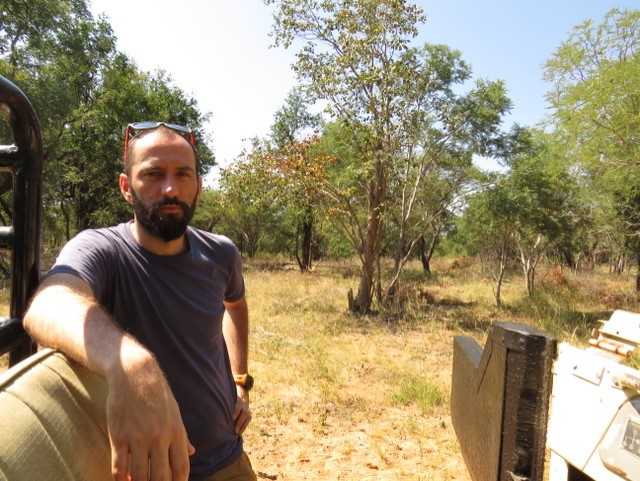
Miguel Gómez was hired as an Assistant Professor at the Department of Environmental and Life Science at Karlstad University shortly before this paper was published. His work revolves around the ecological and evolutionary mechanisms that promote the maintenance of biological diversity at the species and community level.
 Animal Ecology in Focus