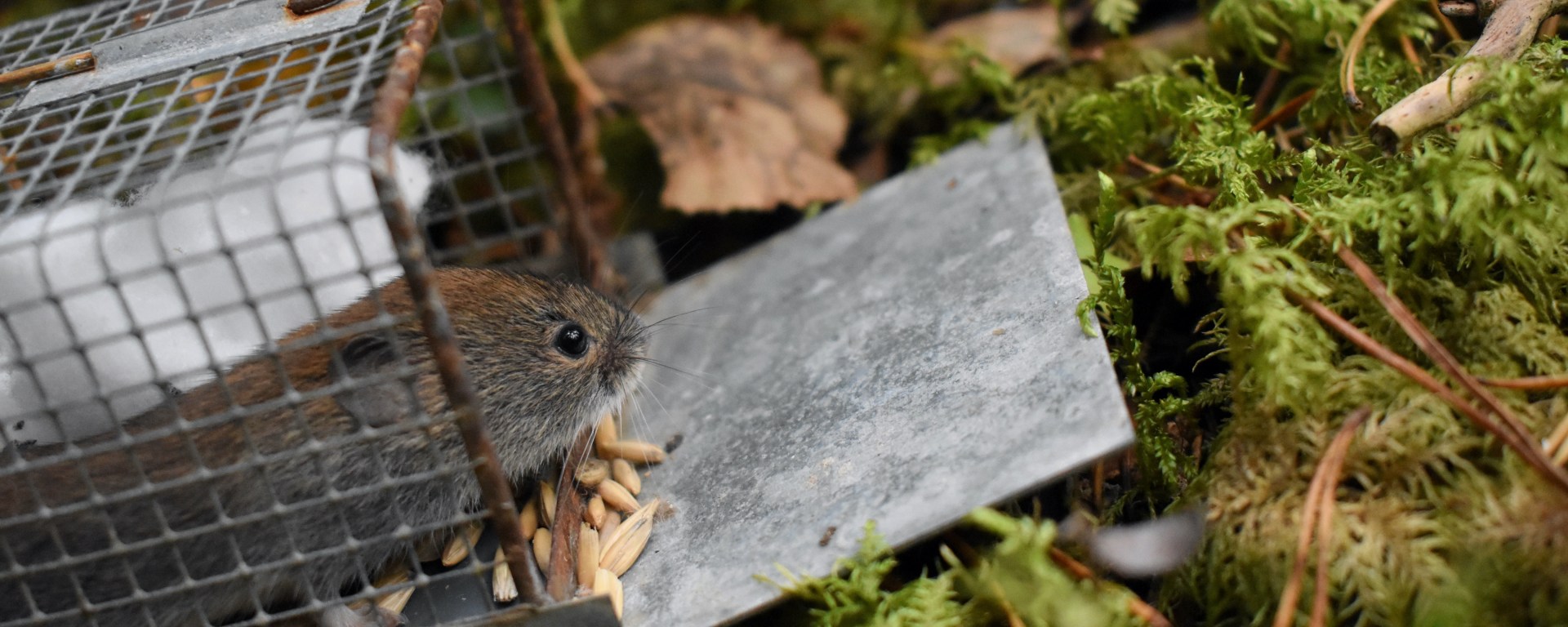
This blog post is provided by Janine Mistrick and tells the #StoryBehindThePaper for the paper “Effects of food supplementation and helminth removal on space use and spatial overlap in wild rodent populations”, which was recently published in the Journal of Animal Ecology. This study leverages a large-scale field experiment in southern Finland to investigate how ecological factors affect spatial behaviour in wild rodents. Janine Mistrick, the lead author of the study, recently completed her PhD at the University of Minnesota in Minneapolis, Minnesota (United States of America).
How animals behave, such as their movements around their environment and interactions between animals, can scale up to have population-level effects on wildlife species. Ecological factors like habitat quality can also influence how animals behave. Habitat quality often varies between habitats or through time and this can affect animal behaviour and influence other processes like social behaviour and pathogen transmission. Understanding factors that influence pathogen transmission in wildlife populations is important for wildlife conservation and public health; however, we have a limited understanding of how habitat quality influences interactions between animals that promote transmission.
Our research team is investigating how habitat quality (specifically, food abundance) and infection with parasitic worms affect the behaviour of wild bank voles. The bank vole (Clethrionomys glareolus) is a small rodent common throughout central and northern Europe and is often used as a model organism in field studies.
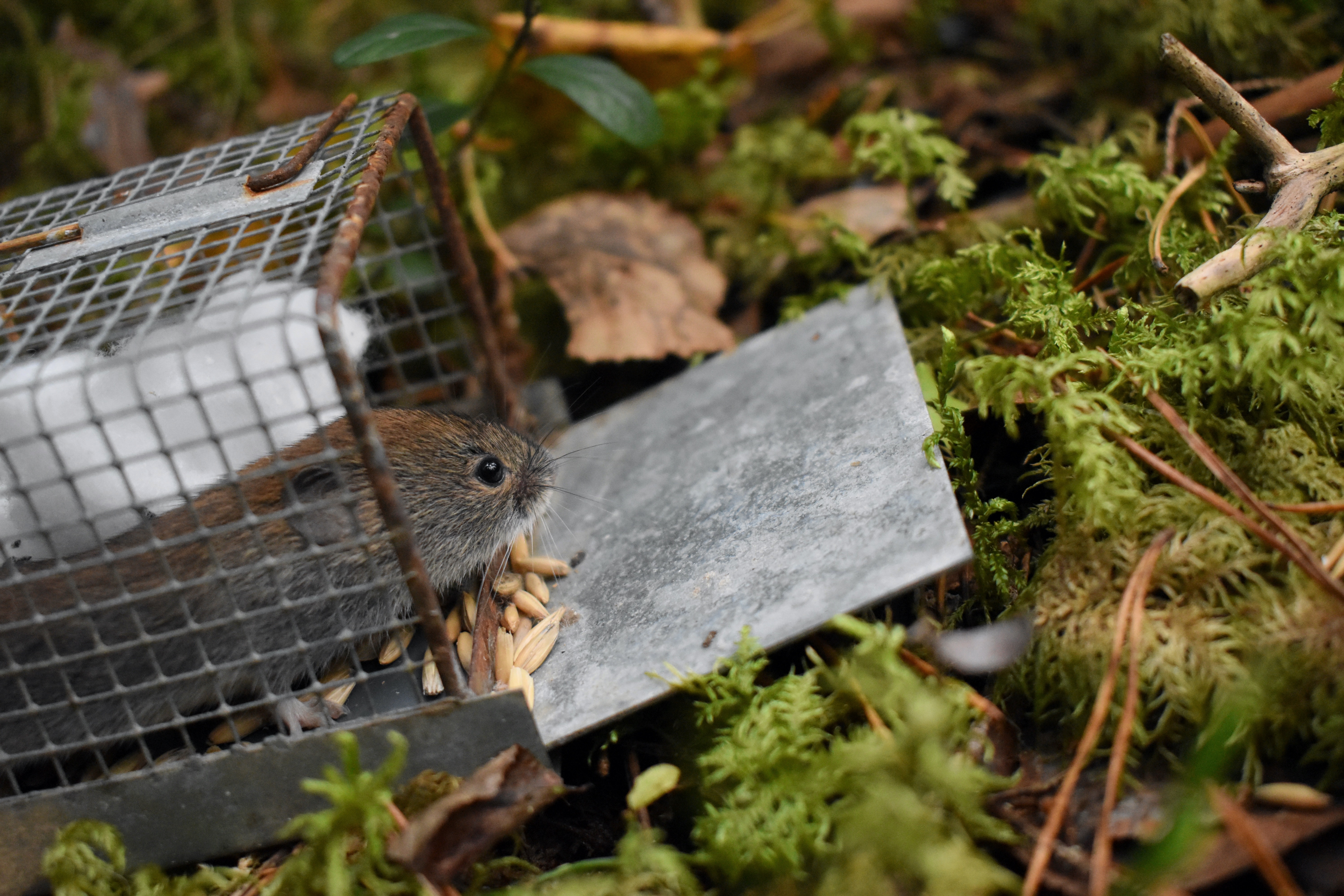
It was important that we could test our research questions in the field – as opposed to in a controlled laboratory setting – so our findings would be relevant to wildlife populations and the conditions they experience in nature. We conducted a large field experiment in southern Finland where we set up grids of live-capture traps at twelve different sites. Four sites received supplemental food (sunflower seeds and mouse chow pellets) and voles were treated with an oral deworming medication; four sites received only supplemental food; four sites received only the deworming medication; and four sites were our controls and received no manipulation.
We trapped voles at the sites once every month from June-October; collected data on their sex, age class, and where on the grid they were caught; tagged the voles with a microchip so we could identify them when we caught them again; and then released them. Over the five months, we caught over 700 individual voles and some individuals were caught many times (up to 17 times for one female!).

We used the locations where each vole was caught to estimate the size of their home range using mathematical models. Voles differ in their home range size based on their sex and age class so we grouped voles into adult (i.e., breeding) males and females and juvenile (non-breeding) males and females to get an average measure of home range size for each group of voles.
We compared home range size between our different experimental treatments to test if adding food or deworming voles affected home range size. We also measured how much the home ranges of all the voles at a site overlapped to estimate opportunities for interactions between individual animals. We did this to test if the food or deworming treatments made interactions more frequent.
Interactions between animals – whether they happen directly where two are “nose-to-nose” or indirectly where two animals use the same environment, but at different times – are important for pathogen transmission. However, when studying wildlife, we can’t always document these interactions directly so we have to find ways to estimate how frequently they’re happening. Overlapping home ranges is one way; we assume that two animals with more overlap are more likely to interact (and thus the likelihood of transmission is greater) compared to two animals that overlap very little.

We found that home range size was different based on vole sex and age class. Especially in the summer when the voles are breeding, males and adult voles had larger home ranges than females and juvenile voles. As for the treatments, voles in fed populations had smaller home ranges than voles in unfed populations in both summer and autumn. Worm parasite removal increased vole home range size, but this effect was delayed and wasn’t apparent until autumn.
Despite the differences in home range size between treatments, there was no difference in the amount of home range overlap between voles. This was surprising as vole populations with supplemental feeding were 2-5 times larger than those without. We concluded that even when there were more voles in the population, the smaller home ranges of each of these voles allowed them to maintain a consistent amount of overlap.
Our research shows how factors like food abundance and parasite infection can alter the way wildlife behave and the impact this has on home range size. Additionally, we found that smaller home ranges might allow voles to limit their interactions with other voles when populations are very large. Our findings can help better predict how variation in habitat quality or parasites might affect interactions between rodents and the impact this could have on processes like pathogen transmission.
Read the full paper
Mistrick, J., Veitch, J. S. M., Kitchen, S. M., Clague, S., Newman, B. C., Hall, R. J., Budischak, S. A., Forbes, K. M., & Craft, M. E. (2024). Effects of food supplementation and helminth removal on space use and spatial overlap in wild rodent populations. Journal of Animal Ecology, 00, 1–12. https://doi.org/10.1111/1365-2656.14067
 Animal Ecology in Focus