
Garben Logghe gives us information on his paper, “arthropod food webs predicted from body size ratios are improved by incorporating prey defensive properties“, which was shortlisted for this year’s Elton Prize. We also hear a little about his story.
about the paper
The world is currently facing a serious biodiversity crisis, with species disappearing at alarming rates. What often goes unnoticed is the loss of interactions between species, which is happening even faster than species extinction1. This is worrying because these interactions play a crucial role in the functioning and stability of ecosystems2,3. Understanding these ecological networks is a daunting task, as the number of interactions between species in natural ecosystems can be overwhelming. As a result, researchers often rely on theoretical networks to describe potential interactions based on existing knowledge or assumptions, such as the idea that predators prefer smaller prey.
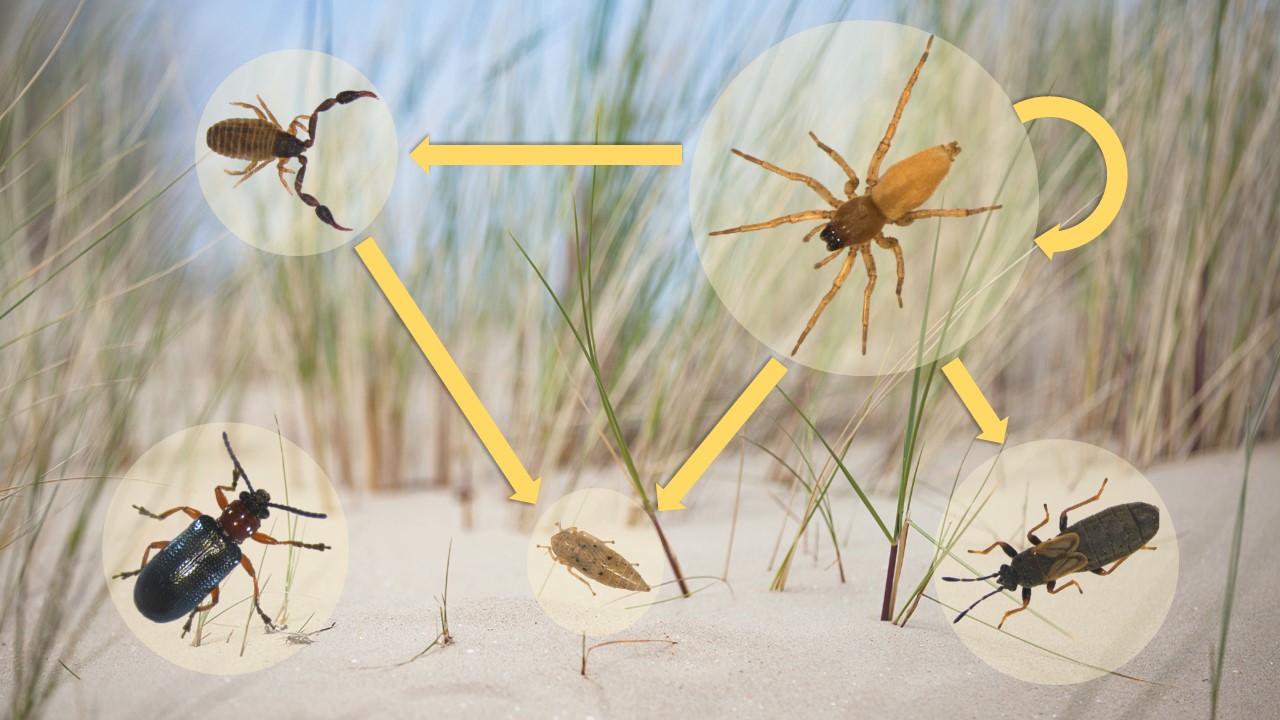
The paper is based on the results of my master’s thesis, where I investigated whether this assumption of size-structured trophic interactions holds true for arthropod food webs in marram grass dunes. My former supervisor and shared first author, Ruben Van De Walle, had previously developed a theoretical food web for this ecosystem based on body size ratios, as well as activity patterns and microhabitat choice. My job was to validate how realistic this food web actually was and whether predators indeed tend to be larger than their prey. Usually, validating realized interactions between species is done through either gut content or isotope studies 4,5. These methods have some important shortcomings, since it is hard to achieve large sample sizes and impossible to discern predation from scavenging. As an alternative, Ruben and I came up with an unusual experiment, reminiscent of gladiatorial combat in ancient Rome. Before we could do that though, we needed of course a large number of test subjects.
To that end, I spent my Saturdays during the summer of 2020 collecting various arthropod species from the marram grass dunes along the Belgian coast. To me this was by far the most fun part of this research, as marram grass dunes harbour many unique and rare arthropod species. Additionally, I was often accompanied in the field by some friends or family, which made the field work even more pleasant. Even days with lots of rain couldn’t stop us from venturing outside! We ended up filling my poor mother’s garage with heaps of vials containing spiders, ants, beetles and other arthropods she deemed “creepy crawlers”. During the week, I would pit individuals against each other in small vials sealed with mesh, observing them until one of the two would perish, either by the other’s actions or from natural causes. One of the main concerns surrounding this set-up was the restricted area in which both predator and prey could move. I was planning to perform additional trials in different arena’s to assess the effect of its size, but unfortunately the COVID-19 pandemic hindered these plans.
After 586 trials involving 718 arthropod individuals, the results were clear: differences in body size did indeed influence the outcome of interactions. Predators generally preferred prey slightly smaller than themselves, but there were some notable exceptions. For instance, beetles, with their though and armoured exoskeletons, were often left alone by potential predators, even when they were smaller. Some predators were also able to tackle prey items much larger than themselves. One of the most astounding examples that I remember clearly was a small pseudoscorpion that had caught a cicada more than twice its own size! The fact that these small critters possess venomous pincers will probably have aided in achieving such an amazing feat.
We could conclude that, at least in marram grass dunes, the idea that predators are larger than their prey holds true for arthropod food webs. However, it seems that taxon specific defences such as body armour, venom or foul smelling chemicals might deter predators from attacking, even when they are considerably larger than the potential prey. We therefore advise future research to also consider the defensive capabilities of prey species when constructing theoretical food webs.
- Valiente‐Banuet, A., Aizen, M. A., Alcántara, J. M., Arroyo, J., Cocucci, A., Galetti, M., García, M. B., García, D., Gómez, J. M., Jordano, P., Medel, R., Navarro, L., Obeso, J. R., Oviedo, R., Ramírez, N., Rey, P. J., Traveset, A., Verdú, M., & Zamora, R. (2015). Beyond species loss: the extinction of ecological interactions in a changing world. Functional Ecology, 29(3), 299–307. https://doi.org/10.1111/1365-2435.12356
- Griffiths, H. M., Bardgett, R. D., Louzada, J., & Barlow, J. (2016). The value of trophic interactions for ecosystem function: dung beetle communities influence seed burial and seedling recruitment in tropical forests. Proceedings of the Royal Society B: Biological Sciences, 283(1844), 20161634. https://doi.org/10.1098/rspb.2016.1634
- Keyes, A. A., McLaughlin, J. P., Barner, A. K., & Dee, L. E. (2021). An ecological network approach to predict ecosystem service vulnerability to species losses. Nature Communications, 12(1), 1586. https://doi.org/10.1038/s41467-021-21824-x
- Jacob, U., Thierry, A., Brose, U., Arntz, W. E., Berg, S., Brey, T., Fetzer, I., Jonsson, T., Mintenbeck, K., Möllmann, C., Petchey, O. L., Riede, J. O., & Dunne, J. A. (2011). The Role of Body Size in Complex Food Webs. In Advances in Ecological Research (Vol. 45, pp. 181–223). https://doi.org/10.1016/B978-0-12-386475-8.00005-8
- Miller-ter Kuile, A., Apigo, A., Bui, A., DiFiore, B., Forbes, E. S., Lee, M., Orr, D., Preston, D. L., Behm, R., Bogar, T., Childress, J., Dirzo, R., Klope, M., Lafferty, K. D., McLaughlin, J., Morse, M., Motta, C., Park, K., Plummer, K., … Young, H. (2022). Predator–prey interactions of terrestrial invertebrates are determined by predator body size and species identity. Ecology. https://doi.org/10.1002/ecy.3634
about the author
Garben Logghe is currently in his final year of pursuing a PhD at both Ghent University and the Research Institute of Nature and Forest. His research focuses on exploring the potential constraints on dispersal experienced by arthropod communities under future climate change. Employing predictive modelling techniques, he examines the impact of landscape composition and interspecific variations in functional traits on future patterns of arthropod diversity. Beyond his academic pursuits, Garben enjoys venturing into nature to observe interesting and rare arthropod species. He harbours a specific fascination with spiders and has delved into taxonomic research related to these animals.

 Animal Ecology in Focus