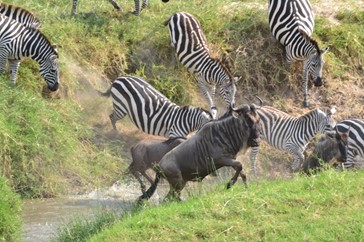
This blog post is provided by Adam Meyer and Shawn Leroux and tells the #StoryBehindthePaper for the paper “A theory for context-dependent effects of mammalian trampling on ecosystem nitrogen cycling”, which was recently published in the Journal of Animal Ecology. Adam Meyer is a PhD candidate in terrestrial ecosystem ecology at Memorial University of Newfoundland. He uses mathematical models and empirical field studies to understand the effects of large herbivores on ecosystem processes. Shawn Leroux is a professor at Memorial University of Newfoundland. His research focuses on the causes and consequences of biodiversity change on ecosystem functions at local, landscape, and continental extents. In their paper they derive a new model for trampling effects on nitrogen cycling
Trampling of plants and soil is ubiquitous among walking vertebrates. Elephants trample. Tortoises trample. Geese trample. Even guinea pigs produce measurable trampling effects on soil properties. So what? For one, trampling is one of the main things large and abundant herbivores, like ungulates, do all day. Second, we need to understand the diverse roles of these animals in ecosystems to support ongoing ecosystem management practices such as restoration and rewilding. A key barrier to doing so is that large herbivore effects on ecosystem properties, such as elemental cycling, are variable across environments. One explanation for environmental variability in these patterns is the operation of multiple mechanisms of animal-ecosystem interactions, whose relative strengths and directions can change depending on soil fertility, temperature, plant traits, and other environmental factors. Progress can be made by understanding how the consequences of different herbivore activities (e.g. plant consumption vs. ecosystem engineering) change across contexts (e.g. environmental gradients).

So back to trampling. What exactly happens when some unsuspecting soil is trampled upon? Soil is a complex 3-dimensional physical-chemical volume with parallel “green” and “brown” food webs representing 59% of the Earth’s total biodiversity. Quite a lot can happen.
From a community ecology perspective, trampling can have top-down or bottom-up effects on the soil-dwelling detritivores that are essential for conversion of organic carbon and nitrogen to inorganic forms – a critical step in terrestrial elemental cycling. Trampling may alter the quantity and quality (e.g. C:N ratio) of plant litter and soil organic matter in soil, the basal energy source of the “brown” food web. This can occur via soil mixing and litter incorporation, or through erosion. Over longer periods, this could also occur via shifts in plant and detritivore communities to more trampling-tolerant species (e.g. fewer predatory invertebrates). From a population perspective, trampling-induced changes to soil architecture (e.g. pore space), chemistry (e.g. pH, moisture, oxygen saturation), and microclimate (e.g. soil temperature), may impact the vital rates and life-history of soil biota, such as the growth and mortality rates of detritivores. For a more detailed accounting of potential trampling effects in tundra, see Tuomi and colleagues’ excellent (2021) review in Functional Ecology.
Suffice to say, there are many potential mechanisms of trampling effects. But what does this all mean for trampling effects on ecosystem properties such as soil-mediated nitrogen cycling? Are trampling effects as complex as the soil itself? This is where theory and mathematical models can help identify potential constraints on patterns and make predictions to guide empirical research. In a recently published article in Journal of Animal Ecology, we derived a new model for trampling effects on nitrogen cycling. Our model follows other “classics” that explore specific mechanisms of herbivore-ecosystem interactions and also compliments recent conceptual models of trampling effects that explicitly consider environment-dependent interactions.

Within a general ecosystem nitrogen cycling framework, we modelled trampling effects on nitrogen mineralisation. Specifically, trampling in the model simultaneously impacts several functional rates of detritivores that are common to all soil systems. These are: the intrinsic mineral-nitrogen release rate of detritivores, the rate of consumption of dead organic matter by detritivores, and detritivore mortality rate. This is obviously an abstraction of the many potential impacts of trampling described above. We feel it is a good start because the community and population effects above will ultimately impact these functional properties of soil biota. We also derived a general definition of context-dependent trampling effects using a simple linear relationship between these vital rates and the amount of trampling (e.g. number of steps). This simple formalization reflects that sites differ both in (1) the functioning of soil biota independent of trampling and (2) in the nature of their response to being trampled upon. For example, some sites may be more or less sensitive to the same amount of trampling.
We found that in diverse environmental contexts, nitrogen mineralisation rates are likely to be reduced by trampling. This occurred via increased detritivore mortality, decreased mineral-nitrogen release, or to a much lesser extent by reduced consumption of dead organic matter. We also found that nitrogen mineralisation can be increased by trampling, but only if (1) trampling increases the intrinsic rate of mineral-nitrogen release by detritivores and (2) effects on mortality are relatively minor. The initial functioning prior to trampling (e.g. the initial pace of nitrogen cycling) did little to constrain the direction of the trampling effect. Rather, the direction of the net trampling effect was driven primarily by the relative signs and magnitudes of trampling effects on mortality and mineral-nitrogen release of detritivores.
Despite its ubiquity, there are relatively few studies that isolate trampling effects. Doing so across environmental contexts is rarer still, likely because it is difficult to disentangle trampling from herbivore consumptive effects using traditional herbivore exclusion methods (Fig 1). In a manuscript in preparation, we conduct an empirical study to compare trampling effects in different environmental contexts over a gradient of trampling severity, using natural moose trails to isolate trampling effects. In this way, we’re testing some of the ideas and predictions from the model. Our hope is to improve understanding of the total effect of large herbivores on ecosystem functioning. Ultimately, understanding parallel consumptive and non-consumptive interaction networks is a key challenge to disentangling greater ecological complexity.

Read the full paper
Meyer, G. A., & Leroux, S. J. (2024). A theory for context-dependent effects of mammalian trampling on ecosystem nitrogen cycling. Journal of Animal Ecology, 00, 1–16. https://doi.org/10.1111/1365-2656.14066
 Animal Ecology in Focus