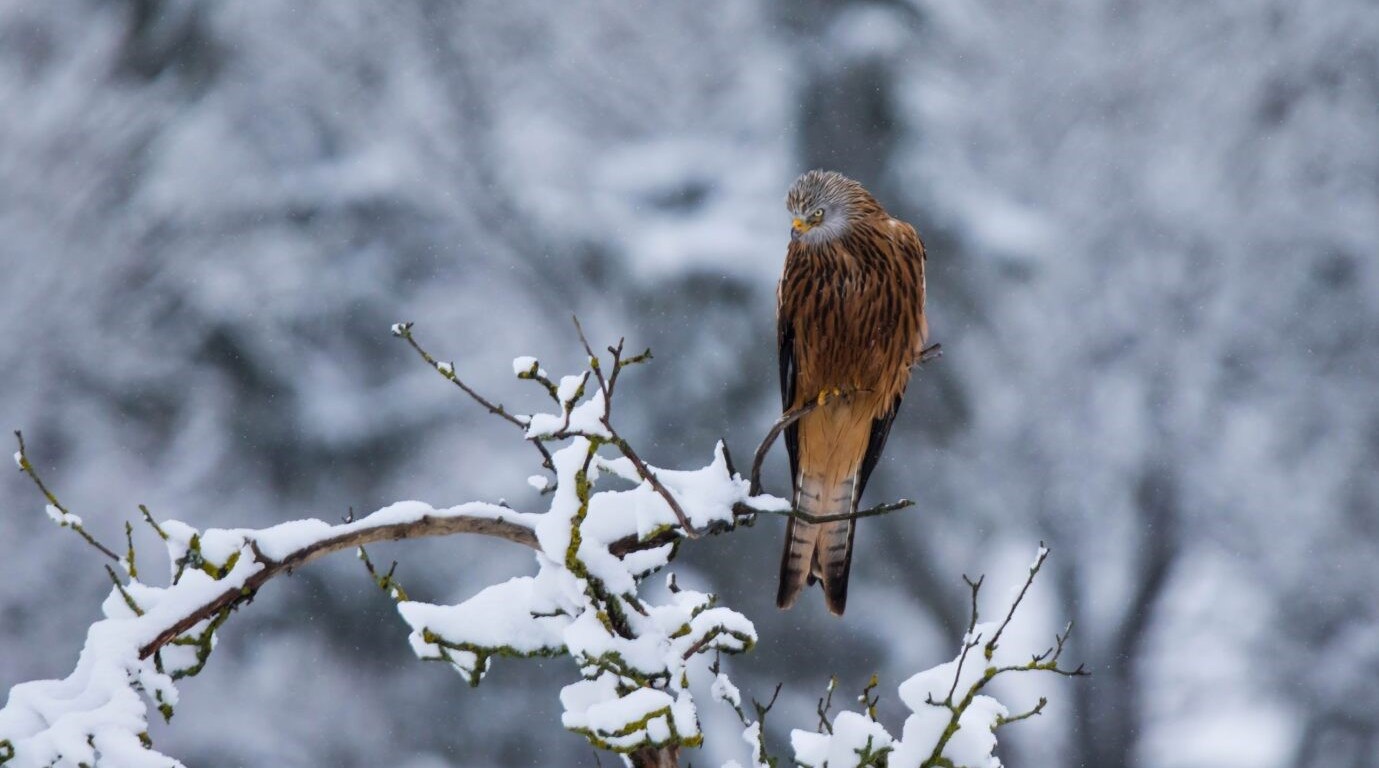
This blog post is provided by Stephanie Witczak and tells the #StoryBehindThePaper for the paper “Sex and size shape the ontogeny of partial migration” which was recently published in the Journal of Animal Ecology. With colleagues, Stephanie explores whether and how red kite migratory behaviour has changed since 2015. They find that age, sex and size all affect migration.
Our questions and motivation
This paper is a crucial first insight into a larger story that I have been part of for the past several years. The Red Kite project at the Swiss Ornithological Institute has been ongoing since 2015. The project is particularly interested in the species’ space use and how it relates to the growth and elevational range expansion of the Swiss population.
I joined the team in 2017 as a PhD student and opted to explore the fascinating partial migration behaviour of the species, wherein some individuals remain year-round on the breeding grounds (residents), while others migrate southwest to overwinter (migrants). One key question that arises in partial migration research is, ‘What causes an individual to be migrant or resident?’ In some species, this is genetically fixed, while in others, animals can switch between behaviours across years. A further question is then, ‘Is this flexibility based purely on current environmental conditions, or are animals more or less likely to migrate dependent on their characteristics?’ Furthermore, given that residence has only recently been observed in the Swiss Red Kite population and the number of overwintering Red Kites in Switzerland has been increasing, it is interesting to consider whether this behaviour could be associated with the population’s growth.
Preliminary data from our population suggested that individuals were flexible in their migratory behaviour, and that young birds were more likely to migrate. As such, this first look into the partial migration behaviour in our population focused primarily on quantifying this flexibility, and identifying which characteristics play a role in determining an animal’s migratory behaviour.
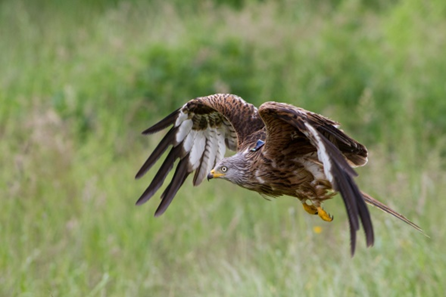
Our methodology
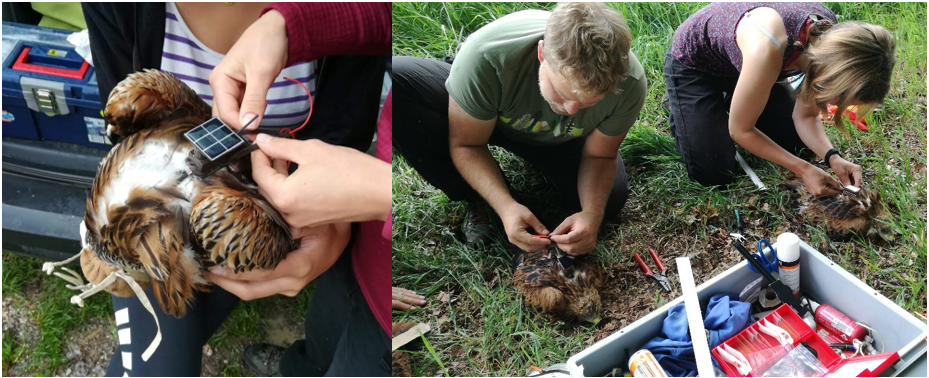
Our project has been deploying GPS tracking devices on Red Kites in western Switzerland since 2015. This GPS data allowed us to easily determine whether birds were resident or migrant each winter. We also gathered information about each animal, including sex, body size, and whether they were captured as a nestling or breeding adult. The latter information provided us with age context.
We tracked individuals across multiple years, yielding information on whether and how their migratory behaviour changed over time, and how long they survived. A multistate capture-recapture model allowed us to determine the probability of becoming a migrant or resident based on the age, sex and size of an individual, whether and how this changed across time, and how the age and sex of an individual influenced survival in migrants and residents.
What did we find?
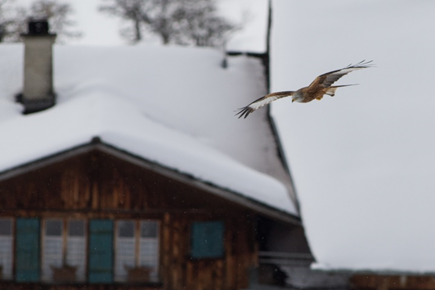
We could confirm that younger birds were more likely to migrate than older birds, and once birds changed from winter migration to year-round residence, they rarely resumed migration in later years. We also found that sex and size played a joint role in determining the age at which birds transitioned from migration to residence, such that large females switched to residence the youngest. Finally, we could show that migrants and residents had different survival, with young female residents exhibiting a tendency towards lower survival than migrants, while adult male migrants exhibited strongly reduced survival compared to residents.
Why is this important?
This study laid a foundation for knowledge on partial migration in Red Kites important for both our project, as well as studies on the species at large. Further, it contributes to the growing knowledge base on partial migration in vertebrates, in general. We now know that there can be flexibility in the migratory behaviour of Red Kites, and this flexibility is strongly related to an individual’s age. While our results on differential survival in migrants and residents suggests that this is partially due to improved survival in (male) residents with age, we believe that this may also be related to the breeding status of birds. Previous literature suggests that residence could improve reproductive success by improving an individual’s chances of acquiring and holding a breeding territory. As the probability of breeding increases with age in our population, residence would yield greater benefits for older individuals, explaining the increase in residence with age. Therefore, the observed influence of sex and size on the age of the transition to residence could be related to sex-specific breeding roles and size-dependent competitiveness. Together, our results suggest that migratory behaviour could be associated with population growth and decline via both survival, as shown here, as well as reproduction. Thus, an important future avenue of research for us is the investigation of differences in reproduction between migrants and residents. Furthermore, we urge future studies on partial migration to consider that characteristics can influence behaviour and survival both individually, as well as in interaction with other characteristics.
About the author
I am a post-doctoral researcher at the Swiss Ornithological Institute, where I recently completed my PhD in cooperation with the University of Zurich. I am broadly interested in movement and population ecology and the interface between the two. I am also interested in human-environmental interactions and how human activity affects wildlife and ecosystems, as well as questions of applied ecology.
Read the paper
Read the full paper here: Witczak, S., Kormann, U., Schaub, M., Oppel, S., & Grüebler, M. U. (2024). Sex and size shape the ontogeny of partial migration. Journal of Animal Ecology, 93, 406–416. https://doi.org/10.1111/1365-2656.14051
 Animal Ecology in Focus