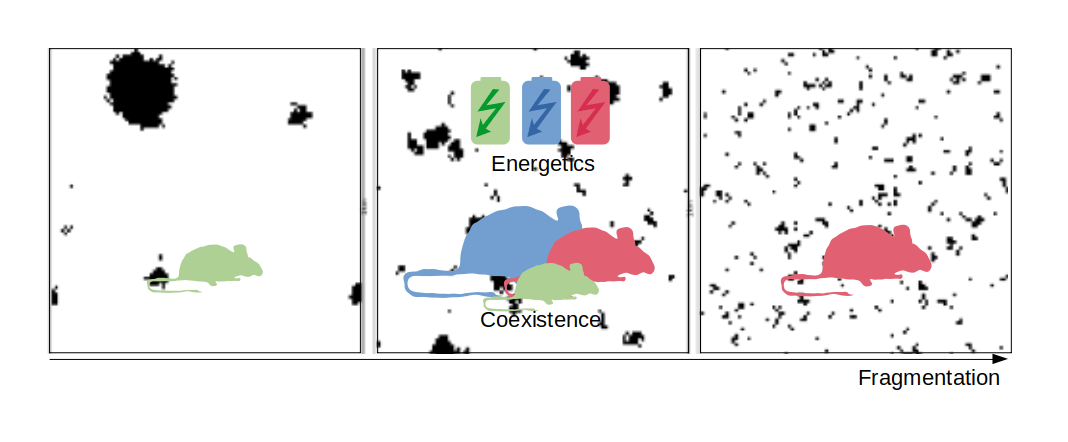
This blog post is provided by Leonna Szangolies and tells the #StoryBehindThePaper for the paper “Individual energetics scale up to community coexistence: Movement, metabolism and biodiversity dynamics in fragmented landscapes” which was recently published in the Journal of Animal Ecology. Together with colleagues, Leonna models how habitat fragmentation affects coexistence among species of different body sizes.
The coexistence riddle
Why do species coexist? In particular, how can species coexist when they seem to be very similar and feed on the same resource? Examples for such coexistence are all around us. Did you know that there are a variety of small mammal species in our agricultural landscapes? For example, there are bank voles, cute little herbivores weighing 15-35g that live in European woodland and other dense vegetation (see Fig. 1). Then there are field voles, also herbivores, living in similar habitats and weighing 20-50g. Why do these two species often coexist in their habitat rather than one species outcompeting the other?
There has been a lot of research on this, coexistence is one of the great questions in ecology, and for us, it becomes particularly interesting in the face of global change. If we want to protect a diversity of species, we need to conserve their ability to coexist, and to be able to do so, we need to understand how and when they do that. Actually, this is quite similar to humans: if we want people of different cultures and religions to coexist peacefully, we need to understand and protect the mechanisms that promote that. We think that, similar to humans, a first step toward coexistence is to have no reason to be “jealous” of each other. In the animal world, this means that the food they get relative to the energy costs they have is similar across species. We hypothesize that coexistence of species correlates with similarity in energy balance across species.

Environmental change effects
Now, as the environment changes, food availability changes as well as energetic costs. For example, new agricultural fields and human infrastructure cause woodlands to become more dispersed and thus natural habitats to be more fragmented. As a consequence, animals must travel greater distances to reach different habitat patches. This increased movement has an energetic cost and animals may find less food to feed on when habitats become so scattered. Such changes in energy intake and costs can affect species differently, depending on their ability to move and depending on their energy needs. Thus, changes in the landscape will affect the energy balances of individuals and species and, consequently, their ability to coexist.
Modelling coexistence
To understand coexistence better and to investigate, which landscapes promote coexistence best, we analyzed community dynamics of small mammals in different landscapes. Since we did not want to see little voles starve in our experiment, and because it is not easy to design their food landscape in nature, we conducted this study using a computer simulation model (Fig. 2). This model simulates the individuals of ten species moving through a landscape of cells that either contain food or do not contain food. The composition of how the cells with food are distributed is described by the degree of fragmentation. Low fragmentation means that the food cells are more clustered together, and high fragmentation means that the food cells are more dispersed and isolated in the landscape. The small mammal individuals forage in the landscapes and then use the energy they gain by this for survival, digestion, movement, growth, and reproduction. More than any real animal would ever tell us, the model can actually tell us how much energy each individual spent on these different processes. To ensure that the model produces realistic dynamics, we compared some model outputs with real data and luckily saw that it reproduces realistic activity ranges and energy rates.

Similarity in energy balance promotes coexistence in medium fragmented landscapes
With the model, we found that the most competing species of different body sizes coexist in medium fragmented landscapes. In low fragmented landscapes, small species dominate because they always have enough food and reproduce quickly. At medium fragmentation, small species reach less food resources because they are limited in their activity range, allowing larger species to find more food and persist. However, when resource fragmentation becomes very high, activity costs become very high for all species, and large species in particular then have low reproductive success. At medium levels of habitat fragmentation, many species of different sizes have similar energy balances and similar relative energy investment in reproduction, leading to similar lifetime reproductive success and coexistence (Fig. 3).

About the author
I am a PhD candidate at the University of Potsdam in the graduate school BioMove. In BioMove we aim to link biodiversity research with movement ecology. I personally work with individual-based simulation models to investigate coexistence mechanisms related to movement and landscape composition.
Read the paper
Read the full paper here: Szangolies, L., Gallagher, C. A., &Jeltsch, F. (2024). Individual energetics scale up tocommunity coexistence: Movement, metabolism andbiodiversity dynamics in fragmented landscapes. Journal ofAnimal Ecology, 00, 1–13. https://doi.org/10.1111/1365-2656.14134

 Animal Ecology in Focus
Excellent post 🎸🎸