This blog post is contributed by Hua Wang, Tiantian Liu, Shucun Sun, Owen T. Lewis, and Xinqiang Xi, sharing the #StoryBehindThePaper for their article “Temporal variability in host availability alters the outcome of competition between two parasitoid species”, which was recently published in the Journal of Animal Ecology. In their study, Wang and colleagues found that temporal variability in host availability had significant effects on both parasitoid fitness and competition, which varied between parasitoid species as the result of their differing life histories.
Why study the interactions between Drosophila flies and their parasitoid wasps?
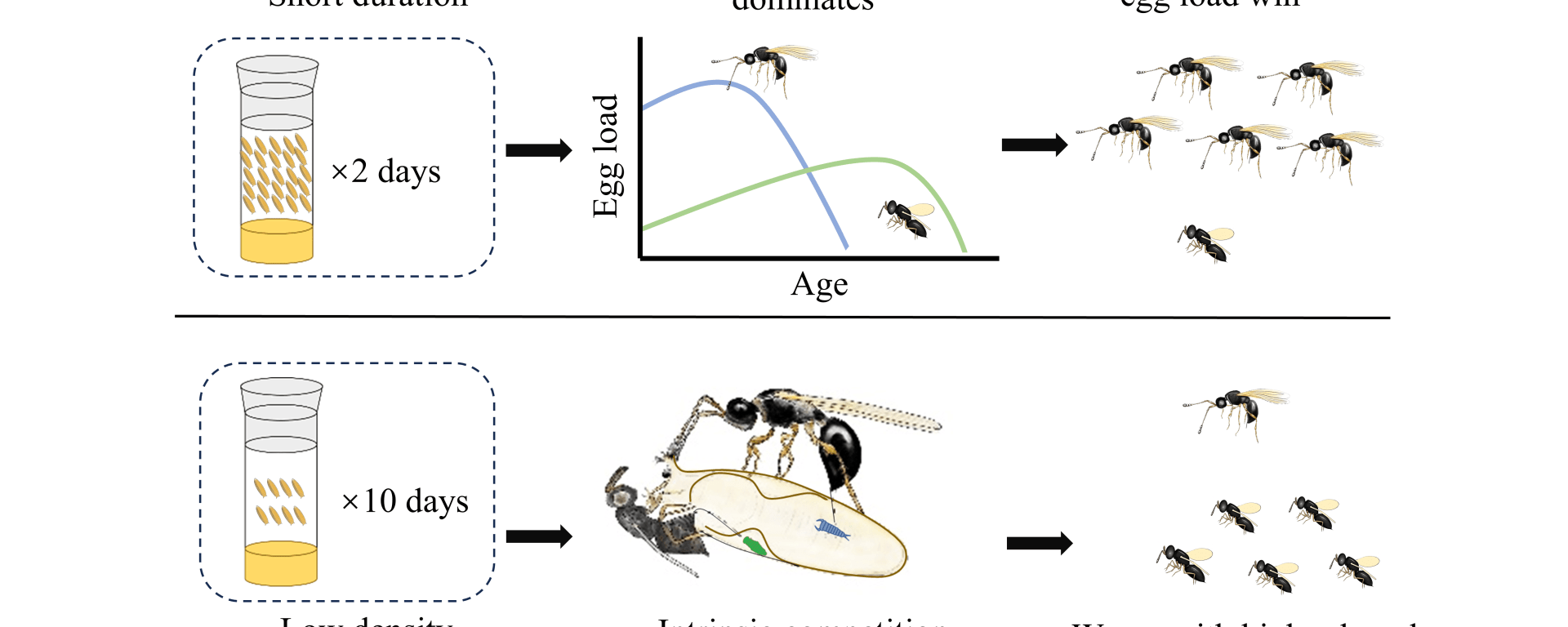
My interest in the interaction between Drosophila flies and their parasitoid wasps grew after I joined Prof. Xi’s lab for postdoctoral research. This shift in research focus was a significant decision for me, and so far, it has proven to be the right one. Drosophila-parasitoid interactions are a key research theme in Prof. Xi’s lab. Tiantian Liu, a master’s student in the lab, discovered that when two parasitoid species with distinct life-history traits compete for the same Drosophila hosts, each species excels at different host densities: one thrives at high densities, and the other at low densities. While much research has been done on how spatial resource distribution affects competition between natural enemies, less is known about how temporal resource variability—i.e., the same amount of resources exposed to consumers for different lengths of time—impacts the fitness and competition between species. Given the importance of fluctuating resource availability in natural ecosystems, both Prof. Xi and Prof. Sun encouraged me to explore this fascinating topic. After discussions with Prof. Xi, we decided to investigate whether the short-lived, proovigenic parasitoid Trichopria drosophilae and the long-lived, synovigenic parasitoid Pachycrepoideus vindemiae, dominate competition under conditions of high host density over short periods and low host density over long periods, respectively.
Fieldwork: collecting parasitoids from Zijin mountain
We collected Drosophila parasitoids from Zijin Mountain National Forest Park in Nanjing, China. To attract these parasitoids, we set up banana traps in three different locations on the southern, northern, and eastern slopes of the mountain. At each location, we randomly selected 11 sites and placed banana baits to attract Drosophila flies to lay eggs, then trapped Drosophila parasitoids. The traps were suspended from tree branches and left for two weeks, during which time we collected parasitoids every three days. After two weeks, the traps were replaced with fresh bananas. The species classification was identified by observed the external morphological characteristics of Drosophila parasitoids under a stereomicroscope. Through this method, we identified four Drosophila parasitoid species at Zijin Mountain, belonging to four families and genera: Trichopria drosophilae, Pachycrepoideus vindemiae, Asobara leveri, and Leptopilina sp. T. drosophilae and P. vindemiae are cosmopolitan, solitary pupal parasitoids of Drosophilidae, but they exhibit contrasting life histories. T. drosophilae is an endoparasitoid that lays its eggs inside the pupae, while P. vindemiae is an ectoparasitoid, laying eggs beneath the puparium of a wide range of Diptera hosts. Although T. drosophilae is more efficient at exploiting hosts due to its higher number of mature eggs, P. vindemiae often prevails in intrinsic competition within multiparasitized hosts.


Laboratory experiments: testing temporal variability
My experiments were conducted in the laboratory to investigate how temporal variability in host availability affects the fitness of T. drosophilae and P. vindemiae and their competition. We allowed two parasitoid species, T. drosophilae and P. vindemiae, to exploit Drosophila melanogaster pupae under three temporal variability treatments, either on their own or simultaneously.
The results showed that temporal variability in host availability had significant effects on both parasitoid fitness and competition. When tested individually (without competition), both parasitoid species had lower fitness when hosts were exposed for a short duration at high density than when exposed for a long duration at low density. However, the number of offspring of P. vindemiae decreases dramatically as host density increases. These differences can be attributed to their egg maturation patterns and ability to distinguish unparasitized hosts. T. drosophilae has more mature eggs, enabling it to exploit more hosts at high density, but its lower ability to detect previously parasitized hosts leads to repeated parasitism at low density. In contrast, P. vindemiae has fewer mature eggs but a better ability to distinguish unparasitized pupae. When both parasitoids exploited hosts simultaneously, interspecific competition significantly reduced the reproductive success of both species. However, the outcome of the competition depended on the temporal variability of host availability. T. drosophilae dominated in short exposure periods, while P. vindemiae prevailed in long exposure periods. This result can be explained by differences in their internal and external competitive abilities. The higher egg load of T. drosophilae allows it to attack more host pupae when they are abundant over short periods. However, P. vindemiae has a competitive advantage within the host due to its superior physiological and behavioral characteristics.

Parasitoids are among the most diverse groups of multicellular organisms, and their hosts are often scarce and unevenly distributed. The ability to partition resources in time or space is crucial for preventing competitive exclusion among species sharing the same hosts. Given the fluctuating dynamics of host populations in natural ecosystems, temporal shifts in competitive outcomes may promote coexistence of parasitoids, even without strong niche partitioning.
Self Introduction
My name is Hua Wang, and I am a postdoctoral researcher in Prof. Xi’s laboratory at the School of Life Sciences, Nanjing University. My research focuses on the interaction between Drosophila flies and parasitoid wasps and the mechanisms by which they function., including interspecific competition, intraguild predation, etc.

Read the paper
Read the full paper here: https://doi.org/10.1111/1365-2656.14191
 Animal Ecology in Focus