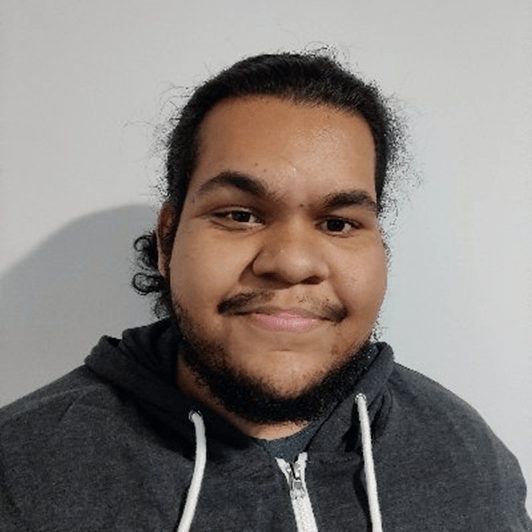
For Black History Month 2024, the British Ecological Society (BES) journals are celebrating the work of Black ecologists around the world and sharing their stories. In this blog, Kristian Harris shares his story and journey in academia.
Biography

Name: Kristian Harris
Affiliation (university/place of employment): The Ohio State University (Graduate Student)
Ecology interests in three keywords:
- Interactions
- Communities
- Microbes
How did you get into ecology?
Growing up in the Caribbean on the island of Trinidad, I had been very lucky to experience the tropics. The ocean, the wildlife and the forests were always an avenue for me to inquire about the biology I had been learning in secondary school. These questions led me towards ecology, and thankfully I’ve been able to pursue a career that allows me to connect with nature as I did as a child. Although, I never imagined I would work in soil, haha!
What are you researching/working on right now?
Currently, my interests lie in understanding how microbial communities tolerate abiotic stress. I seek to understand how microbes respond to selenium stress and how these responses influence species interactions between microbes.
What do you enjoy most about your work or ecology in general?
Ecology allows me to look at an insect and ask wild questions like “how do the bacteria that live inside it help it/harm it?” I think the freedom to inquire about tiny organismal interactions and expand it to a global scale feels exciting.
What are your hopes and ambitions for the future?
I would like to pursue a tenure track job. Mentorship and the freedom to ask questions and explore are all very important to me. I hope to make ecology more inclusive for people like myself, those from the global south who want the freedom to be ambitious and inquire about their environment like I did as a child.
The theme for BHM UK this year is ‘Reclaiming Narratives’. What does this mean to you?
I want to say it’s this idea of who ecology is for/who ecologists are. Truthfully, my journey to ecology began almost out of spiteful. After my white science teacher in 2nd form told my father I should consider a career other than science, I began pursuing biology through a very angry lens. My joy and love for ecology essentially reignited after I began research, where I could actually listen to the stories nature was telling me and explore science with my own purpose.
Shout out your peers! Are there any black ecologists or groups who are doing work you admire?
Yes, the Black Ecology Section Leadership at Ecological Society of America. Karen Bailey, Matt McCary, Gabriela Nunez-Mir, Sudan Kariuki and Maria Miriti.
Are there any aspects of your academic career / personal journey as a Black ecologist that you wish to share?
I would have to say that learning to enjoy the small results in my research have led me to enjoy my time as a scientist much more. I feel like we’re always chasing that mythical discovery but sometimes it’s very rewarding to just see your study organism do something cool. My earlier stages in my PhD felt much harder when I was preoccupied with trying to look uber cool to my advisor as opposed to exploring the study system and letting it give me the narratives to tell. Side note, but I often joke with my mentees that we must look insane because every single one of us have been caught giving names/motivational speeches to the bacteria/fungi we work with.
Are there any ongoing issues in the ecological / academic landscape that you would like to highlight or have experienced?
My mind immediately goes towards physical and emotional accessibility to science. Often, I see fellow trainees burnt out or leave science prematurely simply because they don’t feel like they belong. Nationality, race, socio-economic status and disability all compound and form those physical and emotional barriers that prevent brilliant minds from enduring and thriving in a program. Programs need to do better in fostering an environment that allows trainees to approach leadership with critiques about how hard it can be to do science given the chaos.
If you could see one change in academia to positively impact Black ecologists, what would that be?
Definitely better mentorship. I think its important to understand that yes, diversity is important, but simply recruiting black students is not enough. Programs and faculty need to be honest with themselves and recognize that your department/work environment as it currently exists may be doing more harm than good when you recruit black individuals. A lot of this begins with mentoring and understanding that mentorship for traditionally catered-to demographics may not apply to your black recruits. Building networks with established black ecologists and allowing your black students to interact with them can be a start and in my experience has lessened a lot of the strain that academia can put on us.
 Animal Ecology in Focus