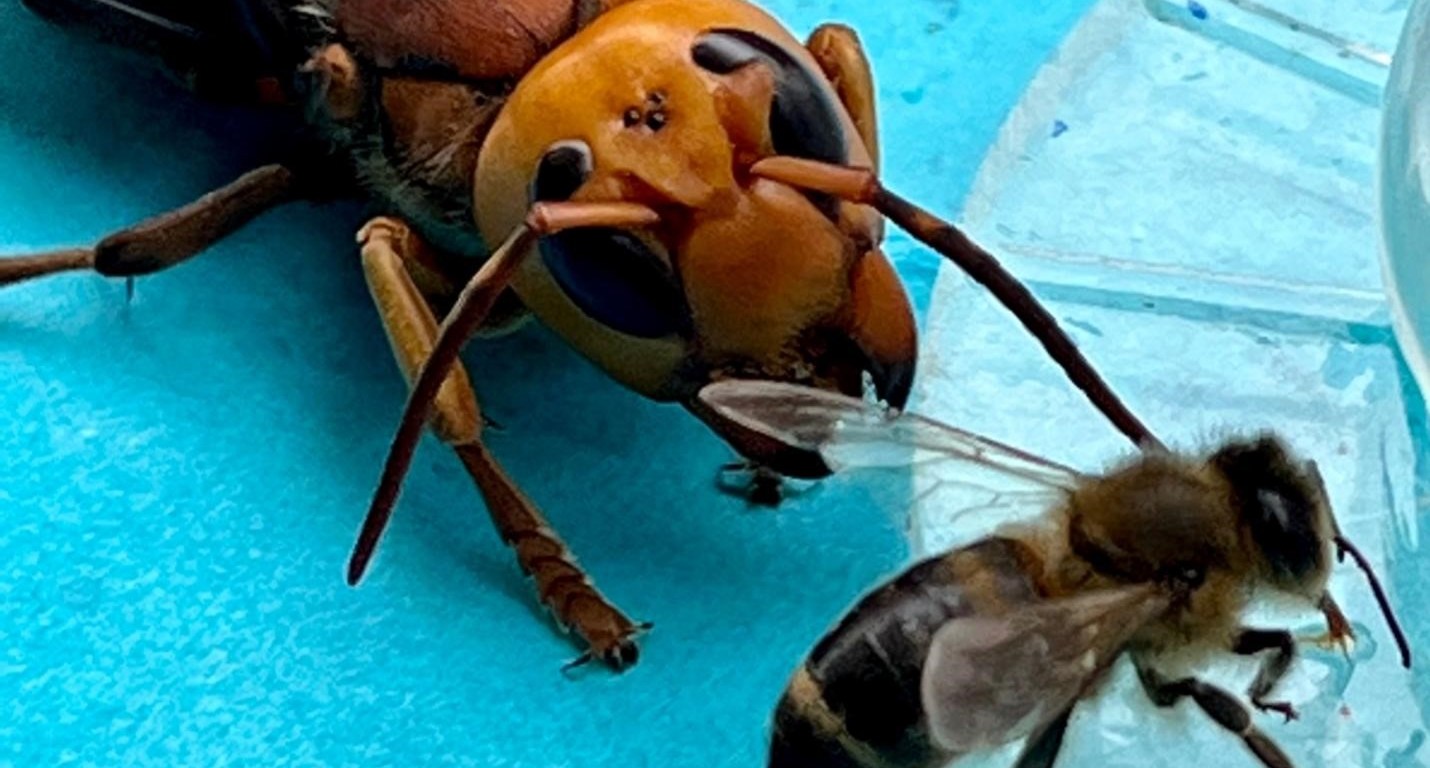
This blog post is provided by Gu G, Wang Z, Lin T, Wang S, Li J, Dong S, Nieh JC, Tan K., and tells the #StoryBehindThePaper for the article “Bee fear responses are mediated by dopamine and influence cognition“, which was recently published in the Journal of Animal Ecology. In their study, the authors explore how western honey bees react to the presence of predators and find that feeding them L-DOPA, a dopamine precursor, can help mitigate the negative effects from fear of predation.
Fear is not just a human emotion; even honey bees experience it. When faced with predators like the invasive Vespa velutina hornets, honey bees show behaviours remarkably similar to the fear responses observed in mammals. The impact of fear on bees goes beyond simple survival; it affects their cognition and sensory abilities, specifically their sense of smell, which is crucial for foraging and communication.
We love social hornets and bees and are deeply curious about their biology. We therefore focused on understanding how non-lethal encounters with hornets could alter the bees’ behaviour and brain chemistry. Honey bees, particularly the species Apis mellifera, have a variety of responses to hornet predators. When hornets hover near the entrance to their hive, bees initially react by increasing their speed, moving rapidly to escape, and staying away from areas near the predator. Over time, however, these responses change into more defensive behaviours, such as clustering together in a group to avoid the predator’s location. This clustering behaviour, a form of fear response, was shown to increase by sixfold when bees were exposed to a hornet for 24 hours.

These fear-induced behaviours were not the only reactions to the hornet’s physical presence. Our experiments demonstrated that exposure to hornets reduces dopamine levels in bees’ brains. Dopamine, a neurotransmitter often linked with pleasure and reward, also plays a role in how bees process fear. We found that bees exposed to hornets experienced cognitive decline, losing their ability to recognize odours and learn from them—key processes in foraging and hive communication. Reduced dopamine levels made bees less responsive to smells, even to those associated with food, which hampered their ability to learn and remember essential
cues for survival.
This phenomenon adds a new layer to what ecologists call the “landscape of fear,” a concept
that describes how prey species, including honey bees, alter their behaviour in response to predation risk. Fear changes their movement, reduces their feeding efficiency, and in the case of bees, diminishes their ability to communicate important foraging information through the waggle dance.


However, not all hope is lost for these bees. In our study, we found that by artificially increasing dopamine levels in bees—through feeding them L-DOPA, a dopamine precursor—we could reverse some of the negative effects of fear. Bees given L-DOPA not only improved their cognitive abilities but also exhibited more normal behaviours, such as foraging and responding to scents. This finding suggests that dopamine could be a key to mitigating the harmful effects of predation stress on bees, potentially improving their survival in environments with high
predator pressure.
As invasive hornet species continue to spread across regions, understanding the cascading
effects of predation on bee behaviour is critical. Bees are essential pollinators, and anything that compromises their cognitive and sensory abilities can have dire consequences for ecosystems and agriculture. Our research highlights the importance of further studying how stress impacts honey bees and developing methods to help protect them from these increasingly common threats.
Read the paper
Read the full paper here: Gu, G., Wang, Z., Lin, T., Wang, S., Li, J., Dong, S., Nieh, J. C., & Tan, K. (2024). Bee fear responses are mediated by dopamine and influence cognition. Journal of Animal Ecology, 00, 1–13. https://doi.org/10.1111/1365-2656.14224
Listen to authors discuss their results in a podcast

 Animal Ecology in Focus