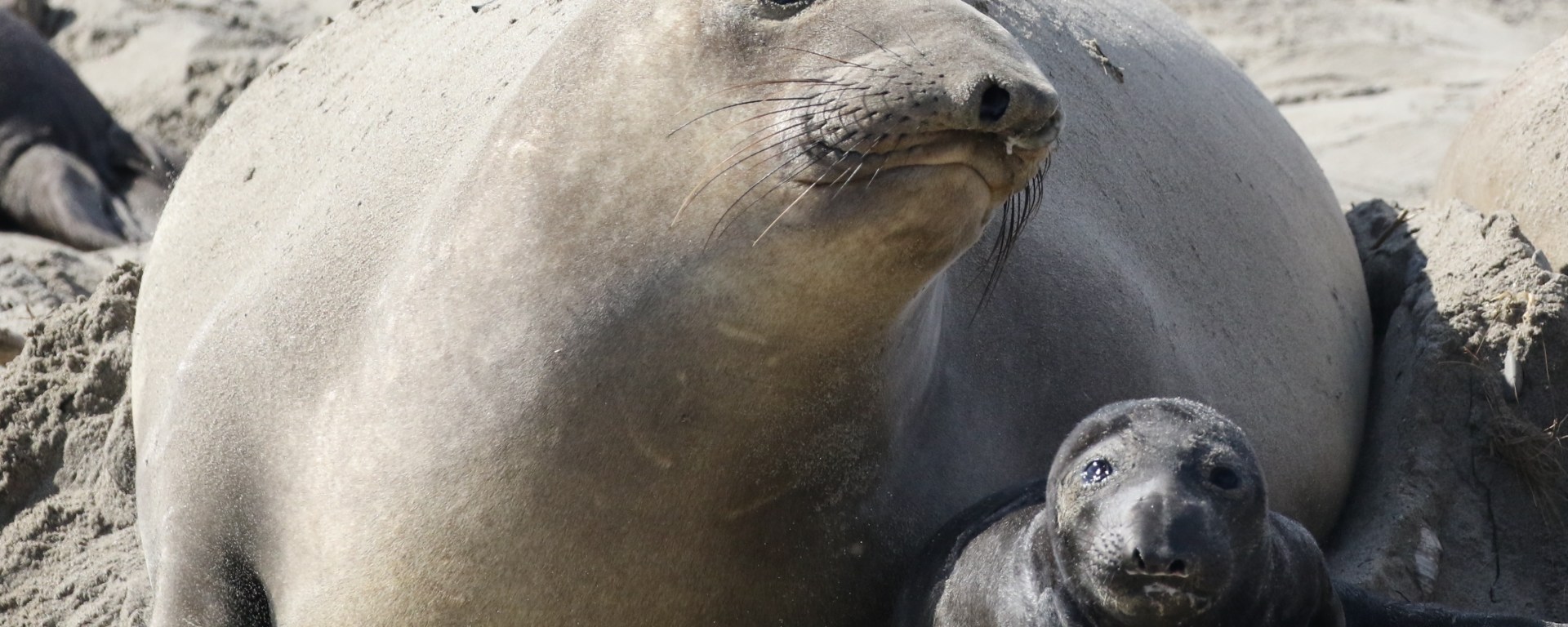
This blog post is provided by PhD candidate Allison Payne and tells the #StoryBehindthePaper for the paper “Reproductive success and offspring survival decline for female elephant seals past prime age”, which was recently published in the Journal of Animal Ecology. Payne discusses how her research on reproductive senescence emerged from an unconventional setting – an undergraduate field class at UC Santa Cruz.
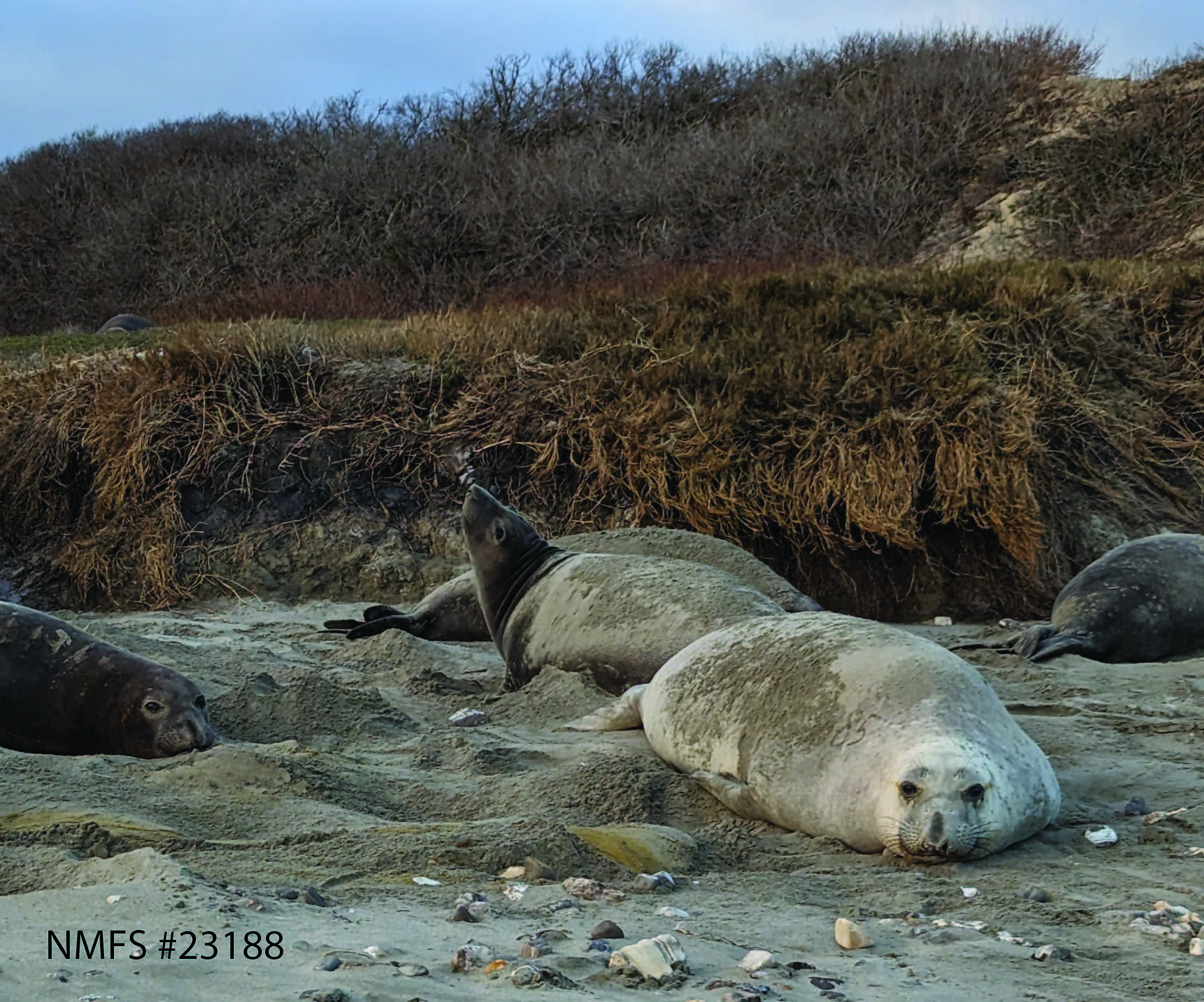
The Northern elephant seal Tag-1885 was essentially a celebrity around Año Nuevo Reserve in California. She was born in winter 2002, surrounded by aggressive females, rearing-to-mate males, and hundreds of other screaming seal pups. At one month old, she was given her ID via an alphanumeric tag on her rear flippers, accompanied by an auspicious database comment noting that she was “very large”. Then she disappeared for three years before returning to Año Nuevo in 2006. For the next eighteen years, she was a fixture on the beach during the winter breeding and spring molting haul outs. Her reliability made her a prime candidate to carry expensive tracking instruments into the Pacific Ocean, where her foraging dives reached depths well below a mile and earned her the program record for deepest diver. She was big, aggressive, and popular, frequently rising to the top of the undergraduate “favorite seals” list at the end of a field season. In 2023 at 21 years old, 1885 arrived late in the season and gave birth to her sixteenth and final pup. We watched throughout the breeding season as the pups around her ballooned in size while nursing from their moms, while her pup remained skinny. After just a couple of weeks lactating – two weeks shorter than usual – she swam back into the Pacific Ocean.
During spring of that same year, I was a teaching assistant for “Field Methods for Large Marine Vertebrates,” an undergraduate field course taught at UC Santa Cruz by Professor Roxanne Beltran and Dr. Patrick Robinson. This class is a course-based undergraduate research experience, or CURE: fourteen students participate in fieldwork at Año Nuevo Reserve, where they contribute to a long-term study of elephant seals established by Professors Burney LeBoeuf and Dan Costa. Students generate a set of questions, and work together to analyze data, perform literature reviews, and write up their findings. As I took students to search for flipper tags among the dunes, we kept an eye out for the famous 1885, but never saw her.
In our small field teams, we started wondering about what life was like for older seals. I recounted 1885’s small pup and abbreviated breeding haul out, and students brainstormed hypotheses about the different ways senescence might be impacting the animals. As a group, we used our experiences in the field to come up with hypotheses, took advantage of the long-term elephant seal demographic dataset for analysis, and, eventually, wrote a manuscript for the Journal of Animal Ecology’s Special Issue on Intraspecific Variation. A year and a half later, our manuscript was published. We found evidence for reproductive senescence: breeding probability and offspring survival to age one declined with advanced maternal age. Although only a tiny fraction of seals live as long as 1885, we calculated that reproductive senescence would result in 5.3% fewer pups per year than would be expected from a non-senescent population, potentially slowing population growth. Our research shows that old seals like 1885 are an important part of the story of how elephant seal populations persist.
The only thing harder than wrangling seals is wrangling a large coauthor list, but the fourteen undergraduates who participated in the class were instrumental in creating the final product. The CURE also has a major benefit: by giving undergrads an opportunity to participate in authentic research, they are able to build confidence, experience a sense of belonging, and see themselves as scientists.
I worked on identifying how age influences sex ratios and it became a huge interest of mine now seeing how age impacts energy expenditure on reproduction. Now, I am a 3rd year undergraduate student working as a field assistant in the Beltran Lab studying terminal investment in Northern Elephant seals for my senior thesis! -Adrien Bastidas
Looking at all the data gathered from the nearly four decade-long northern elephant seal observations, I was in awe. It also made me realize that this research takes time to thoroughly evaluate the information gathered and learn new information about the northern elephant seals and their environment. -Jasmine Salazar
It blew my mind that I was capable of doing so many things I never imagined myself being able to do, like being inches away from tens/hundreds of elephant seals, and accomplishing my major goal of attaching satellite tags to elephant seals. Being part of this field class was by far the most impactful educational experience I’ve had so far. -Danissa Coffey
Data processing and coding were significant challenges for me during this process. I had never used R Studio before, but by the end, I was able to create clear, informative graphs that effectively showcased the patterns in molt season departure and breeding season arrival. -Savanna Wright
Working on this paper has opened doors to so many opportunities, including becoming an undergraduate lab member and co-author in one of my first research papers. It also showed me how much I enjoy the scientific process, so much so that it motivated me to pursue my own senior thesis project (also about elephant seals!). -Kelli Ong
At some point during this research, I realized that examining and documenting small changes in an individual seal’s maternal care over the course of her lifetime, when examined at scale, could help uncover the underlying mechanisms that drive patterns at both individual and population-wide levels within the species. Also knowing that there is such a deep gap in our understanding of reproductive and physiological changes in all female mammals, I was excited to have the opportunity to contribute to reducing this gap. -Elise Baugh
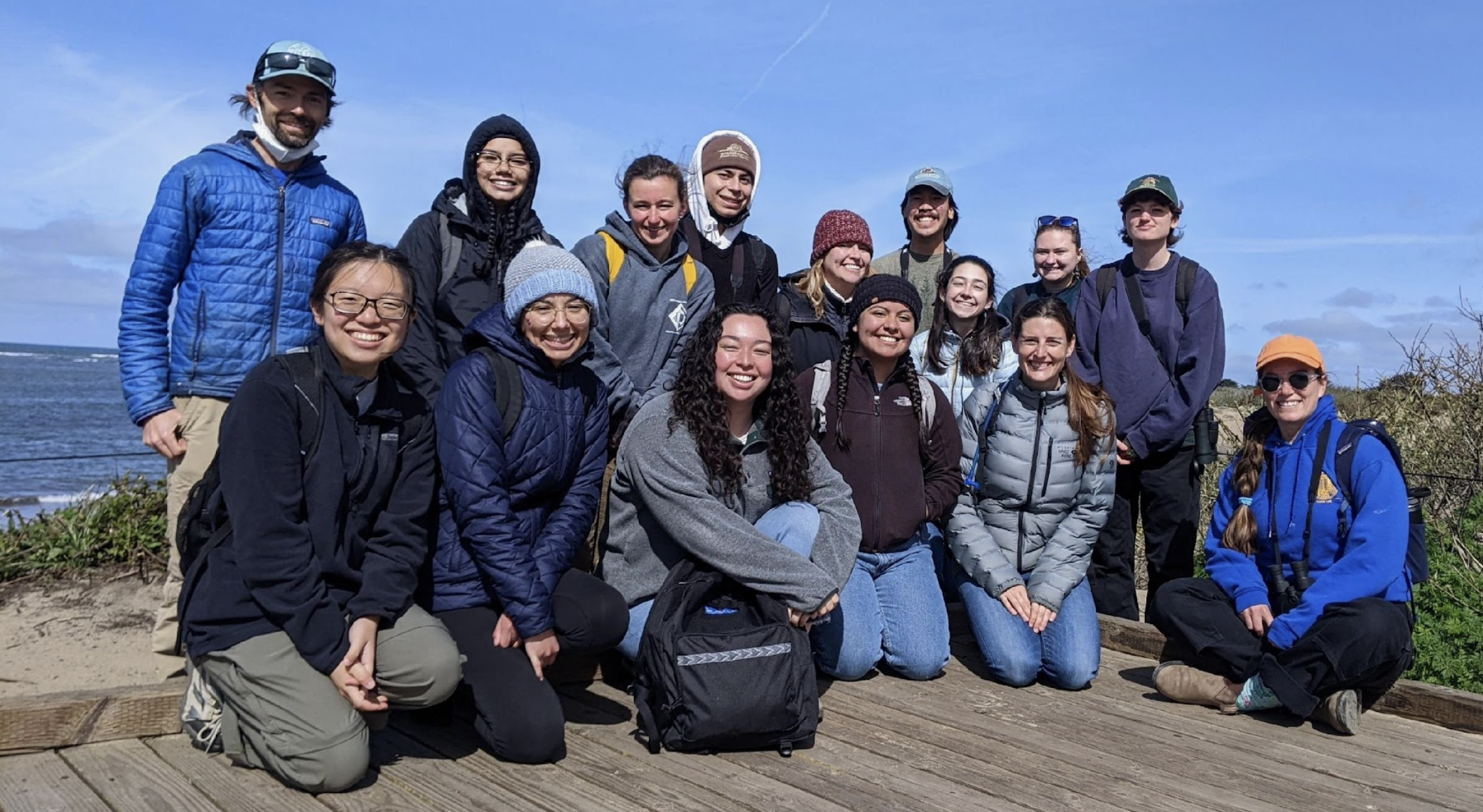
While the benefits of this particular field class are anecdotal for now, we hope to quantify them as the field class continues to train cohorts of early career scientists with real-world research experiences. And while we said goodbye to 1885 after twenty-one years of observation, her legacy lies in the many research questions she continues to inspire in elephant seal researchers of all backgrounds, ages, and experience levels.
Read the paper
Read the full paper here: https://doi.org/10.1111/1365-2656.14226
 Animal Ecology in Focus