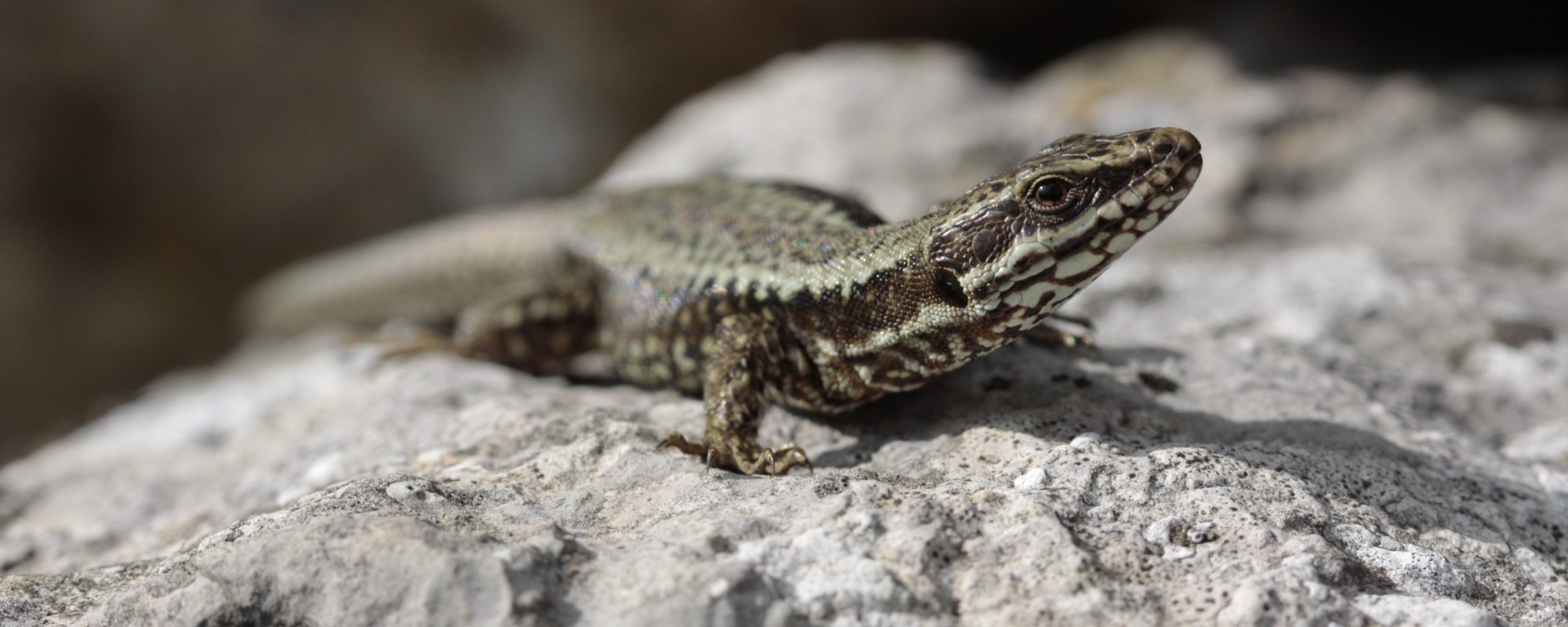
This blog post is provided by Urban Dajčman and tells the #StoryBehindThePaper for the paper “Microclimate variability impacts the coexistence of highland and lowland ectotherms“, which was recently published in the Journal of Animal Ecology. In their study, Dajčman and colleagues investigate how two Slovenian lizard species respond differently to environmental conditions in locations where they occur together or separately.
When hiking in the forests and rocky clearings of southeastern Slovenia on a warm spring or summer day, it’s not unusual to spot a group of sun-basking lizards shuffling around to find the best spot. If you take a short break from the hike and join the basking lizards on the warm rocks you can notice they are Podarcis muralis, the common wall lizard, typically found in warmer lowland habitats, and Iberolacerta horvathi, Horvath’s rock lizard, a species more closely associated with cooler, high-elevation environments.
In certain upland areas of southeastern Slovenia, around 600 to 900 metres above sea level, these two species with similar ecological preferences can be found living side by side. These species are closely related, ecologically similar, and potential competitors — both are small-bodied, diurnal, insectivorous lizards that rely on external heat sources to regulate their body temperature. They use similar habitat structures, occupy mostly overlapping thermal niches during the active season, and could plausibly compete for resources like basking spots, shelter, or prey. In such systems, coexistence is not a given. Classical ecological theory tells us that when two species occupy similar niches, one should eventually outcompete the other — unless some form of niche differentiation or environmental variability allows them to partition resources.

One of our main goals was to see whether we can use mechanistic models to see if they are dividing their thermal habitat use. Additionally, we wondered whether seasonal or daily thermal conditions create time windows where each species can perform better. Alternatively, perhaps the environment at these elevations is simply favourable enough to reduce competitive pressure altogether. These questions are central to understanding how biotic interactions are mediated through the abiotic environment. In areas where the conditions are harsh (e.g. very cold or very hot), species might be limited more by physiology than by interactions. In contrast, in moderate, resource-rich environments, the local rules of coexistence may depend more on behavioural dynamics and life history strategies.
By investigating how each species responds to the same set of environmental conditions and how those responses differ for locations where they occur together (syntopy – co-occurrence of species in the same site) versus alone (allotopy – where only one of the species is present) we can begin to untangle the relative influence of abiotic factors in shaping their realised niches.
To try to gain some insight into our system, we used a mechanistic modelling approach that combines Dynamic Energy Budget (DEB) theory and NicheMapR microclimate and biophysical models. This allowed us to simulate the full life cycle of both lizard species — including development, activity, reproduction, and survival — under realistic microclimatic conditions at 15 sites along an elevational gradient. We collected detailed trait data for both species (such as thermal preferences, reproductive parameters, body size, behavioural traits, …) and simulated microclimatic conditions using long-term weather data, terrain characteristics, and soil profiles.
We used this microclimatic data to run biophysical simulations via the ectotherm model in NicheMapR combined with DEB theory. Each site was modelled as if both species were present, enabling us to in silico observe how these animals perform along the whole altitudinal gradient. Our approach made it possible to compare how each species would perform — in terms of life history outcomes (lifespan, reproductive output, activity windows) — across the gradient and to compare these outcomes considering known data on distribution (i.e. alone or in syntopy).

Importantly, we found that life history traits varied not just with altitude, but with species identity and location type. These patterns suggest that species respond differently to the same environment, and that local conditions interact with species traits to produce context-dependent outcomes. Our findings show that locations associated with syntopy offer the most favourable conditions for both species. Sites at these “middle” altitudes provided longer active periods, faster egg development, and higher annual fecundity compared to high-elevation or lowland sites.
The key takeaway is that coexistence between these two lizards is not simply a matter of microclimatic availability. It reflects a complex interplay between environmental variability, species-specific physiological traits, and potentially interspecific interactions. It would appear that in mid-elevation areas where syntopy most commonly occurs both species find conditions that best fulfil their ecological needs. Such environments may also reduce the intensity of direct competition. If activity windows are wider and resources more plentiful, both species may be able to partition time or space in ways that enable coexistence — a scenario that aligns with ideas from coexistence theory on environmental heterogeneity and niche differentiation.
Although this study focuses on two lizard species in a specific region, the broader implications apply widely. As climate shifts understanding abiotic variability along elevational gradients is of utmost importance since these zones may become critical refuges or zones of increased competitive pressure, depending on how species respond.
Our work highlights the value of mechanistic modelling in predicting how species function in their environment. This approach allows us to understand from mechanistic principles how and why life history traits vary across known locations of distribution, which is essential for forecasting species responses to environmental change. This approach also opens the door to future integration of species interactions directly into mechanistic models which is an important next step for integrating biophysical and microclimate models and use them to understand coexistence in complex communities.
Read the paper
Read the full paper here: https://doi.org/10.1111/1365-2656.70030
 Animal Ecology in Focus