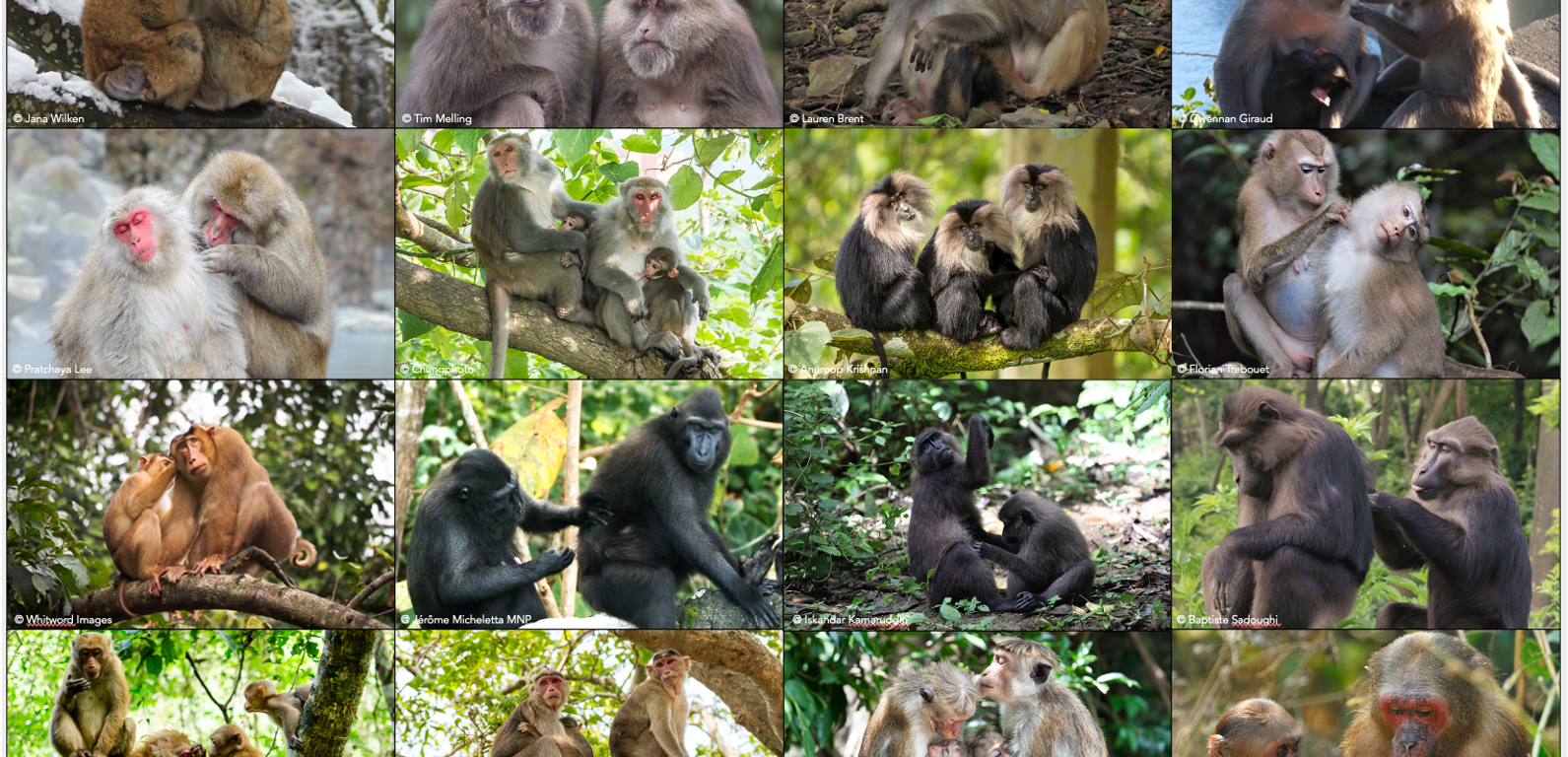
This blog post is provided by Macaela Skelton and tells the #StoryBehindThePaper for the article “MacaqueNet: Advancing comparative behavioural research through large-scale collaboration“, which was recently published in the Journal of Animal Ecology. In their study, Skelton and colleagues highlight the creation of the first standardised database on macaque social behaviour, which is paving the way for large-scale comparative research.
Social behaviour varies widely across species, shaped by differences in ecology, development, and evolution. But behaviour is not influenced by just one thing—it’s the result of many different factors working together. To truly understand why animals behave a certain way, we need comparative research – studies comparing behaviour and its drivers across species. Reliable comparisons require large amounts of data and thankfully, decades of behavioural research have generated a plethora of data on individually recognised animals, which is perfect for cross-species comparisons.
Macaques are ideal for comparative research. With 25 species, they are one of the most wellstudied and geographically widespread primate groups. For decades, individual macaques have been observed by researchers all over the world. All species are closely related and have very similar social organisation. All macaques live in large groups with several males and females. Females live in their family group for life, while adult males migrate to other groups. All macaques engage in the same affiliative and agonistic behaviours, which form the backbone of their social networks.
Despite their similarities, macaque species thrive in very different environments, from snowy mountaintops, bustling cities, and rainforests. Each species faces different ecological and evolutionary pressures, causing social structures to vary. In crested macaques, networks are cohesive; individuals socialise with many group members and the strength of these relationships are relatively equal, resulting in shallow dominance hierarchies. Whereas in rhesus macaques, networks are differentiated. Individuals socialise a lot with some partners and will have stronger relationships with these, while rarely interacting with other group members, leading to steep and linear hierarchies. Comparing behavior across macaque species, which share similar genetics and morphology, helps minimize confounding factors and identify the true drivers of behavioural variation.
However, comparative research poses challenges, even in macaques. Despite having so much behavioural data for cross-species comparisons, we lack a single, standardised database. While data collection methods tend to be similar across studies, research groups tend to collect data independently for specific questions. Once collected, data are stored separately within the labs who collected it, making it difficult to know what data is available, and how to access it. There is also no single, universal way to standardize data for cross-species comparisons. Each comparative study must go through the often-complex task of gathering data from different sources and restructuring it into a consistent format before any analysis can begin.
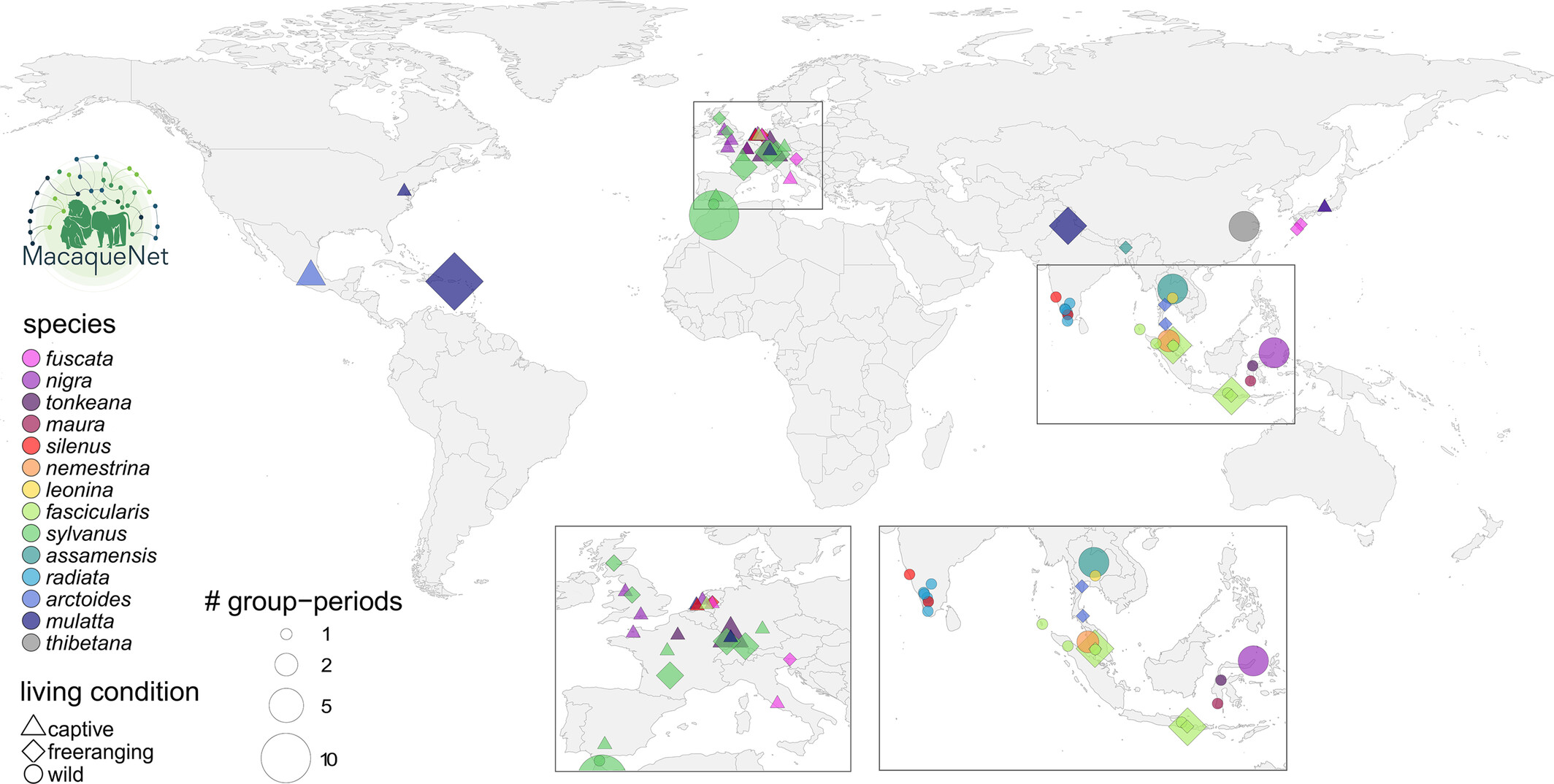
These challenges inspired the creation of MacaqueNet: A global initiative fostering collaboration and data sharing in macaque research. Established in 2017, MacaqueNet has two components: First, a community comprised of 100 macaque researchers worldwide so far, strengthened through symposia, bi-annual newsletters, and a website. Second, MacaqueNet has the first publicly searchable database on macaque social behaviour, where data is standardised and stored in one place. Adhering to FAIR principles, data is easy to find (Findable), openly available or requestable (Accessible), compiled in a consistent format ready for diverse comparative questions (Interoperable), and accompanied by detailed metadata for accurate interpretation (Reusable). Anyone can request data, promoting equality and representation in macaque research. Currently, the database includes data collected from 61 populations and 14 macaque species over the last 4 decades (Fig. 1). By centralizing data in one place, we will identify gaps in existing research. As a community we can decide which behaviours or species to study and adapt data collection methods.
Building on the success of initiatives like ManyPrimates and SPI-Birds, MacaqueNet is paving the way for large-scale comparative research. With nearly 4,000 behavioral data points already available, and plans to expand into ecological, life-history, and genetic data, we are just getting started. By sharing many resources used to build MacaqueNet openly on GitHub, we hope to inspire other research communities to adopt similar collaborative approaches. While macaquespecific, our community-driven principles can be applied to any field. Comparative research presents challenges, but by connecting the dots across datasets, species and research groups, we can generate more high-quality data that drive impactful discoveries and further funding opportunities.
Want to learn more? In our newly published paper, lead author Dr. Delphine De Moor introduces MacaqueNet and highlights the power of large-scale collaboration in animal behaviour research. Via our website, you can find more details about macaques, current projects and the MacaqueNet database
Read the paper
Read the full paper here: https://doi.org/10.1111/1365-2656.14223
 Animal Ecology in Focus
Thank you, Edie Abrahams. A neutral initiative unifies macaque behavior data and is suggested for other species.