
This blog post is provided by Krizler Tanalgo and tells the #StoryBehindThePaper for the article “The behavioural costs of overcrowding for gregarious cave-dwelling bats”, which was published last year in the Journal of Animal Ecology. In their study, Tanalgo and colleagues investigated the effects of overcrowding on bat diurnal activities, revealing that they may not be very good at sharing tight spaces.
Bats are one of the most diverse groups of mammals on the planet. Yet, despite this diversity and their advanced ability to map their surroundings by echolocation, we know virtually nothing about social interactions between bats. Almost half of global bat species are cave-dwelling, and many species congregate in large colonies within caves and underground habitats for shelter and protection from potential predators.
However, with the growing loss of habitats, including the loss and disturbance of caves, bats may be forced to abandon their traditional roosts, which could lead to overcrowding in remaining caves. Such was the case of the Monfort cave, one of the biggest known colonies of bats on earth, with over one million bats (Rousettus amplexicaudatus) currently living there. Yet despite the social interactions known to play roles in bats’ lives, how they respond to overcrowding remains unknown. Our study, published last year in the Journal of Animal Ecology, sheds light on the impact of overcrowding on bat social dynamics, offering valuable lessons for humanity as we navigate the challenges of our overpopulated world.
The idea of the project began in 2017 when we first met the cave’s owner and discussed her concerns about the ‘disappearing’ population of bats in the Monfort cave. The cave was so overcrowded that bats spilled out of the entrance of the caves, adorning the openings, and forcing many to roost on the outskirts of the cave, exposed to light all day and possibly too close for comfort, and all these bats on the edge of the cave were males. This left us with the question: how did these bats respond to stress? Would the overcrowding make them fight more, and could that impact their health? So, we decided that it was worth exploring, and it also provided an opportunity to explore a question that may be a bigger issue than we realised, as we continue to lose karst and cave habitats worldwide. Initially, we intended to use the common approach of measuring the hormone levels of the bats. However, the cave owners preferred that the bats be left alone, and observations conducted from the outside of the cave, where human observers would cause minimal additional stress. Consequently, we developed a non-invasive method to study stress responses using a video camera set at openings of the cave. The condition of the cave allowed us to observe the patterns of the diurnal behaviour of bats in their roosting sites.
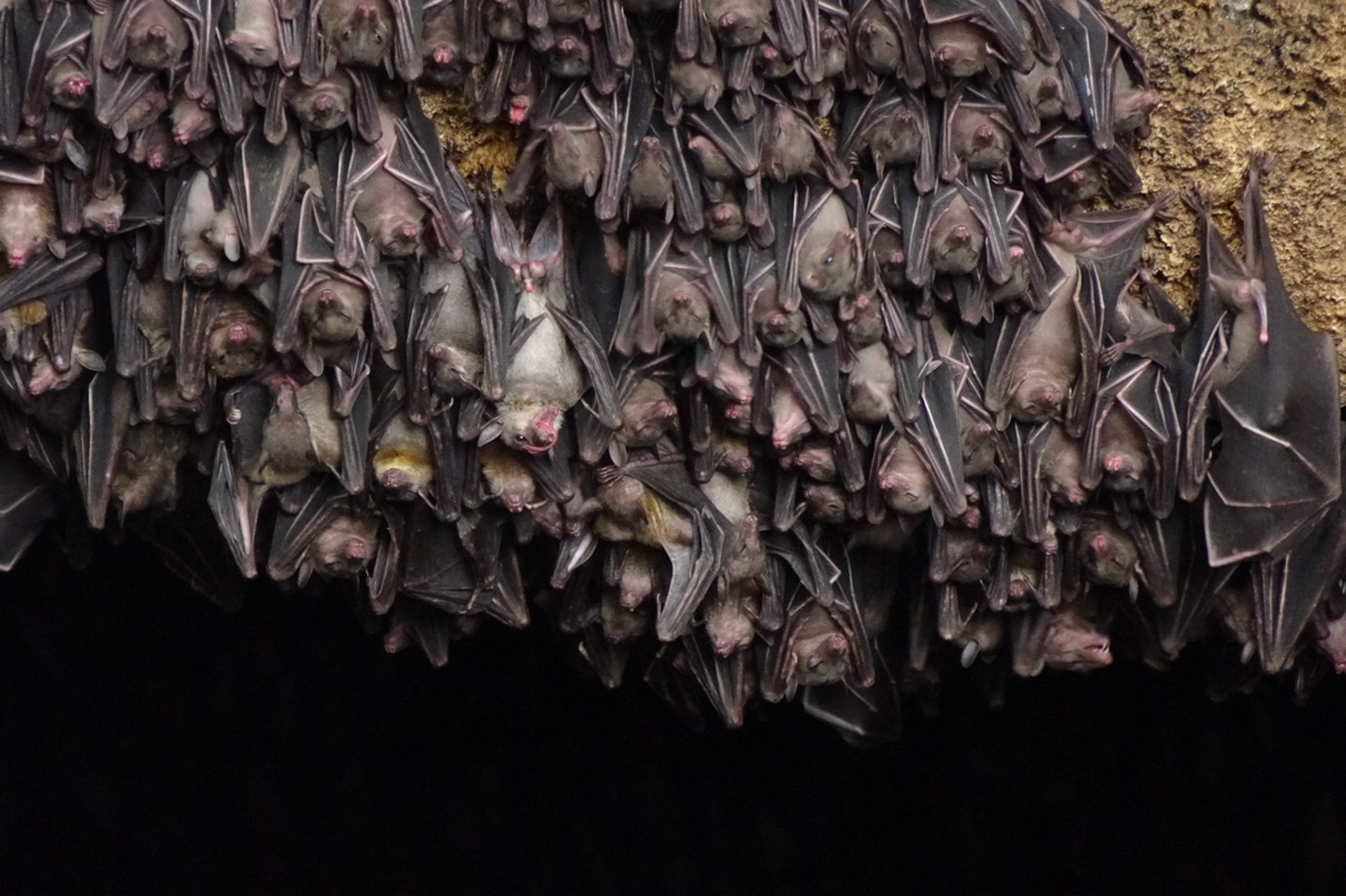
We compared two distinct groups of bats, less crowded and overcrowded colonies, to understand how crowding impacts bat behaviour. Less crowded bats showed more positive behaviours, such as relaxing and sexual behaviour. However, overcrowded roosts, showed more negative behaviour, such as aggressiveness and increased wing movement (either for cooling themselves due to overheating, or to try to maintain more space). Thus, while the less crowded bats may be more relaxed and reproductively viable, crowded bats risk injury from aggression and waste energy in interacting and keeping cool. Our observations of bats demonstrate the detrimental effects of overcrowding, echoing the ‘behavioural sink’ hypothesis, where increasing population density could lead to social behaviour decay, which has rarely been found in wild populations.
As we contemplate the implications of overcrowding in bat colonies, parallels have emerged with our own human societies, highlighting issues that may become more prevalent as areas become uninhabitable under a warming climate. Just as overcrowding leads to negative social behaviours among bats, it can also exacerbate societal tensions and inequalities, especially in marginalised communities (the male bats forced to the edges of the cave in our study) where poor living conditions and overcrowding can exacerbate negative behaviours. Bats may not be great at sharing tight spaces, but who is?
Opposite to the crowded conditions, sexual behaviour among bats increased in less crowded areas, suggesting that access to space and resources can foster positive interactions even in the face of overcrowding. This highlights the importance of proactive measures to mitigate the effects of overcrowding, both in bat colonies and human societies. It is astonishing that bats still have time for romance amidst the chaos of overcrowding. We must give these love-struck flyers the space they need to spread their wings and find their bat-ter halves. By prioritising habitat preservation and resource management, environments conducive to positive social interactions and collective well-being can be created.
Moreover, recognising the connection between bat social behaviour and the quality of roosting sites has important implications for conservation efforts. Bats carefully choose their roosts based on local species-specific conditions and disturbance, as well as access to areas to feed and even drink. Protection of bat roosts, as well as reducing disturbance (especially during reproductive periods), must be prioritised in protection efforts. Who knew bats were the original social distancing experts? It turns out that bats like their space just as much as we do! Let’s take a lesson from our furry friends and give each other the personal space we need.
Read the paper:
Read the full paper here: https://doi.org/10.1111/1365-2656.14072
 Animal Ecology in Focus
Thank you for the article, Krizler Tanalgo. The study of bat behavior under overcrowding draws a beautiful parallel to our human lives, reminding us of the importance of space and calm. Even bats prefer privacy!