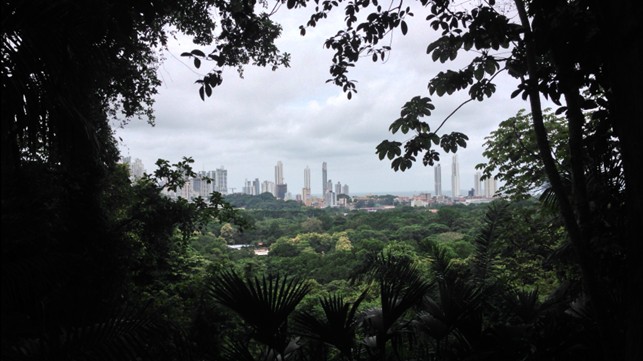
This blog post is provided by Andrew Cronin and tells the #StoryBehindThePaper for the article “Urban developmental environments alter tadpole phenotypes depending on origin”, which was recently published in the Journal of Animal Ecology. In their study, Cronin and colleagues investigated the effects of urbanisation on a species with a complex life history, the túngara frog.
Crouching next to a sickly-looking puddle adjacent to the busy street, I stared into the opaque waters, hoping to see movement. As the cars and trucks zoomed past and regularly honked at me, I had to remind myself how I had gotten into this position. It was all for the tadpoles. Specifically, I wanted to learn if and how urban environments alter the development of frogs during the beginning of their lives.
Human activity is rapidly changing environments around the world, with urbanisation representing one of the most extreme examples of this transformation. Populations in urban areas face a drastically altered environment, causing many populations to move or perish. We continue finding evidence that populations able to persist in these urban environments begin to look, behave, and function differently from non-urban populations. However, the vast majority of our knowledge about these differences between urban and non-urban populations come from studies on adults. Our knowledge of urban impacts on early life, on the other hand, is much more limited. This disparity exists even though early life stages may face the brunt of selection due to elevated mortality in early life, and the fact that early life conditions play a crucial role in explaining differences between urban and non-urban adults. Our knowledge of early life in cities is especially depauperate in species with complex life cycles (species that have distinct life stages characterized by significant changes in their morphology, behaviour, and often habitats).

To fill this knowledge gap, working with a fantastic team, we set out to explore the effects of urbanization on tadpoles from the túngara frog (Engystomops pustulosus). This wonderful little frog has been studied for many decades and has taught us a great deal about how mating decisions are made and how sexual signals evolve. These frogs are also able to survive in urban and non-urban environments, making them well suited to examine how urban environments impact organisms. Combining the knowledge of their sexual signals with túngara frogs’ aptitude for forest and urban living, previous work (Halfwerk et al. 2019) has shown that adults differ in their sexual signalling. However, we know very little about the impact of urbanisation on early life stages of this species.

To test for the effects of urbanisation on tadpoles, we collected pairs in amplexus (males and females clasped together that are ready to mate) from urban and forest populations and brought them back to the lab. Collecting these pairs, which form at night, is generally quite straightforward. However, in urban areas, the process sometimes moves slowly, as residents and police occasionally come around asking (quite reasonably) what on earth we are doing. After parents successfully made their nest, we split the clutch in two, allowing us to place half of the clutch in urban environments and half of the clutch in forest environments. This reciprocal transplant design allowed us to look at both the immediate implications on urbanization on developing tadpoles and to test if any impacts of urbanization were based on where the parents came from.

We found both immediate effects of urbanisation on tadpole development as well as effects of origin of the tadpoles (which habitat the parents came from). Tadpoles raised under urban conditions were smaller, regardless of their origin. Size matters here, as smaller individuals may be at a higher risk of mortality during the fragile period of metamorphosis. Urban developmental conditions producing smaller tadpoles also provides a potential explanation as to why urban adults of this species are smaller than their forest counterparts.

So, where tadpoles were raised appears to matter, but so does where their parents came from. Tadpoles from urban populations consistently developed faster than tadpoles from forest populations. Faster developmental rates may be a consequence of warmer temperatures in cities, but whether or not this is adaptive remains an open question. When examining tadpole behaviour, we found that origin and developmental environment significantly interact. Tadpoles from urban populations behaved differently depending on where they were raised. For tadpoles from forest populations, it didn’t matter where they grew up, they behaved more or less the same. Increased behavioural plasticity may also help urban populations deal with the heterogeneous environment of cities, with cities varying from block to block and changing over short time scales.
Cities will continue to expand to accommodate a higher percentage of the growing human population. Therefore, understanding how species will respond to the changes we make will be highly important from a conservation perspective, and can continue teaching us a great deal about contemporary evolution. This study highlights the importance of viewing differences between urban and non-urban populations through a developmental lens. We hope this study also inspires further investigation in the effects of urbanisation on species with complex life history, which predominate in the natural world.
Read the paper:
Read the full paper here: https://doi.org/10.1111/1365-2656.70071
Listen to the audio abstract here:
 Animal Ecology in Focus