This blog post is provided by David Costantini and tells the #StoryBehindThePaper for the article “Selective logging weakly influences species co-occurrence in a community of tropical understorey birds”, which was recently published in Journal of Animal Ecology. In this study, Costantini et al. explored the processes shaping species co-occurrence of understorey birds in old-growth and selectively logged habitats in Borneo.
Tropical forests are primarily degraded by selective logging—the most widespread method of commercial timber extraction in the tropics. Currently, over 400 million hectares of natural tropical forest are designated for timber harvesting, and selectively logged forests are now more extensive than intact old-growth forests in most tropical countries. Compared to old-growth forests, logged forests tend to be less structurally heterogeneous, with lower canopies often interrupted by forest gaps, denser understorey vegetation dominated by fast-growing pioneer species, and an increased abundance of lianas, which are woody climbing plants that hang from trees of tropical rainforests. Despite these structural changes, selectively logged forests can maintain high levels of biodiversity, largely due to declines in forest-specialist species being offset by increases in edge-tolerant species.
Understanding how selective logging affects patterns of species co-occurrence—the frequency with which species are found together across a community—is key to uncovering the ecological processes shaping animal assemblages after disturbance.
In a recent study published in Journal of Animal Ecology, we present findings from a long-term investigation (2014–2023) comparing species co-occurrence patterns between old-growth and selectively logged forests in Borneo. Our results show that selective logging had only a weak effect on co-occurrence patterns over time, suggesting a degree of resilience in understorey bird communities to logging disturbance. Most species consistently co-occurred with the same set of species across both forest types, reflecting high co-occurrence fidelity. However, some species exhibited subtle shifts in fidelity between habitats. For instance, purple-naped spiderhunters and little spiderhunters, two tropical bird species native to South-East Asia, showed reduced fidelity in logged forests, with the latter being more abundant in disturbed areas. This increased abundance may lead to greater niche overlap and hence lower co-occurrence fidelity. Conversely, species like the rufous-backed dwarf-kingfisher, cream-vented bulbul, and white-bellied munia had lower fidelity in unlogged forests, possibly due to their preference for forest edges (i.e. ecotonal zones) which are more common in logged habitats, where they may co-occur with other forest-edge specialist species.

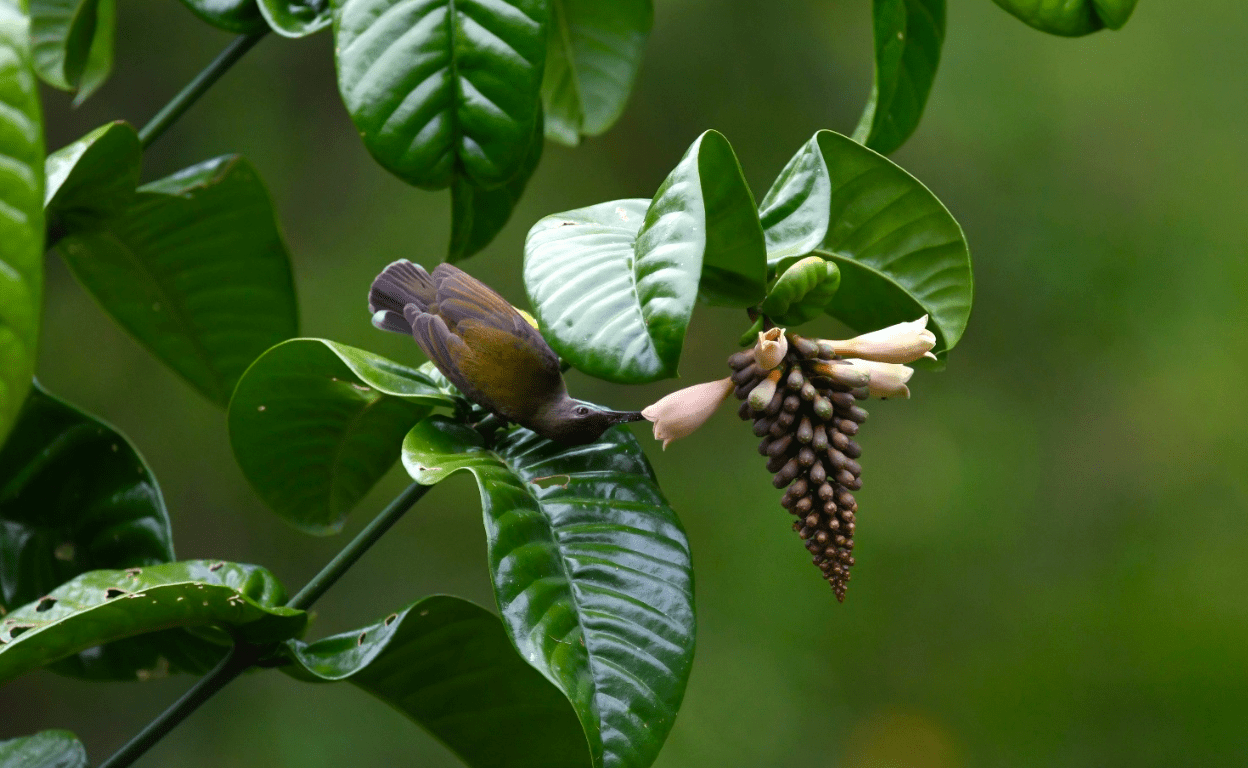
The little spiderhunter (Arachnothera longirostra) belongs to the family Nectarinidae. While it primarily feeds on floral nectar, spiders and other arthropods also constitute important components of its diet. The greater abundance of spiders in the understorey of selectively logged forests may help explain the higher occurrence of little spiderhunters in these disturbed habitats compared to unlogged forests in Borneo. Photo from Simone Messina.
We also examined how species’ functional traits influenced co-occurrence patterns. Traits such as trophic niche and foraging strata were considered, as these are known to mediate avian responses to logging. Additionally, we assessed Kipp’s distance—a wing morphology metric linked to flight and dispersal capacity—and body mass, a proxy for metabolic demand. Species with specialized diets (e.g., frugivores or insectivores) and those employing aerial, soaring, or gliding foraging strategies (associated with larger Kipp’s distances) tended to show lower fidelity in species co-occurrence.
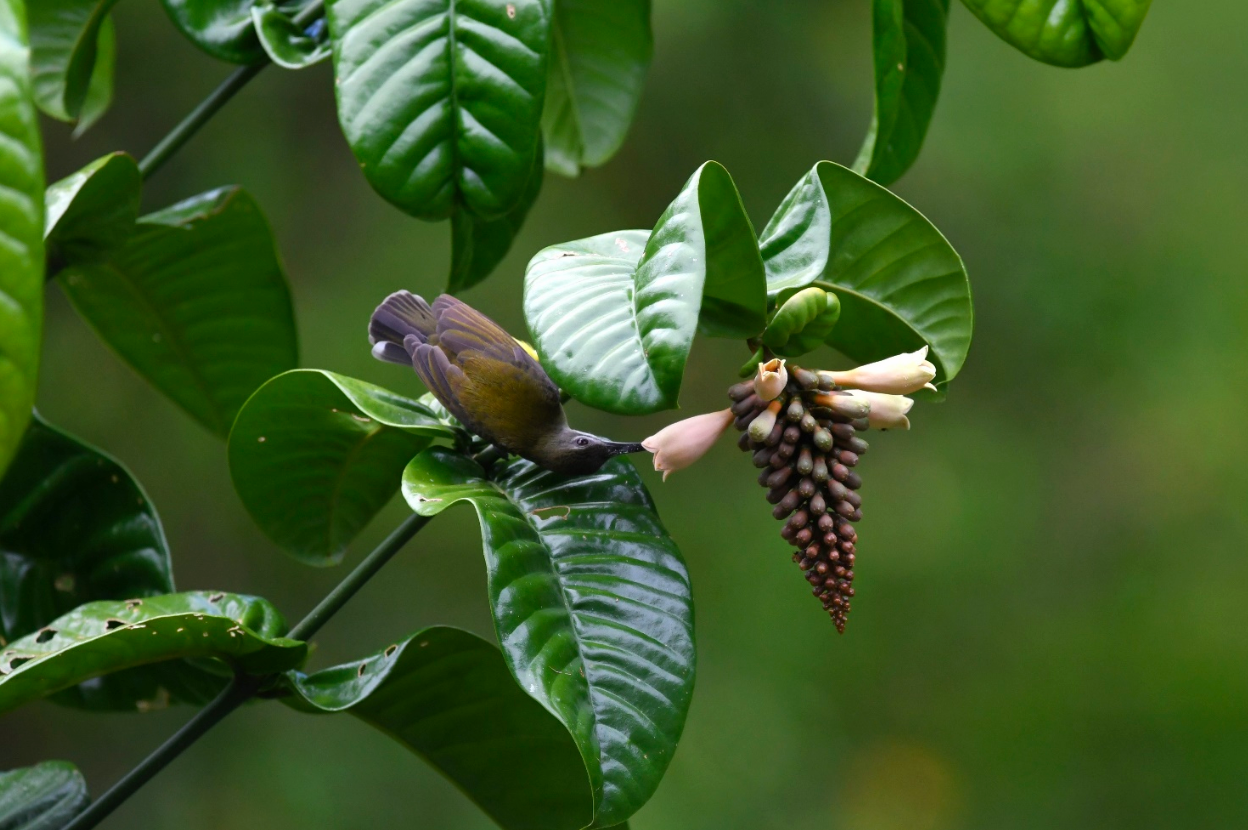
A little spiderhunter feeding on nectar. Photo from Simone Messina.
Temporal shifts in co-occurrence were strongly influenced by changes in local abundance. Although many species that increased or decreased in abundance over time exhibited parallel changes in co-occurrence patterns, others did not follow this trend. This suggests that niche segregation and environmental filtering—where habitat structure and abiotic conditions determine species persistence—may jointly shape community composition.
Our findings highlight the conservation value of selectively logged forests. Despite the absence of restoration interventions, these disturbed habitats can continue to support resilient bird communities, underscoring their potential role in broader tropical biodiversity conservation strategies.
Read the paper:
Read the full paper here: https://besjournals.onlinelibrary.wiley.com/doi/10.1111/1365-2656.70085
 Animal Ecology in Focus