
This blog post is provided by Marco Basile, Gilberto Pasinelli, and Eckehard Brockerhoff and tells the #StoryBehindThePaper for the article “Large-scale importance of bark beetle outbreaks for standing deadwood and woodpeckers”, which was recently published in the Journal of Animal Ecology. In their study, the authors revealed the nature of the interaction between bark beetles and woodpeckers, highlighting the beetles’ role as providers of deadwood in European forests.
Bark beetles may remind us of degrading forest health conditions, dead trees, and forest workers racing against time to salvage wood before it decomposes and becomes worthless as timber. Perhaps a gloomy thought for some of us and surely for forest managers; however, the sudden increase of dead and dying trees following bark beetle outbreaks would be a rather positive event, if were you woodpecker, of course.
For decades, European forests have been intensively managed, mainly for timber production. Especially Norway spruce has been planted widely also in areas where it would not naturally occur. Although practices markedly changed in the last couple of decades, and non-timber values have been increasingly recognised, the legacies of intensive forest management are still there, especially the widespread deficiency of deadwood. This resource is pivotal for many forest species, from saproxylic beetles that can use it as breeding substrate, to many vertebrate species that use it to find food or as shelter. Among those, woodpecker make extensive use of deadwood: when lying on the forest floor, it is a great source of prey, such as saproxylic insect larvae or carpenter ants; when standing, it can be used for excavating a nest cavity, for hunting larvae that prefer freshly dead or dying trees, or for producing their typical drum rolls.

Given the importance for many forest species, current forest management strategies aim at increasing levels of deadwood. The achievement of this objective normally involves leaving dead and dying trees in the forest during harvesting, thus avoiding removing all woody material. But what if forests could benefit from the natural provision of deadwood and managers could consider that in management plans as a complementary measure? This is what we investigated using multiple long-term datasets of forest and bird monitoring programmes, dating back to the early ‘80s. For the first time, we demonstrate that bark beetle outbreaks contribute to increased population densities of at least two woodpecker species, with effects being present over temporal windows of 7-9 years. Moreover, the study clarified that this beneficial effect is not directly dependent on bark beetles but rather on the subsequent increase in standing deadwood, generated by an increase in beetle-killed trees.
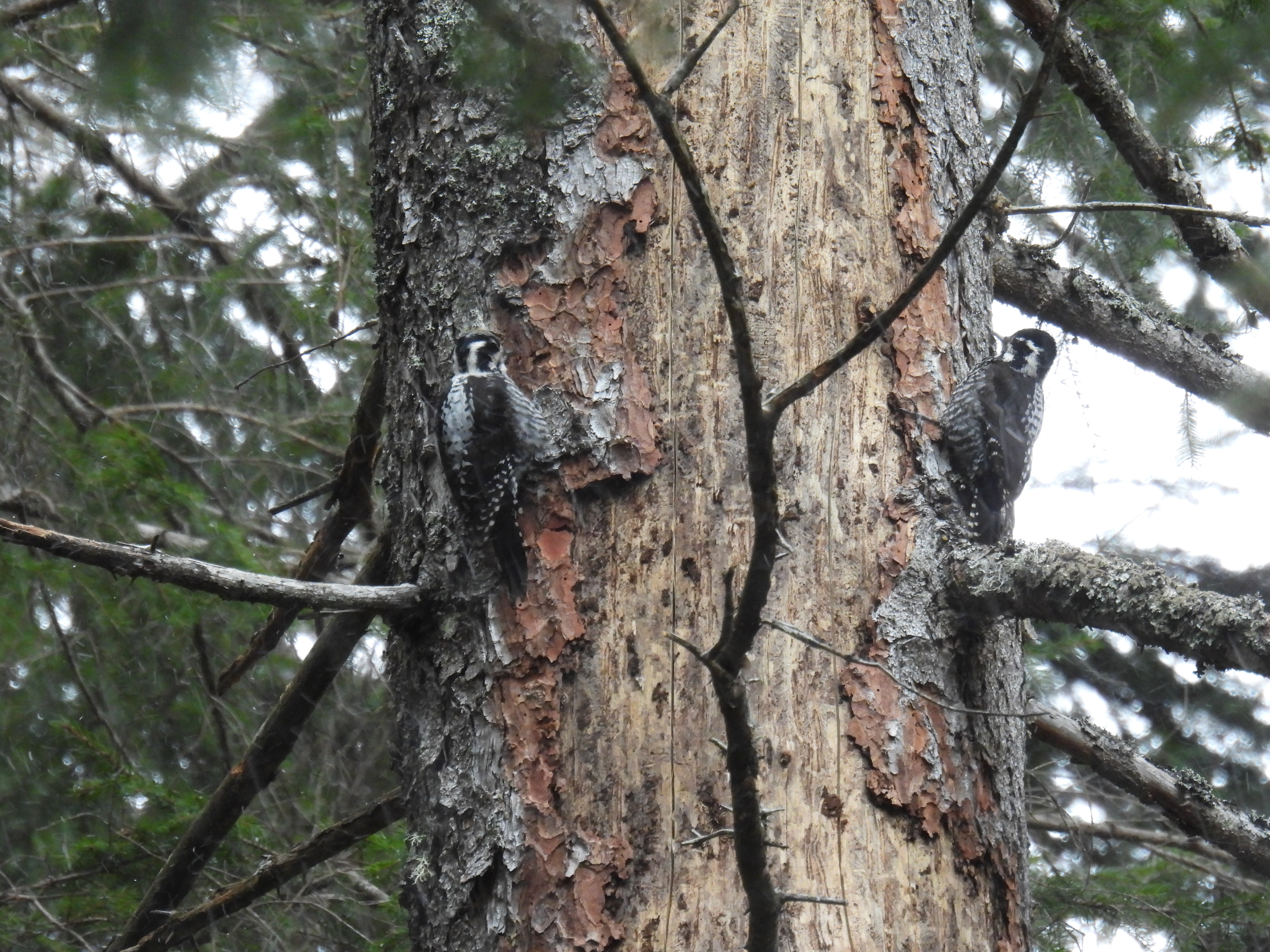
The study has a spotlight on two woodpecker species, the black woodpecker and the three-toed woodpecker. While the first is more of a generalist species, the three-toed woodpecker is a bark beetle and spruce forest specialist, able to colonise new infestation sites within short time. Freshly beetle-killed trees become important resources for the three-toed woodpecker as they can immediately supply food, such as bark beetle adults and larvae. Furthermore, once wood decomposition begins, other insects colonise deadwood, adding to the available food resource pool. Finally, the dead trees can also be used for excavating nest cavities, as long as they stand. Moreover, standing dead tree may be suitable for repeated cavity excavations over time. This supply of tree cavities is useful for many other species in terms of foraging, shelter or nesting. A squirrel may use the cavity as a daily shelter, a colony of wasps may build their nest, bats may use it as winter roost site, and so on. Thus, what began with a tree under attack from bark beetles became a plentiful of resource for forest biodiversity.

Nevertheless, it is important to remark that the findings of this study do not undermine the gravity of very large bark beetle outbreaks. In some cases, forests may be severely compromised by extensive tree mortality, which may ultimately result in the loss of forest habitat for many species. Thus, very large outbreaks are not necessarily beneficial for biodiversity. The optimal solution lies somewhere in the middle, where spotted outbreaks in space and time supply forests with new deadwood resources but allow forest regeneration to replace canopy cover losses.
In any case, future management plans for forests under risk of bark beetle infestations may consider leaving some beetle-killed deadwood as a potential nature-based solution for increasing deadwood levels in support of forest biodiversity.
Read the paper
Read the full paper here: https://doi.org/10.1111/1365-2656.70096
 Animal Ecology in Focus