
This blog post is provided by Valentin Moser and tells the #StoryBehindThePaper for the article “Habitat heterogeneity and food availability in beaver-engineered streams foster bat richness, activity and feeding”, which was recently published in Journal of Animal Ecology. This study shows that beaver engineering creates structurally diverse habitats that support a broader range of bat species.
Beavers are recolonizing large areas in their former range in Eurasia and North America. Where beavers proceed with building dams, the environment changes on a large scale. Flowing water is impounded and slowed. Sometimes large areas can be flooded and any trees left standing in the water eventually suffocate and remain into the environment as standing deadwood.
We set out to explore how beavers and their engineering affect bat communities. To do this, we installed bat detectors in eight paired systems in Switzerland: one beaver system with a dam, paired with a comparable control area, 500 meters up-or downstream. Beavers are surprisingly adaptable and tolerant of human activity (sometimes not vice versa) and manage to settle in urban and agricultural areas as well. To incorporate this diversity of habitats, we had a broad range of land-uses around the beaver systems, reflecting typical beaver habitats in Switzerland. From the recorded bat calls and with the help of BatScope, a program that classifies bat calls, we could then associate species identity, activity, and feeding activity. Simplified, activity is the number of passes in front of the detector, while feeding activity is the number of feeding buzzes detected. These feeding buzzes are a characteristic sequence of calls when a bat is approaching and trying to feed on prey.
Indeed, we found an increase in species richness in beaver areas compared to the control areas by about one species, from four to five species. Also, the activity (by 1.6x) and feeding activity (by 2.3x) was elevated! We were very happy to see that the beaver activity has such a large positive effect on the bat community, including finding more Red-listed, threatened species in the beaver systems.
However, bats profiting from beavers has been shown before; the questions remaining open was the “why”. This is what we tried to answer next. The literature suggested two main hypotheses:
An increase in habitat heterogeneity, meaning more niches and microhabitats, perhaps leading to more bat roosts, places where bat species can safely spend their day. Another hypothesis was an increase in food availability: Beaver systems are known to be productive and have an abundance of insects, possibly attracting feeding bats.

To answer these hypotheses, we recorded some more variables during the field season. To record the abundance of flying insects, we installed flight-interception traps right above the water surface. We also conducted a deadwood monitoring, measuring the volume of standing deadwood in the beaver and control areas. Finally, back in the lab, we supplemented these variables with a canopy heterogeneity variable based on a GIS model. Next, we constructed a Structural Equation Model to help us answer our question of why bats seem to be attracted to beaver systems.
We found strong positive links of beavers to the two variables indicating habitat heterogeneity, standing deadwood volume and canopy heterogeneity. The standing deadwood was then also positively linked to arthropod abundance, which was positively linked to bat feeding. There was also a direct positive link from standing deadwood density to bat species richness. Bat species richness and feeding together then explained total bat activity. Some positive direct links between beaver and bat richness and feeding indicate that our model does not include all beaver habitat modifications important to bats, for example open water area or edge habitat could also be of importance.
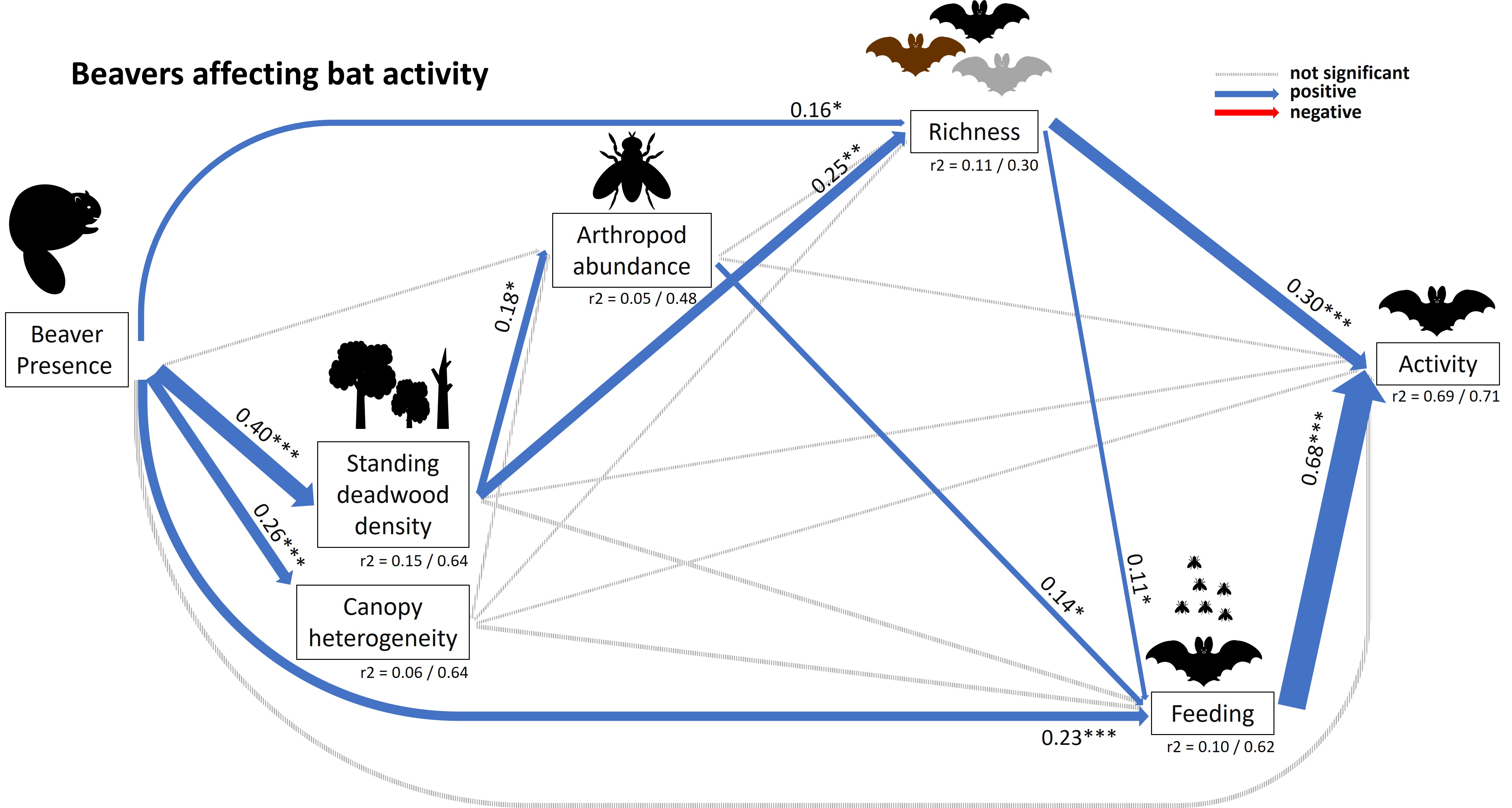
So what does this tell us? Bats come to beaver systems to do different things. For sure, some bats come to beaver systems to feed. As an example, the Daubenton’s bat Myotis daubentonii certainly profits from the more open water area, where they hunt for emerging insects. However, the higher richness in beaver systems also indicates that there are more reasons bats come to beaver systems. The strong link from the increased beaver-caused standing deadwood to the bat richness could give a clue: In many European landscapes, bats are limited by the amount of standing deadwood, as other studies have shown. Bats use standing deadwood to roost, each species with their own strategy: Some go in holes (for example created by woodpeckers), others press themselves into the smallest cracks while Barbastelle bats Barbastellus barbastellus hide under bark that is slowly peeling off. Bats might use standing deadwood in beaver systems to roost.
Beavers therefore provide both habitat heterogeneity and food availability for the bats. With standing deadwood, beavers help bats by bringing back a particularly rare resource into the landscape.
Read the paper:
https://besjournals.onlinelibrary.wiley.com/doi/10.1111/1365-2656.70136
 Animal Ecology in Focus