
This blog post is provided by Thomas Haaland and tells the #StoryBehindThePaper for the article “Eco-evolutionary dynamics of partially migratory metapopulations in spatially and seasonally varying environments”, which was recently published in Journal of Animal Ecology. This study models how coexistence of seasonal migration and year-round residence arises and is maintained in a metapopulation context, and how such ‘partially migratory metapopulations’ respond to extreme climatic events.
The value of general theoretical models in ecology and evolutionary biology is unmeasurable. Theory helps us build, check and follow the narratives that we construct about the world. Without a narrative proposing to explain our observations, they never become anything more than just that – a gathering of observations. When coupled with an underlying narrative, however, observations can support our refute hypotheses, building scientific knowledge step by step. Thus, even without any data, these narratives form crucial components in advancing our scientific understanding. Some narratives in biology are simple, straightforward and intuitive, but others are more complicated, unintuitive and easy to get wrong. Perhaps two competing explanations for the same phenomenon predict different outcomes. Perhaps logical-seeming verbal arguments lead us to an illogical place. In these cases, mathematical models, computer simulations, and other forms of theoretical work, can play important roles in clarifying confusion, disentangling different arguments and straightening muddied logic, highlighting exactly which processes might matter and when.
Theoreticians and empiricists
Much of the best theory in this respect is highly general, able to be applied to any number of different species or populations. Parameterizing a model with population-specific values to obtain case-specific predictions can be interesting for that specific population, but may lose interest to anyone outside of this particular system. Therefore, a modelling ethos of simpler-is-better is not uncommon: If a general ecological problem can be distilled down to, say, a set of equations with just two or three key parameters, then the theoretician rejoices, both for the elegance of their work, and for its potentially broad, long-lasting and far-reaching importance and impact.
Empiricists, on the other hand, are then faced with the challenge of applying these highly general theories to their specific study systems, parsing through mathematical abstraction to find results that support or refute narratives around the phenomena they are studying. However, in this process they might conclude that the models’ simplicity fails to capture some key element of their study system, halting any further conceptual progress. It’s not uncommon that theory lags behind biological realism in this way, though ideally a synergistic interplay between empirical and theoretical work arises, where each feeds into and motivates next steps in the other in a positive feedback loop. The missing key element identified in an empirical system can be incorporated into new theory, which in turn can inform new empirical work about what exactly to look for and where to look for it.
Partial migration: do the models match the real world?
Partial migration, the coexistence of seasonal migrants and year-round residents within a population, is such a phenomenon that has attracted both empirical and theoretical interest. Why and when are both strategies maintained in a population over time? Mathematical models have proposed mechanisms of seasonal density-dependence (producing frequency-dependent selection on migration tactic), rules of territory acquisition, and individual differences in body condition, experience or age, all of which have received some empirical support. However, as all good models, they all rely on sets of simplifying assumptions – one of which rendered them almost useless when faced with a particularly intriguing study system.
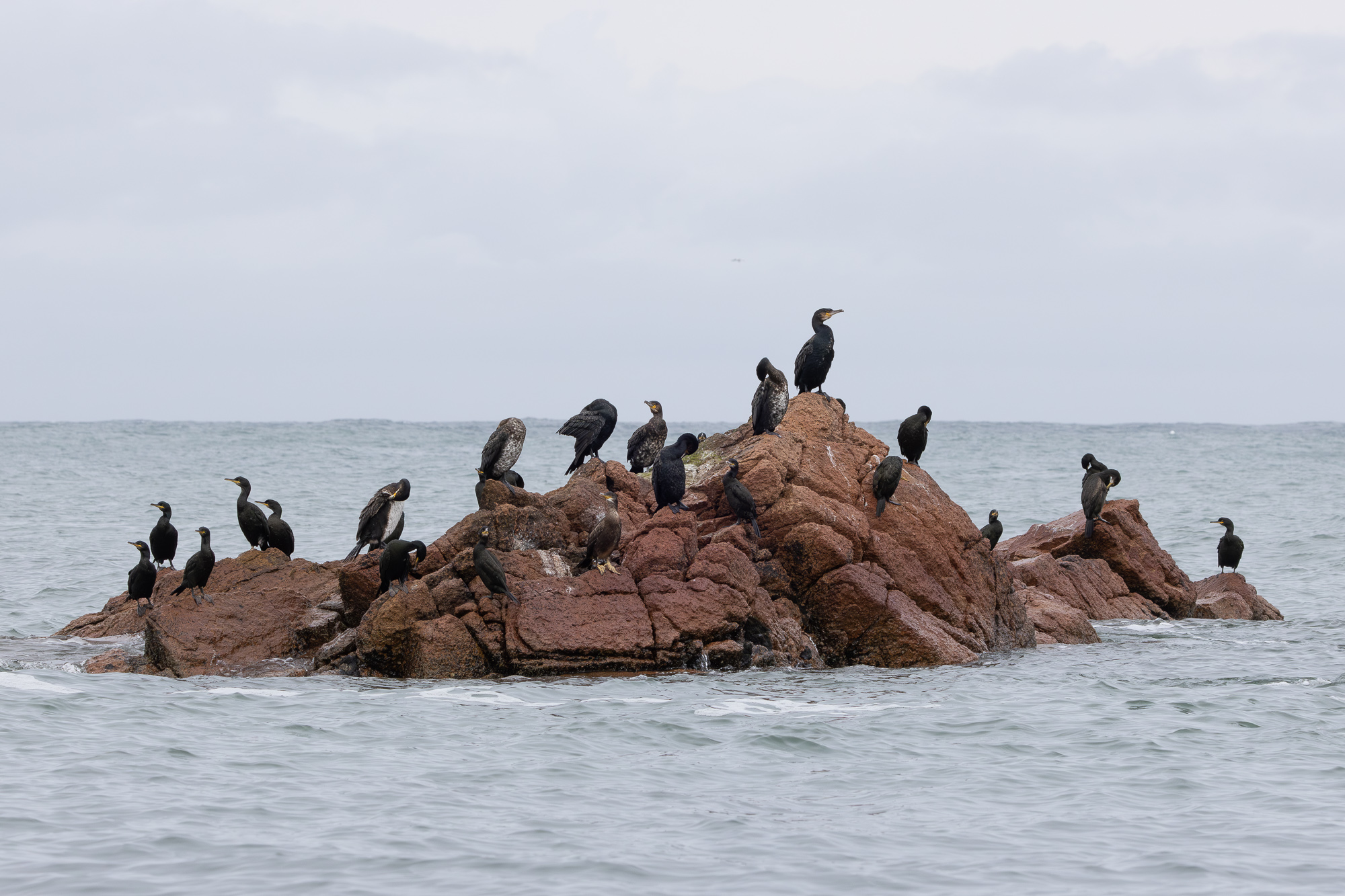
We study a metapopulation of European shags (Gulosus aristotelis)on the east coast of Scotland, UK. In several distinct shag colonies breeding in different sites along the coast, approximately half of the shags remain resident year-round in their breeding colony, and the other half seasonally migrates, spending the winters at different locations up and down the coast, often hundreds of kilometers away from their breeding colony, before returning home the next spring. Oftentimes, these migrations will even involve reciprocal movements between colonies, where migrants from colony “A” overwinter in colony “B”, and migrants from colony B overwinter in colony A. Other times, migrants from both colony A and B may overwinter in a shared different location, “C”. Thus, these distinct breeding “subpopulations” could be said to form a “partially migratory metapopulation” (PMMP). Whereas gene flow (the main mechanism connecting subpopulations in the traditional metapopulation concept) is limited among colonies, these subpopulations remain interconnected through the seasonal movements of migrants.
Rethinking partial migration models
PMMPs, we argue, feature some unique and intriguing phenomena that represent a drastic break from the assumptions made by typical models of partial migration, and thus require new theory if we are to understand how they arise, are maintained, and might respond to environmental change. For example, most models of partial migration assume a simple two-patch structure, where one patch is suitable for occupation year-round, and the other site is only available to migrants, either in the breeding or the non-breeding season. In both cases, the models assume that migration happens in a vacuum, and that there simply exists empty space into which migrants can move. However, real animal migrations almost never work like this, and migrants from a given population almost always arrive in locations that they share with many other migrants, of the same or different species, as well as any local residents at the migratory destination. Thus, seasonal density-dependence acting in the migratory destination depends not only on the number of migrants from the focal population, but on population densities and proportions of migrants in a number of other populations as well. This breaks a key tenet of traditional partial migration models by decoupling frequencies of migrants vs. residents from their seasonal vital rates.
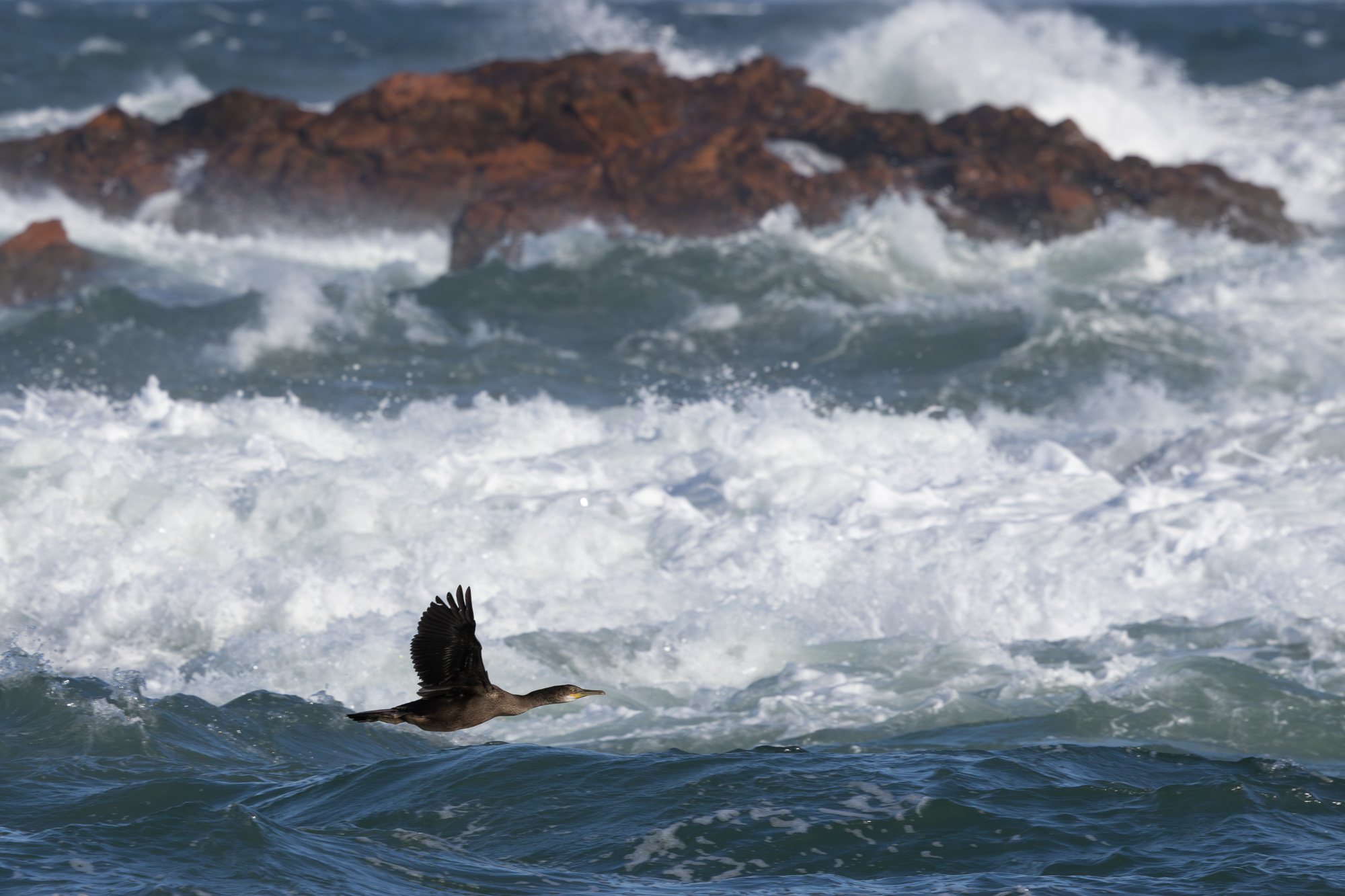
The model we present here explores this and other eco-evolutionary dynamics exhibited by PMMPs, breaking ground for further theoretical and empirical work to understand these common structures. For example, we show how following a local perturbation (e.g., an extreme weather event striking a certain location, as is seen in dramatic winter storms occasionally causing population wrecks in the shags), population and evolutionary dynamics can ripple through the entire metapopulation, with consequences of the perturbation being observed far from the original shock both in space and time.
Thus, while refraining from parameterizing our model directly to the shag system, the shags clearly both inspired and informed our model, which hopefully can in turn help us explore the intriguing narratives revealed by the shags and other partial migrants.
Read the paper
Read the full paper here: https://doi.org/10.1111/1365-2656.70240
 Animal Ecology in Focus