Ameli Kirse (she/her) provides the story behind her paper, “The clockwork of insect activity: advancing ecological understanding through automation“, which was shortlisted for this year’s Elton Prize. We also hear a little about her journey into animal ecology.
About the paper:
What is your shortlisted paper about, and what are you seeking to answer with your research?
In this paper, we explore how combining automated insect sampling with DNA metabarcoding can reveal fine-scale, taxon-specific activity patterns across entire insect communities, thereby also providing insights into potential interactions among taxa. Our aim was to move beyond traditional monitoring approaches that focus mainly on species presence or abundance, and instead ask when insects are active and how these temporal patterns differ across groups. By capturing circadian rhythms directly in the field, we sought to gain deeper insights into insect behaviour, ecological interactions, and temporal niche partitioning. The study highlights how modern technologies can open new perspectives on long-standing ecological questions.
Were you surprised by anything when working on it? Did you have any challenges to overcome?
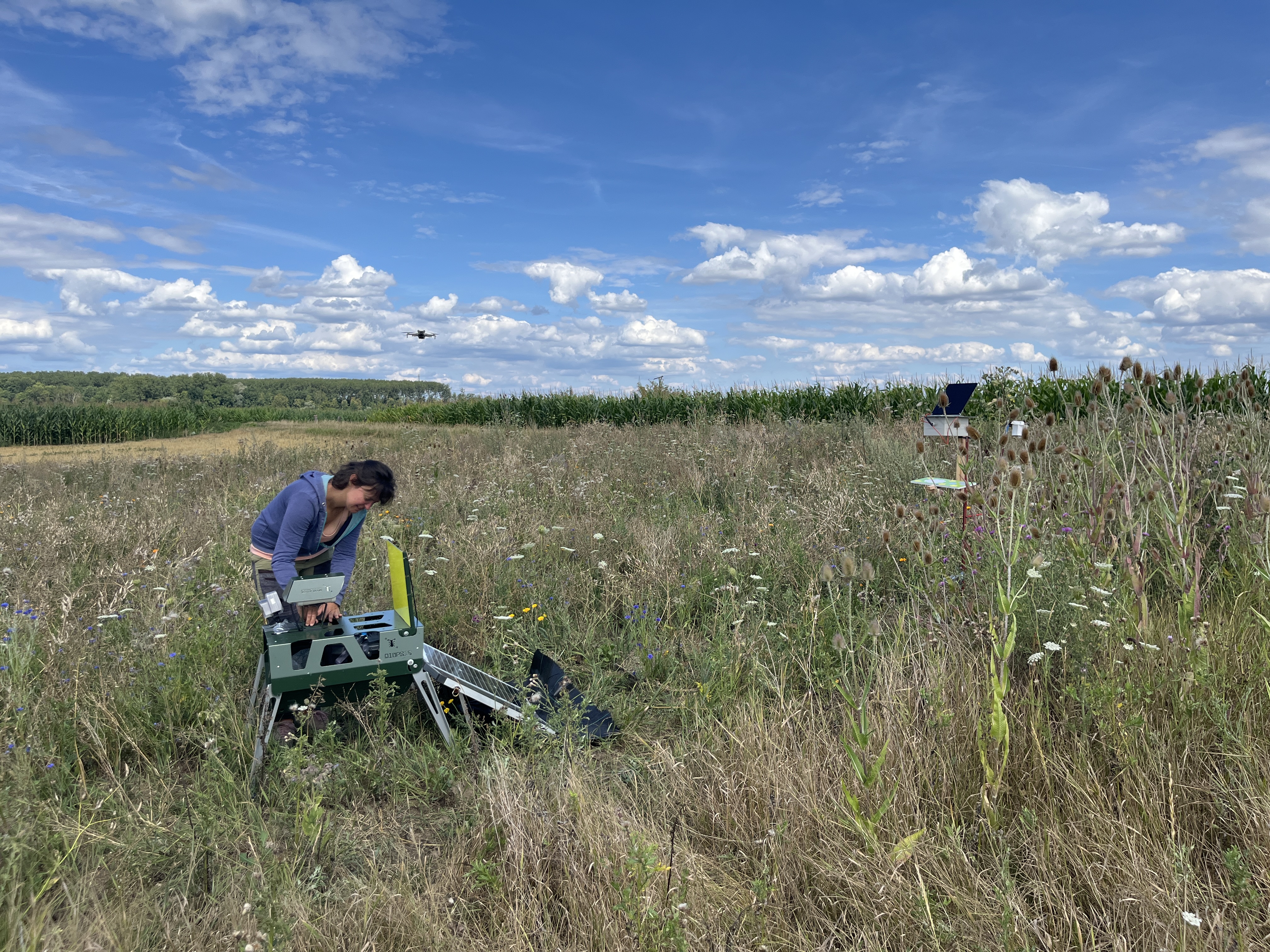
I was surprised by how complex and diverse activity patterns were, even among closely related species. Some species showed much more nuanced temporal behaviour than expected, revealing ecological dynamics that are rarely captured by conventional monitoring. A major challenge was working with a monitoring system that was still under development, technical failures and data gaps were unavoidable. Turning these imperfect real-world data into robust ecological insights required flexibility, careful modelling, and a lot of patience.
What is the next step in this field going to be?
The next step in ecology is integrating modern technologies more deeply into how we study complex biological systems. This includes moving toward automated, high-resolution monitoring approaches that capture not only species presence, but also behaviour and temporal dynamics. By combining molecular tools, innovative monitoring technologies, and bioinformatics, we can address ecological questions at scales and depth that were previously inaccessible. Embracing interdisciplinary methods will be essential for improving our understanding of ecological interactions, system dynamics, and responses to environmental change.
What are the broader impacts or implications of your research for policy or practice?
Our study demonstrates the ecological value of time-resolved insect monitoring, while also highlighting an important limitation: the Malaise trap used is a lethal sampling method and, depending on the temporal resolution, still requires bi-weekly maintenance. Building on these insights, my current work focuses even more strongly on developing automated, non-lethal monitoring solutions that ideally operate autonomously. This shift is essential for long-term, large-scale biodiversity assessment, particularly in agricultural landscapes. Within initiatives such as BioMonitor4CAP, these approaches aim to deliver robust, standardised biodiversity indicators that can inform result-based schemes and support a more evidence-driven development of the future Common Agricultural Policy.
About the author:
How did you get involved in ecology?
The foundation was laid during my Bachelor’s degree at the University of Würzburg, where I first came into contact with ecology. I was fascinated by the field because it connects organisms, environments, and processes across scales, directly influences everything happening on Earth, and yet still holds many open questions. At the same time, I became aware of the limitations of traditional biodiversity monitoring, which often makes it difficult, or even impossible, to address these questions. This motivated my focus on modern approaches, particularly DNA metabarcoding, during my Master’s degree, which I further deepened during my PhD by developing strong bioinformatic skills. I learned early on that bioinformatics would become essential for understanding complex ecological systems. During my first postdoc, I was finally able to bring all these interests together by using applied technologies to address ecologically relevant questions. This paper illustrates what becomes possible when we remain open to new ideas in ecology.
What is your current position?
I am currently working within the EU project BioMonitor4CAP, where I am responsible for coordinating the project and co‑leading a work package focused on developing, testing, and calibrating farmland biodiversity monitoring systems. My work centers on the development and implementation of automated biodiversity monitoring approaches, with a strong emphasis on automated, non‑lethal methods. These include camera traps designed specifically for insects, as well as acoustic sensors used to assess both bird and insect communities. A key objective is to generate robust, scalable data that can directly inform result‑based schemes and support the future development of the Common Agricultural Policy (CAP).
Have you continued the research your paper is about?
Yes, very much so. My current work builds directly on the ideas developed in this paper: Moving away from a narrow focus on monitoring single taxonomic groups and instead aiming to assess interactions and relationships across entire communities. I am now focusing even more strongly on automating insect monitoring using non-lethal tools. Within BioMonitor4CAP, this research is closely linked to policy, as we aim to provide reliable biodiversity indicators that can support result-based agri-environment schemes and help shape a more evidence-driven Common Agricultural Policy.
What one piece of advice would you give to someone in your field?
Be open to interdisciplinary approaches and don’t be afraid of imperfect data. Some of the most interesting ecological insights emerge when new technologies meet real-world complexity, and when you’re willing to learn from both successes and setbacks.
 Animal Ecology in Focus