Angus Mitchell (he/him) provides the story behind his paper, “Tropical fishes can benefit more from novel than familiar species interactions at their cold-range edges“ which was shortlisted for this year’s Elton Prize. We also hear a little about his journey into animal ecology.
About the paper
What is your shortlisted paper about, and what are you seeking to answer with your research?
Our paper asks a simple but underexplored question: can novel species interactions benefit animals experiencing climate-driven range shifts?
As ocean warming pushes tropical fishes into cooler temperate reefs, they increasingly encounter unfamiliar species rather than the tropical communities they evolved with. We tested whether these novel interactions hinder or help tropical fishes at their cold-range edges.
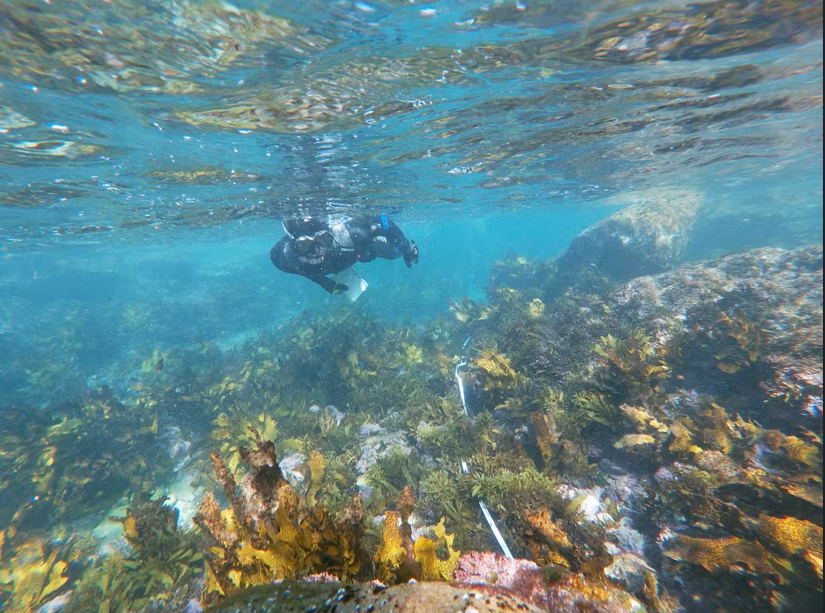
Using field experiments and behavioural observations, we found that tropical fishes often forage more effectively in mixed tropical–temperate shoals than in familiar tropical-only groups, particularly at their range limits. This suggests that novel species interactions can sometimes facilitate range expansion rather than constrain it.
Were you surprised by anything when working on it? Did you have any challenges to overcome?
One of the biggest surprises was just how that these novel interactions between tropical and temperate fish were beneficial. There’s a strong narrative in ecology that unfamiliar interactions are risky or destabilising, but we found novel shoaling conditions provided social and foraging benefits to range-extending tropical fish in temperate ecosystems.
The main challenge was working with inherently messy field data. You can’t control who shoals with whom on a reef, so we had to be very careful in our statistical approaches to test the effects of shoal composition from environmental variability. That realism, though, is also one of the strengths of the study.
What is the next step in this field going to be?
The next step is to move beyond asking whether interactions change under climate change to understanding how and why they do to better inform our predictions of ecosystems will function in the near future.
That means scaling from genes to ecosystems, linking behaviour to mechanisms — physiology, energetic trade-offs, learning, and even microbiomes, and scaling up from individual interactions to population persistence and community restructuring. We also need more work in natural systems, where ecological buffering and context dependence really matter.
What are the broader impacts or implications of your research for policy or practice?
Our findings suggest that climate impacts on ecosystems won’t just be driven by increasing temperatures or habitat loss, but also by who interacts with whom.
For conservation and management, this means that maintaining diverse, intact communities may help species cope with climate change by preserving beneficial interactions. It also cautions against assuming that all novel species interactions will be negative — some may actually enhance resilience.
About the author
How did you get involved in ecology?
I have always been fascinated by how ecosystems respond to changing environments, and I’ve spent much of my life outdoors. My interest in ecology really took shape through fishing. Growing up fishing on polluted rivers, often dominated by invasive fish species, made environmental impacts feel very real — I could see how degradation directly affected the fish and ecosystems I cared about. That combination of time outdoors, personal experience, and scientific curiosity drew me towards a career in ecology.
What is your current position?
I am currently a Chancellor’s Research Fellow at the University of Technology Sydney, where I research climate resilience in marine and estuarine fishes. By combining studies in climatically extreme lagoons with mechanistic experiments, I investigate how fishes respond to warming, hypoxia, and acidification, with the goal of identifying traits and processes that could help climate-proof estuarine and reef fish communities under future climate change.

Have you continued the research your paper is about?
Yes — this paper has strongly shaped the direction of my research. I’m now expanding this work to examine how behavioural plasticity, physiology, and thermal history interact to determine which fish species and populations can persist under climate change stressors such as marine heatwaves, warming and acidification. To do this, I use natural CO2 seeps, ocean-warming hotspots paired with climate-simulated experiments to understand how novel species interactions play out under realistic future climate scenarios.
What one piece of advice would you give to someone in your field?
Spend time observing nature. As climate-change-focused ecologists, we often prioritise controlled experiments, but ecosystems frequently behave in ways we don’t predict. Some of the most interesting and important insights come from embracing ecological complexity rather than trying to eliminate it.
 Animal Ecology in Focus