Elise Sivault (she/her) provides the story behind her paper, “Insectivorous birds and bats outperform ants in the top-down regulation of arthropods across strata of a Japanese temperate forest“, which was shortlisted for this year’s Elton Prize. We also hear a little about her journey into animal ecology.
About the paper
What is your shortlisted paper about, and what are you seeking to answer with your research?
Our paper represents a significant experimental effort to investigate how top-down control by birds, bats, and ants shapes prey populations and indirectly influences herbivory across forest strata. Given the complexity of trophic cascades, variations between the canopy and understory were expected. However, these dynamics were still poorly studied across strata, largely due to accessibility challenges.
This study was a cornerstone of my PhD research and part of a global project conducted by my former lab (more details can be found at https://multitrophicinteractions.blog/).
Were you surprised by anything when working on it? Did you have any challenges to overcome?
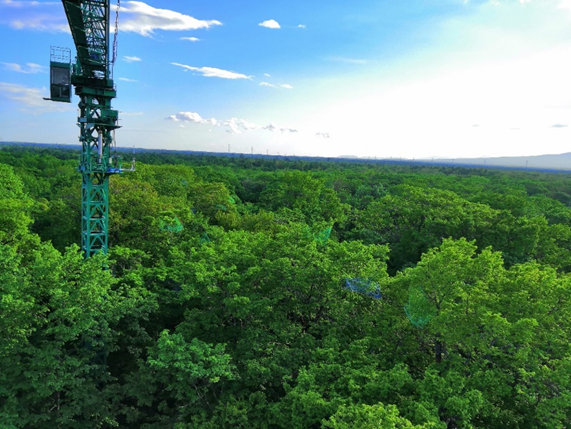
An experimental framework like this comes with its fair share of challenges. Our team collected and classified over 10,000 arthropods and scanned approximately 4,000 leaves to estimate herbivory—making this truly a collaborative effort. Accessing the canopy was made possible by a crane (see Fig. 1), so a fear of heights was not an option! Of course, every experimental setup has its limitations. In our case, we excluded only the flying fauna that directly feed on leaves and focused on a constrained time frame, working with small saplings and tree branches. However, since such limitations typically lead to underestimations, the actual effects in nature are likely even stronger than what we observed.
in the Tomakomai Experimental Forest, Hokkaido.
What is the next step in this field going to be?
What became clear in our study was the need to include tests of bottom-up control in our experimental design. It appears that both top-down and bottom-up controls are rarely studied together and both likely contribute to the patterns observed. Furthermore, despite the minimal impact of ants in our study, we identified significant gaps in understanding the role of arthropod predators in trophic cascades, not only for ants but also for spiders, which were found highly abundant in our arthropod dataset.
What are the broader impacts or implications of your research for policy or practice?
Like many other taxa, birds and bats face threats from habitat loss, hunting, and the impacts of climate change. Yet, our findings suggest that a decline in bird and bat populations could have widespread consequences for forest ecosystems, from the forest floor to the canopy. It is imperative that we prioritise the conservation of these essential predators.
About the author
How did you get involved in ecology?
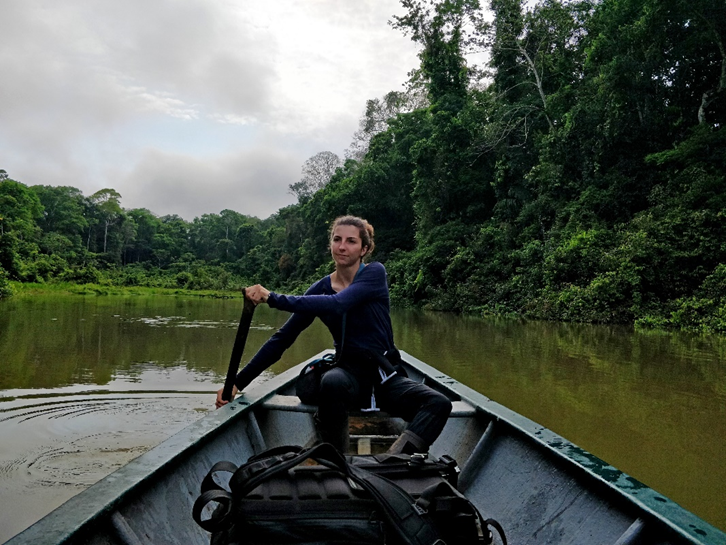
While traveling in the tropics at an early age, I developed a strong attraction to these ecosystems and a desire to learn more about their dynamics. Since my bachelor’s, it became clear that I wanted to pursue a career as a tropical ecologist, with a particular focus on mammals. That is why I made a concerted effort to develop bat projects not only in temperate regions but also in the tropics during my PhD, especially in Papua New Guinea.
What is your current position?
My PhD project gradually steered me towards conservation-focused research on bats. Shortly after my defence in 2024, I accepted a postdoctoral position at the National Museum of Natural History in Paris, in the CESCO lab. There, I am studying the factors influencing bat mortality in wind farms and developed recommendations to mitigate their impact on biodiversity. More information about my current team projects can be found here: https://croemer3.wixsite.com/teamchiro?lang=fr.
Have you continued the research your paper is about?
Despite a slight shift in my research focus, I remain actively involved in several publications related to this work. We have applied the same method used in this paper to various study sites in both temperate and tropical forests to compare patterns, and we hope to publish the results soon. Additionally, we are working to better understand how gleaning birds and bats detect arthropods on leaves, with a particular focus on their responses to plant volatiles.
What one piece of advice would you give to someone in your field?
Research can be challenging, and not every experiment or project will go as planned. Learn to embrace failure as part of the learning process, and use it as an opportunity to refine your methods and ideas.
 Animal Ecology in Focus