Elizabeth Postema (she/her) provides the story behind her paper, “Eyespot peek-a-boo: Leaf rolls enhance the antipredator effect of insect eyespots“, which was shortlisted for this year’s Elton Prize. We also hear a little about her journey into animal ecology.
About the paper:
What is your shortlisted paper about, and what are you seeking to answer with your research?
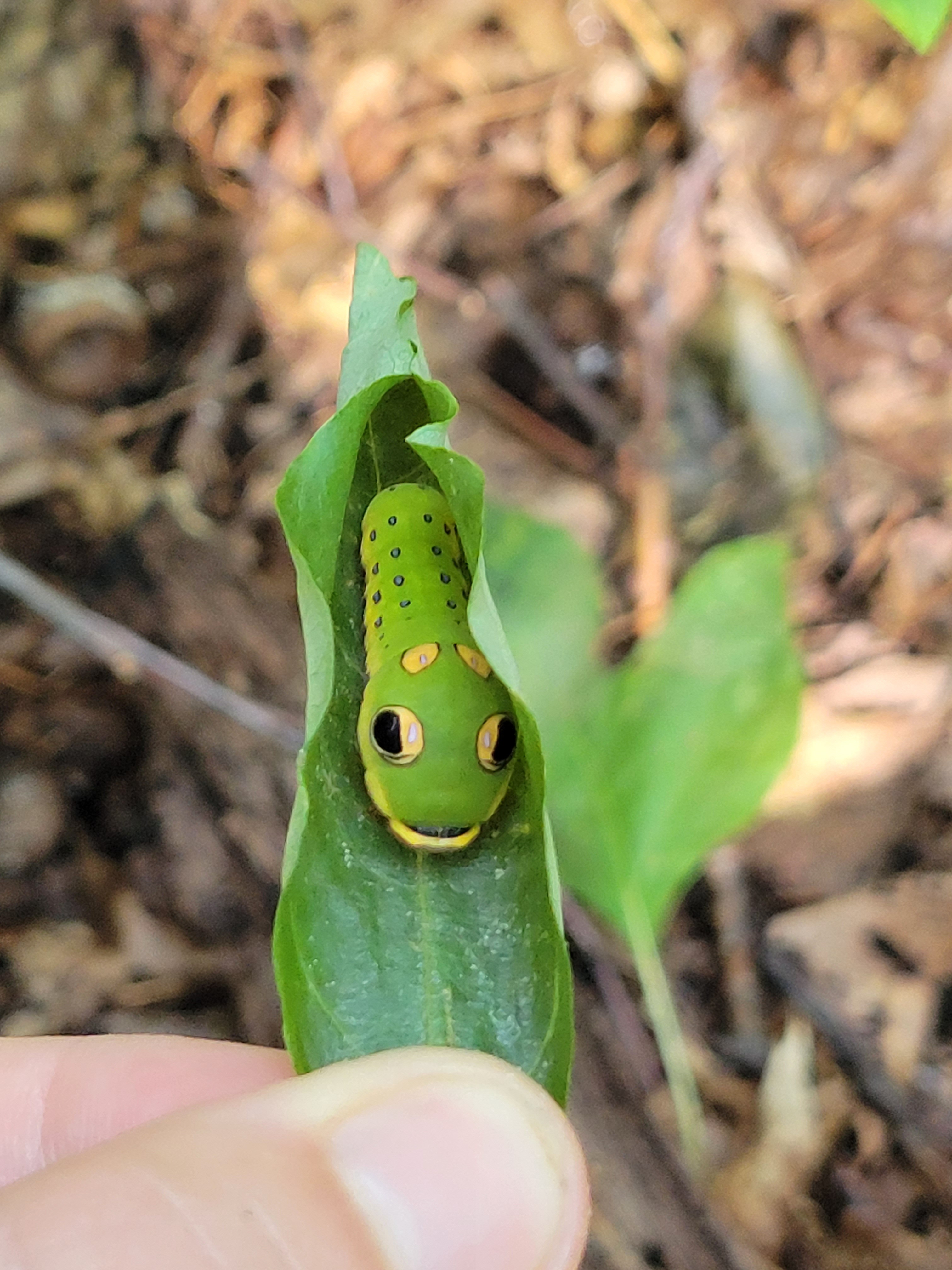
In this paper, I was interested in how the behavior of a prey animal might impact the effectiveness of its defensive visual signal, mediated through the host plant architecture. I worked with spicebush swallowtail (Papilio troilus) caterpillars to answer this question, as this species has highly conspicuous eyespots, but also creates rolled leaf shelters to hide out in. This combination struck me as a paradox: why have such a conspicuous color pattern if, most of the time, that pattern is hidden?
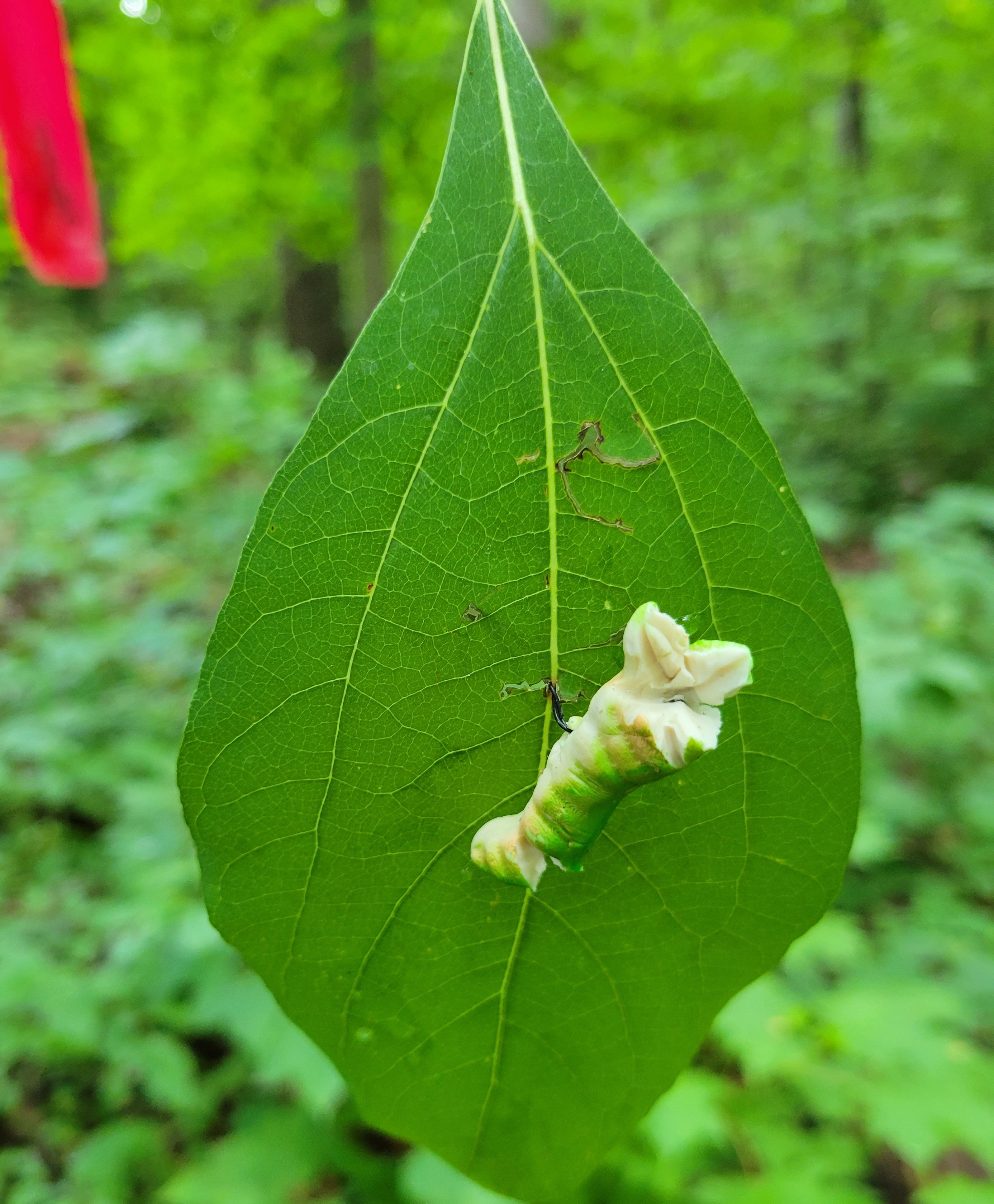
I suspected that this might be a way for individuals to resolve the need for eyespots to be sufficiently intimidating to predators without being too visible. If a predator has plenty of time to check out eyespots from afar, they might start to see through the bluff! Fake eyes may ultimately be more startling to predators if they are only revealed at the last second – hence the “peek-a-boo” image in the title. From this idea I set up a simple factorial experiment: make clay caterpillars with and without eyespots, put them on open leaves or in leaf rolls, and see which group gets attacked most.
I found that not only are leaf rolls good at protecting prey regardless of color pattern, but that they defend prey even better in tandemwith eyespots. So there’s a fascinating synergy between behavior, morphology, and environment that helps the caterpillar stay alive. I think this is a pretty ingenious evolutionary solution for a species that is, in some sense, stuck in place as a juvenile.
Were you surprised by anything when working on it? Did you have any challenges to overcome?
I was surprised by the incredible abundance of leaf rolls in forests, and how commonly they are occupied by all sorts of arthropods (particularly spiders). They also have a wide variety of shapes and sizes that are actually pretty easy to spot once you know what to look for. This made me rethink leaf rolls not as a place for hiding, per se, but as a method for obscuring identity. Leaf rolls seem to reduce the information available to potential predators, even if the rolls themselves are relatively easy to find.
Hand-painting all the clay models took a lot of work, but an even greater challenge was transporting them all into the field. I needed to figure out something lightweight enough to fit hundreds of models in a single backpack, and organized enough to keep the two model types separate, without squishing the models together or rubbing their paint off. In the end, I found that the best method was rolling them up in thin bath towels, with a different towel for each model type.
What is the next step in this field going to be?
I would love to do more work characterizing the overall community of leaf-rolling organisms in forest ecosystems. Who builds them? Who occupies them? Are there any physical or behavioral traits that make an organism more likely to create and/or live in a leaf roll? Do these dynamics change over the course of a season, or in response to different climatic conditions? I have a lot of questions about how predator-prey interactions play out in these microhabitats, and how those interactions ultimately shape arthropod diversity and plant-insect relationships.
What are the broader impacts or implications of your research for policy or practice?
This research shows that we cannot understand the ecology of visual signals without factoring in the structure of the natural environment and the behavior of signaling and signal-receiving animals, prey and predator alike. This isn’t a new idea by any means (I am particularly inspired by John Endler’s work here), but what this project does emphasize is that the background for a given signal isn’t some diffuse, unquantifiable thing. Habitats have distinct visual features that can be quantified and/or experimentally manipulated to better understand how predator-prey interactions play out in natural conditions.
About the author:
How did you get involved in ecology?
I became an ecologist in large part thanks to a childhood spent poking around in the woods. I grew up near a small forest and spent a lot of my time there playing in the creek or looking under logs. I also had excellent college biology professors, who helped me see the connections between my artistic aspirations and scientific experimentation. By the end of my freshman year, I had already changed my major from Studio Art to Biology. When I figured out that I could make a career out of, essentially, running around the woods, how could I do anything else with my life? One fun thing about this paper is that I conducted all the experiments and surveys in my home town (Ann Arbor), in the same parks and preserves that inspired my love of ecology in the first place! So this project, for me, was a big “full circle” moment.
What is your current position?
I am currently a postdoctoral researcher at the Field Museum of Natural History in Chicago, working in the insect collections with the curator Bruno de Medeiros. For more details on what I do now, check out my website: https://egpostema.github.io/elizabeth-postema/
Have you continued the research your paper is about?
In a sense, yes, but with very different methods. I remain fascinated by the many strategies insects use to avoid predation, and how these strategies are shaped by conflicting selection pressures. I see my earlier field work on leaf rolls as one test case for this much broader research program. As a postdoc at the Field, I now have access to millions of pinned insects, so I am able to ask much bigger questions. I am currently working with an AI pipeline I developed called DrawerDissect (preprint: https://ecoevorxiv.org/repository/view/9647/) to photograph and extract morphological data from thousands of insect specimens at a time. With this and other AI-based pipelines, I can investigate the ecology and evolution of insect phenotypic traits on a global scale. Ultimately, I plan to integrate these two methods: big-picture analyses to coordinate observations across many taxa, and targeted field experiments to investigate specific hypotheses.
What one piece of advice would you give to someone in your field?
It might seem obvious, but my biggest piece of advice for any ecologist is to spend a lot of time in nature. Let the pattern recognition part of your mind run wild when you’re outdoors. Allow yourself to notice details, no matter how mundane they may seem. By doing this you will train yourself to see connections between things that might get filtered out otherwise. Human brains are remarkably good at “blurring out” information that doesn’t seem immediately relevant. Becoming a better ecologist requires you to actively work against that neural filter. This is, in some ways, rather similar to how you become a better artist; letting go of what you think an object looks like, and instead, really looking at it.
 Animal Ecology in Focus