Garrett Hopper provides the story behind his paper, “A test of the loose-equilibrium concept with long-lived organisms: evaluating temporal change in freshwater mussel communities“, which was shortlisted for this year’s Elton Prize. We also hear a little about his journey into animal ecology.
About the paper:
What is your shortlisted paper about, and what are you seeking to answer with your research?
We worked with long term monitoring datasets for freshwater mussels to address the age-old question, “are animal assemblages changing over time and does temporal change vary among ecosystems?” We couched our questions within the loose-equilibrium concept which acknowledges that ecologists should expect some level of temporal variation in assemblages in response to natural disturbance regimes, but essentially the same assemblage should be expected over time unless some disturbance beyond that which the assemblage is adapted to occurs, which would result in consistent directional change away from the expected assemblage composition.
Were you surprised by anything when working on it? Did you have any challenges to overcome?
That the assemblages were temporally variable could surprise folks less familiar with mussels because generalized descriptions of mussel assemblages include terms and phrases like, “long-lived”, “sedentary”, “spatially and temporally stable”, which suggest these assemblages should change little through time. To those more familiar with the vast differences in life history strategies exhibited by cooccurring mussel species, I think the temporal changes we described would be expected. Not to mention the level of imperilment faced by freshwater mussels caused by factors such as river channelization, impoundment, and pollution to name a few, and many assemblages are now changing rapidly for unknown reasons.

What is the next step in this field going to be?
Finding creative ways to continue monitoring mussels is critical. Monitoring programs like the ones that produced the datasets for this paper are often not valued as stand-alone efforts. However, monitoring is our connection to the natural world and provides critical data on the status and trends of mussels and the condition of their habitats. Designing monitoring programs around key questions in mussel conservation and management is the next step in ensuring that monitoring efforts are thoughtfully designed, rigorously conducted, and are flexible enough to be improved after re-evaluation.
What are the broader impacts or implications of your research for policy or practice?
Researchers and managers working with assemblages of long-lived animals, like mussels, need information on the form assemblage change may take and the species composition and factors causing change. Our paper shows a wide range of possible assemblage trajectories associated with a broad ecological gradient that could inform conservation practitioners attempting to maintain or create a desired assemblage condition.
About the author:
How did you get involved in ecology?
My earliest memories of catching sunfish on cane poles with my grandpa in eastern Oklahoma always come to mind when I’m asked this question. I do think those early experiences instilled a deep appreciation for the natural world within me, but I became interested in studying ecology through a combination of undergraduate research positions in aquatic ecology, good experiences with encouraging mentors, and coursework. In graduate school, I was always fascinated by theories that tried to explain the complexity of ecology, and I was encouraged by my mentors to collect data to address questions guided by these theories. I always found it remarkable that data collected in the field could be translated in meaningful ways to advance our understanding of the world around us. I don’t go fishing as much as once did, however I’d like to think my research will help conserve natural ecosystems, so others can have opportunities to appreciate time spent in those places with their family.
What is your current position?
I am an Assistant Professor in the School of Renewable Natural Resources at Louisiana State University. I teach undergraduate Ichthyology and Biology of Fishes courses, and a graduate student seminar about Mussel Ecology and Evolution.
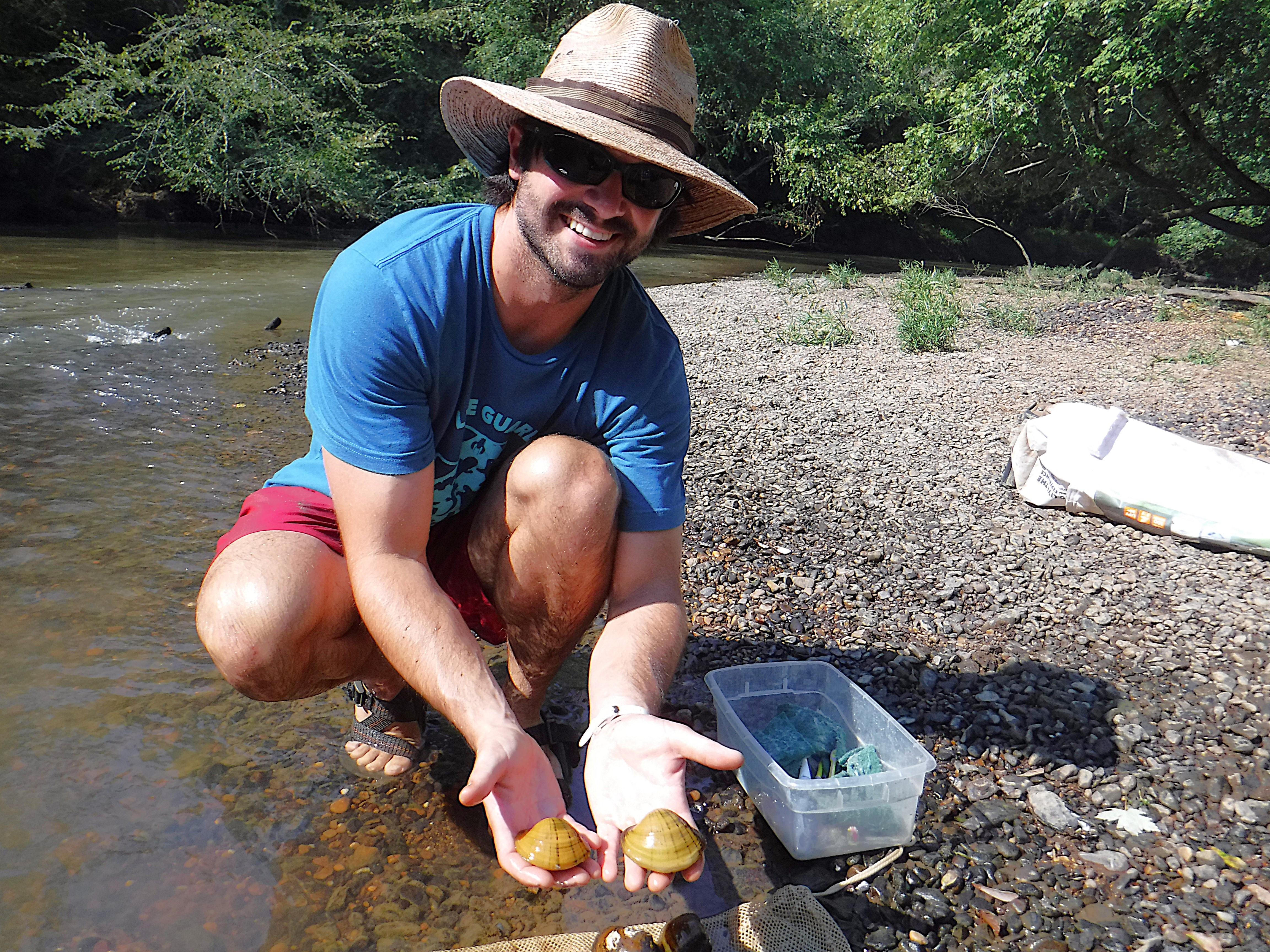
Have you continued the research your paper is about?
I have continued to develop new research projects around monitoring mussel assemblages. I maintain active collaborations with many of the co-authors from this publication. In fact, a few of us are participating in a special session on critical data needs for freshwater mussel conservation at an upcoming conference. I’ve also been working with members of the Freshwater Mollusk Conservation Society’s Ecosystem Services & Field Studies Committee to develop a report style publication format to encourage more submissions of mussel monitoring datasets. The idea is to ensure that monitoring datasets are published and accessible to scientists, while easing the burden of putting together a typical article. Most of this work falls under the umbrella of collecting rigorous monitoring datasets around focus questions, encouraging data sharing, and preventing the permanent loss of important datasets that could result in better conservation and management of mussels.
What is one piece of advice would you give to someone in your field?
I encourage other ecologists to foster relationships with people in their field, as well as people in other fields. Science is increasingly collaborative and having a diverse team will improve the quality of your work.
 Animal Ecology in Focus