Leonna Szangolies (she/her) provides the story behind her paper, “Individual energetics scale up to community coexistence: Movement, metabolism and biodiversity dynamics in fragmented landscapes“, which was shortlisted for this year’s Elton Prize. We also hear a little about her journey into animal ecology.
About the paper
What is your shortlisted paper about, and what are you seeking to answer with your research?
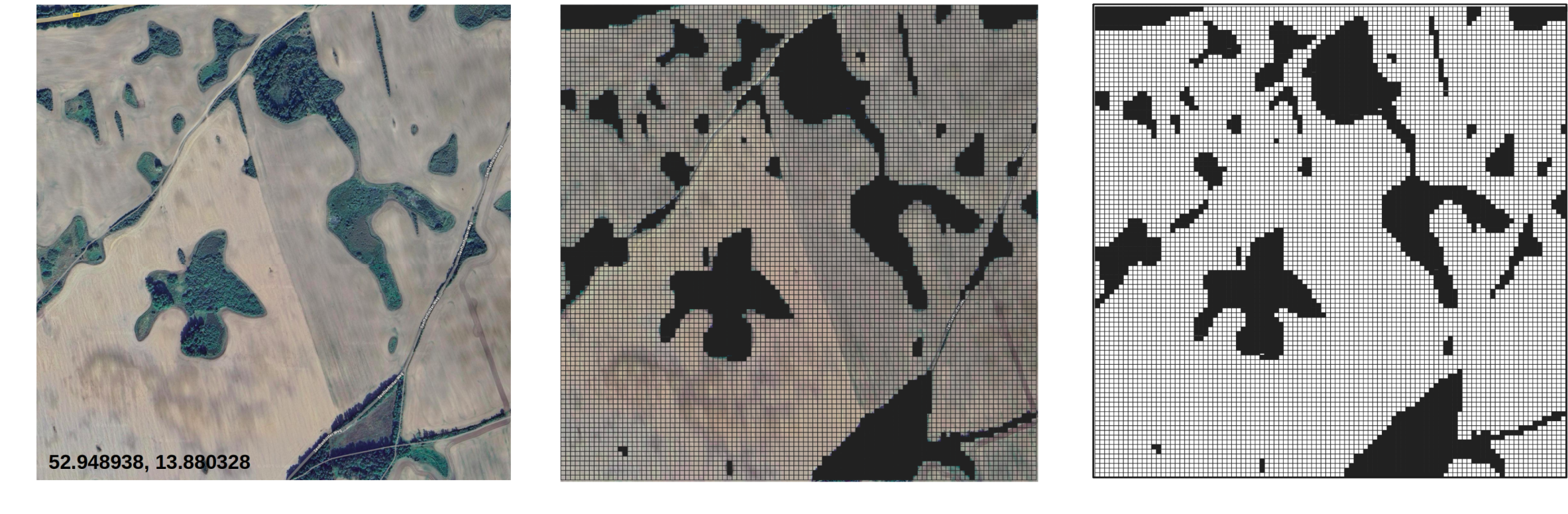
One of the key questions in ecology is why species coexist. In order to take a step towards answering this, we developed a novel individual-based metabolic community model, revealing a correlation between similarity in energy balance and species coexistence. Our findings suggest that energetics, currently rarely considered in community ecology, offers a new perspective of understanding coexistence and community dynamics. This is particularly relevant to predict and preserve biodiversity under ongoing environmental change. We used our model to specifically examine the impact of habitat fragmentation on mammal community diversity, demonstrating peak coexistence at moderate fragmentation levels, where species exhibited similar energy balances.

Were you surprised by anything when working on it? Did you have any challenges to overcome?
Whilst we faced several challenges when implementing and parameterizing our energetic community model, such as limited data for energetic costs of processes or diverging theories on energy allocation strategy of animals, we were excited by how well our emerging model outputs matched patterns from literature data. Furthermore, although we were convinced that energetics play a role in community dynamics, we did not necessarily expect the strong correlation of similarity in energy balance and species coexistence. This fascinating result was a main outcome of this study, additionally to the benefit of intermediate habitat fragmentation for biodiversity which is particularly interesting for nature conservation.
What is the next step in this field going to be?
The predictions from modelling results can motivate experiments and field studies. The hypothesis that intermediate fragmentation benefits biodiversity should be studied in real landscapes before application on a large scale for nature conservation. Similarly, the hypothesis that similarity in energy balance favors coexistence can be tested in experiments measuring energy intake and expenditure of coexisting species. We generally suggest to apply energetics in community studies, not only in modelling, to advance future research and biodiversity conservation. The presented, validated metabolic community model may therefore be applied to other global change effects and extended to other trophic levels and interaction types.
What are the broader impacts or implications of your research for policy or practice?
Our demonstration of the energetic conditions under which coexistence is likely can be extrapolated to general theory and provide a new understanding of coexistence. This understanding is crucial to develop conservation measures, possibly even addressing the energy balance of species. Examples include feeding to increase energy intake and providing easily navigable movement corridors to reduce costs. Based on our findings, landscape conservation measurements may focus on intermediate fragmentation, which proved beneficial for biodiversity. While we are not suggesting fragmenting existing large habitats, the relevance of smaller habitat fragments should not be neglected, contributing to an overall moderately fragmented landscape and providing important functions.
About the author
How did you get involved in ecology?
After I finally got my long-awaited dog as a child, I spent most of my free time outside in the woods and fields. This fostered my interest in biodiversity and nature. To give this interest a solid background, I began studying biomathematics, which taught me a lot of theory about biological processes. I see huge value in this theoretical approach, but I also wanted to get more insights into hands-on nature conservation. My bachelor’s in biomathematics together with my master’s in ecology, evolution and nature conservation provides the perfect basis for me to study and understand ecological processes and suggest conservation measures.
What is your current position?
I have been working as a PhD candidate at the University of Potsdam in the graduate school BioMove for the past three years. I submitted my PhD thesis in January and the defense is already planned. Afterward, I have a one-year postdoc position in the working group Plant Ecology and Nature Conservation at the University of Potsdam to continue my research and prepare my own project proposal for a DFG grant.

Have you continued the research your paper is about?
Using the validated metabolic community model, presented in this study, I have continued by simulating scenarios of multiple global change effects. A study on habitat fragmentation in combination with climate change-induced drought events underlined the value of intermediate habitat fragmentation for coexistence even in the presence of other stressors. Additionally, the relevance of energetics for coexistence motivated me to develop a conceptual framework linking individual energetics, movement, and species coexistence. In my future research, I will continue developing and testing coexistence theory by integrating individual-level processes through using available literature, simulation modeling, and integrating experimental data.
What one piece of advice would you give to someone in your field?
I would generally suggest an interdisciplinary view of ecological processes and patterns. My research integrates several ecological disciplines including ecophysiology, movement ecology, community ecology, and biodiversity research, and uses methods from mathematics and computer science, thus being highly interdisciplinary. I would strongly suggest community ecologists to consider individual-level processes, particularly individual energetics to better understand coexistence patterns. Similarly, I would advise researchers focused on individuals, to also take into account the community level. I would also suggest ecologists to value the potential of theoretical modelling and ideally better combine experiments and modelling to increase trust and applicability of results.
 Animal Ecology in Focus