Maria del Mar Labrador (she/her) provides the story behind her paper, “Host space, not energy or symbiont size, constrains feather mite abundance across passerine bird species“, which was shortlisted for this year’s Elton Prize. We also hear a little about her journey into animal ecology
About the paper
What is your shortlisted paper about, and what are you seeking to answer with your research?
This paper asks a simple but fundamental ecological question: what determines how many symbionts a host species can sustain? By analysing a large dataset on feather mite abundance across many bird species and applying a framework based on metabolic theory, we tested whether their numbers are limited by host energy (like gland secretions) or by space (wing area and feather structure).
Our results show that space—not energy—sets the upper limit to feather mite populations, specifically the number of feather barbs mites can occupy. This challenges common assumptions in macroecology and helps us understand how host traits shape symbiont communities.
More broadly, this research aims to understand the fundamental mechanisms that regulate symbiont abundance across species and to shows how ecological theory can be applied to host–symbiont systems.
Were you surprised by anything when working on it? Did you have any challenges to overcome?
The biggest challenge was applying Hechinger’s (2013) quantitative framework to our system. We are not mathematicians, so it took us quite a while to make sure we were using the equations correctly and adapting them to our study system. We had to think carefully about which variables really mattered and how the biology of feather mites and birds could fit into his theoretical framework.
Although this was the hardest part, it was also the most rewarding. Working through the framework helped us understand our system much better and showed us how useful this type of quantitative approach can be in ecology. This work made me less afraid of dealing with mathematical tools and more open to using quantitative approaches in the future.
What surprised me most was how clearly space emerged as the limiting factor once we applied the framework properly. I was also surprised to see how feather barb length and number changed with bird size. It was something I had never really thought about before.
What is the next step in this field going to be?
The next step in this field is to move from describing patterns with formulas to understanding the processes that create them. Our study suggests that space can limit feather mite abundance across bird species. One of the challenges now would be to identify the ecological processes causing this spatial limit, such as competition or density dependence.
Also, future research should test whether similar limits occur in other host–symbiont systems to help us understand symbiont abundance in general.
What are the broader impacts or implications of your research for policy or practice?
Our study shows that the number of symbionts a host can support is not always limited by energy, as traditionally assumed, but sometimes by space. By demonstrating that structural traits such as feather barb number can constrain feather mite populations, we highlight the importance of understanding the study system and incorporating organisms´ biology into ecological theory.
Moreover, our work employs a framework that imporves predictions of symbiont abundance by integrating biological realism into theoretical models. This approach can be extended to other host–symbiont systems, including parasites of conservation or veterinary concern.
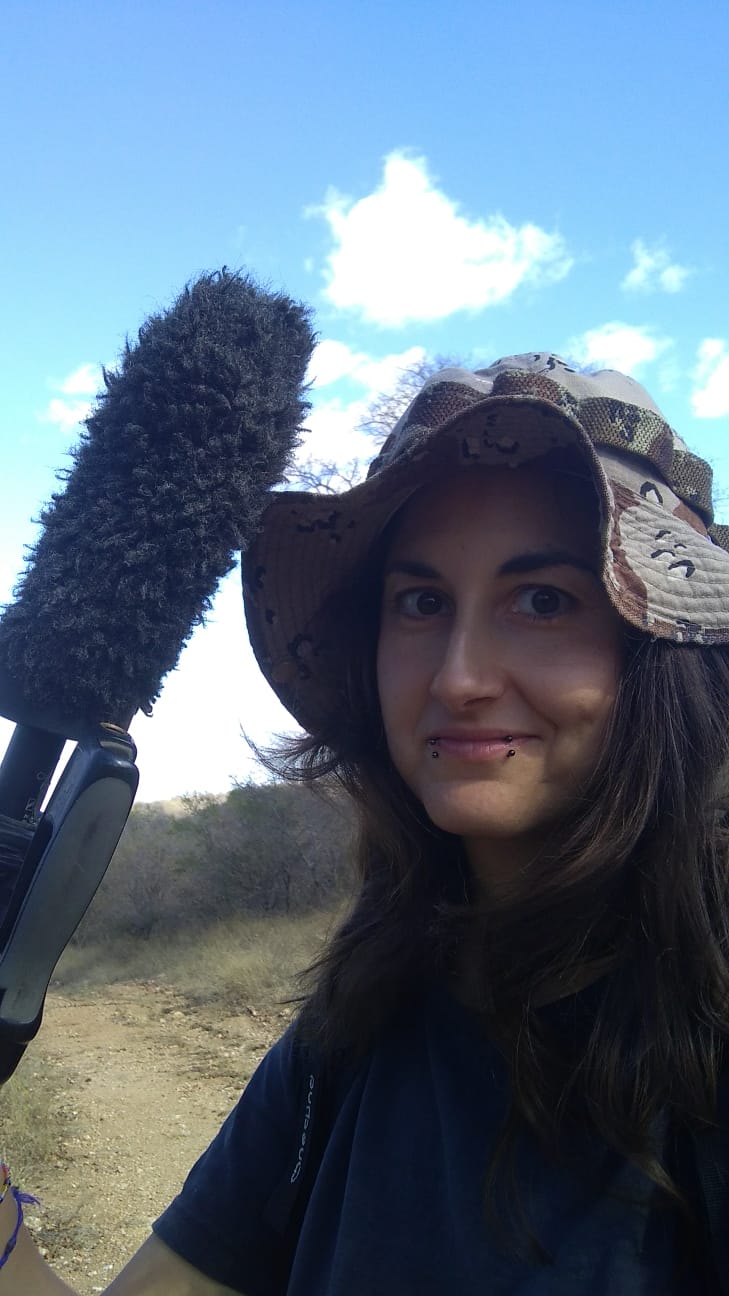
About the author
How did you get involved in ecology?
My interest in ecology did not come from my family or from growing up close to nature. However, since I was a child, I have always been curious about the natural world. This interest started with the books my parents had at home and grew stronger thanks to inspiring teachers who encouraged me to study biology.
During my undergraduate studies, I was not sure which area of science I wanted to follow. I joined a research group working on cyanobacteria in water reservoirs, studying the toxins they produce and their seasonal dynamics. This was my first real experience in ecology research.
At the same time, I discovered ornithology, and birds quickly became my main interest. I decided that I wanted to focus my career on them. I later received a grant that allowed me to do a PhD on the interaction between passerine birds and the tiny mites that live on their wings. These mites are often seen as parasites, but our research group showed that their role is more complex than many people think.
Apart from cyanobacteria and feather mites, I have also studied mammal ecology when I joined a project studying social interactions within and between groups of dwarf mongooses. Working in a different system helped me see ecology from a broader perspective and strengthened my interest in studying interactions at different levels.
I am naturally curious, and I find it hard to focus on only one topic. Although academic careers often reward specialization, I enjoy being involved in different projects. For me, ecology is about understanding connections between organisms and their environment, and that is what continues to motivate me.
What is your current position?
I am currently finishing a postdoctoral position at the Doñana Biological Station (CSIC). In this role, I have worked on a project aimed at quantifying animal mortality in Spanish wind farms and evaluating the effectiveness of different anti-collision measures implemented there.
Although this research is not directly related to my previous work, it has given me the opportunity to learn a great deal about renewable energy and its ecological impacts. It has also helped me better understand the challenges of balancing biodiversity conservation with the transition to cleaner energy sources.
At the same time, while I look for future positions, I collaborate with my ringing group to analyze and publish data from several interesting long-term projects. Staying connected to this work is very important to me, as it allows me to continue contributing to more basic and observational ornithological research.
Have you continued the research your paper is about?
I published one additional article on feather mites and birds after the prize-nominated paper. However, that study did not focus on the same specific questions. In the nominated article, one of the most important aspects for me was the conceptual framework we used and adapted. Although my current projects have shifted, the questions raised in that study are still relevant, and they could be revisited in different contexts in the future.
What one piece of advice would you give to someone in your field?
Spend time observing your system. Not just collecting data, but watching, reading, and exploring to understand what is actually happening. Ecology can become abstract very quickly, but in the end it is about real organisms in real places.
Also, accept that uncertainty is part of the job. Results will be messy, projects will change direction, and plans will fail. It is just how research works.
Finally, talk to people. Share ideas, ask questions, build collaborations. Good contacts are not just useful for your career — they genuinely improve your science.
 Animal Ecology in Focus