Martin C. Arostegui (he/him) provides the story behind his paper, “Cranial endothermy in mobulid rays: evolutionary and ecological implications of a thermogenic brain“, which was shortlisted for this year’s Elton Prize. We also hear a little about his journey into animal ecology.
About the paper:
What is your shortlisted paper about, and what are you seeking to answer with your research?
The ability to maintain elevated body temperature relative to the environment, known as endothermy, is exceedingly rare among fishes. Manta and devil rays (i.e., mobulids) are suspected of exhibiting this trait in their cranium but the mechanism by which they generate heat is unknown. Drawing on parallels from brain size evolution in homininds and cetaceans, I theorize that the large, metabolically expensive brain of mobulids may act as a thermogenic organ. However, the potential for brain enlargement to yield the dual outcomes of cranial endothermy and enhanced cognition suggests one may be an evolutionary by-product of selection for the other. This emphasizes the need to account for non-cognitive functions when translating brain size into cognitive capacity in animal research.
Were you surprised by anything when working on it? Did you have any challenges to overcome?
I was most surprised that, nearly 30 years after mobulid rays were first theorized to be cranially endothermic, the mechanism by which they generate heat remained unexplored. This is in stark contrast to the long history of literature exploring endothermy in tunas, for example, and the immense research and conservation interest in mobulids as charismatic and endangered megafauna. What I found most challenging was that none of the heat-generating mechanisms known from other fishes seemed to fit, which required me to branch into fields of inquiry that I had no prior experience in. But at the same time, this drove my interest in researching and proposing a novel solution to this puzzle at the intersection of anatomy, physiology, evolution, and ecology.
What is the next step in this field going to be?
This ecological-evolutionary mystery is multifaceted but two steps in particular strike me as the most important. Currently, cranial endothermy is morphologically inferred to be present in these species but is not yet definitely proven, such as via tissue-temperature measurements of a live animal. Thus, testing this fundamental assumption is critical but challenging due to the need for non-invasive sampling of these protected species. In tandem, clarifying the extent and diversity of this trait within the genus is key to understanding its evolutionary history, trajectory, and contemporary implications.
What are the broader impacts or implications of your research for policy or practice?
In the marine environment, endothermic species are thought to exhibit trophic and competitive advantages relative to their ectothermic counterparts, especially in cold waters where the latter’s performance is thermally limited. However, endothermy does not come without risk as the higher energetic demands of this strategy can elevate susceptibility to extinction during periods of low food availability. If mobulids are in fact endothermic, it could exacerbate their population decline as the ocean warms and becomes less productive.
About the author:
How did you get involved in ecology?
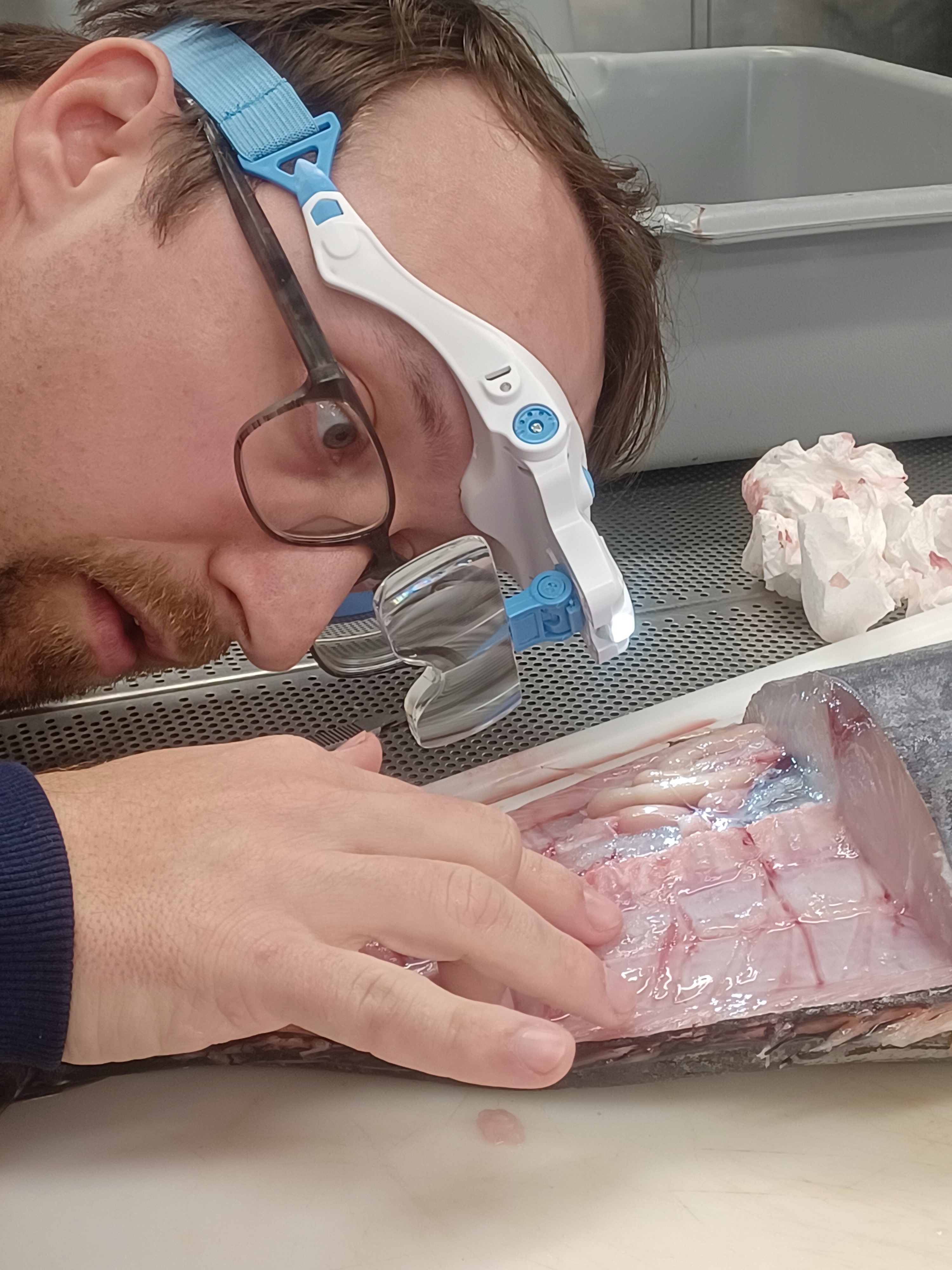
I was raised always being on, in, or near the water, particularly fishing and spearfishing. My passion for these activities grew into one for the conservation of fishes and their habitats and, eventually, doing the science that would improve our understanding and management of them. Blending my years of experience in the field with my formal academic education in ecology rapidly catalyzed my passion into a focused drive and capacity to tackle as many knowledge gaps about fish as I can. Consequently, I value both basic and applied fish ecology projects.
What is your current position?
I am a Research Associate III within the Marine Predators Group of the Biology Department at Woods Hole Oceanographic Institution. In this position, I primarily work on large marine predator fishes, such as tunas, billfishes, and sharks, focusing on their movement, trophic, and physiological ecology, ecosystem linkages to the mesopelagic zone (200 – 1,000 m), and fisheries management and conservation. However, the topic of endothermy in fishes is of particular interest to me, both the morphological adaptations that enable it and the ecological advantages it provides.
Have you continued the research your paper is about?
In collaboration with an international team from the United States, United Kingdom, and Australia, I’ve been working to acquire the data that would allow for interspecific comparison and phylogenetic contextualization of cranial endothermy in mobulids. Consistent with the path forward I proposed in my concept paper, we have been conducting computational scientific imaging on these megaplanktivores to visualize the focal, endothermy-related anatomical tissues in high resolution and tackle the pressing questions about this rare metabolic phenotype.
What one piece of advice would you give to someone in your field?
Always strive to be increasingly interdisciplinary. The ability to see an ecological problem from more perspectives not only will enhance your ability to answer it but will also improve the depth and nuance of that answer. In time, what were once superficially disjointed pieces of information will intertwine to reveal previously hidden processes of the natural world. By collaborating with experts of varying specialties and teaching yourself new skills from other disciplines, you will dramatically improve your efficacy as a research scientist.
 Animal Ecology in Focus