Traditionally one of the UK’s most charismatic (and certainly distinctive) mammals, the badger has received mixed attention in recent times as a result of their involvement in disease transmission. To celebrate National Badger Day, Dr Andy Robertson describes the long-term study of these animals in Woodchester Park. Dr Robertson is a NERC Knowledge Exchange Fellow at the University of Exeter’s Environment and Sustainability Institute, and … Continue reading Badgers and Disease Ecology
World Giraffe Day celebrates the longest-necked animal on the longest day (or night, depending on your hemisphere!) of the year – 21st June. Yet many aspects of giraffe ecology remain poorly studied. Dr Kim VanderWaal, a researcher at the University of Minnesota, studies how animal social behaviour translates into contact networks and pathogen transmission patterns. To mark World Giraffe Day, she tells us about her … Continue reading Social networks and disease transmission – A story of giraffes
Earlier this month, the European Cetacean Society (ECS) held their 31st annual conference in Middelfart, Denmark. Established in 1987, ECS has several hundred members from more than 25 European countries as well as several countries outside Europe. It aims to promote and advance the scientific studies and conservation efforts of marine mammals, and to gather and disseminate information about them to members of the Society … Continue reading Marine Mammal Conservation in the Light of Marine Spatial Use
Movement is fundamental to organismal life and constitutes the mechanistic link explaining the patterns observed in many ecological processes. Measures of animal movement, e.g. dispersal, residence time, home range size and overlap, form the basis of fundamental ecology theories and are essential for managing wildlife populations or predicting disease transmission rates. Hence research on the patterns, causes and consequences of the movement of organisms has pervaded … Continue reading Get the BES moving! BES Movement Ecology Special Interest Group Launch
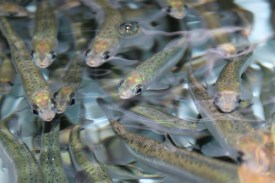
Using tags surgically implanted into thousands of juvenile salmon, University of British Colombia researchers have discovered that many fish die within the first few days of migration from their birthplace to the ocean. Continue reading “Salmon smolts find safety in numbers”
Taken from GPS collars equipped with wide-angle cameras, these amazing shots represent an unprecedented window into the lives of reindeer, one of the most ancient deer species in the world. Few people are aware that within the heart of Europe there still exist mass migrations as spectacular but more secretive than those in the Serengeti. Yet, reindeer migrations represent one of the most endangered phenomena in the Northern hemisphere. Wild reindeer are extremely wary of humans, who have been harvesting them since pre-historic times using large-scale pitfall systems. Their anti-predator strategy consists of aggregating in large herds roaming across vast mountain plateau in southern Norway, and avoiding human activities. Following the industrial revolution, the development of anthropogenic infrastructures has therefore led to the fragmentation of the last remaining wild mountain reindeer population into 23 virtually isolated sub-populations, and has hampered/blocked migration routes used since pre-historic times. Due to the increase in tourism, hydropower and other human activities in mountain areas, fragmentation is rapidly ongoing. Continue reading “The secret life of wild reindeer”


 This post is a press release from the authors of Journal of Animal Ecology paper “
 Animal Ecology in Focus