We are delighted to announce Leonna Szangolies as the 2024 winner of our Elton Prize early career researcher award
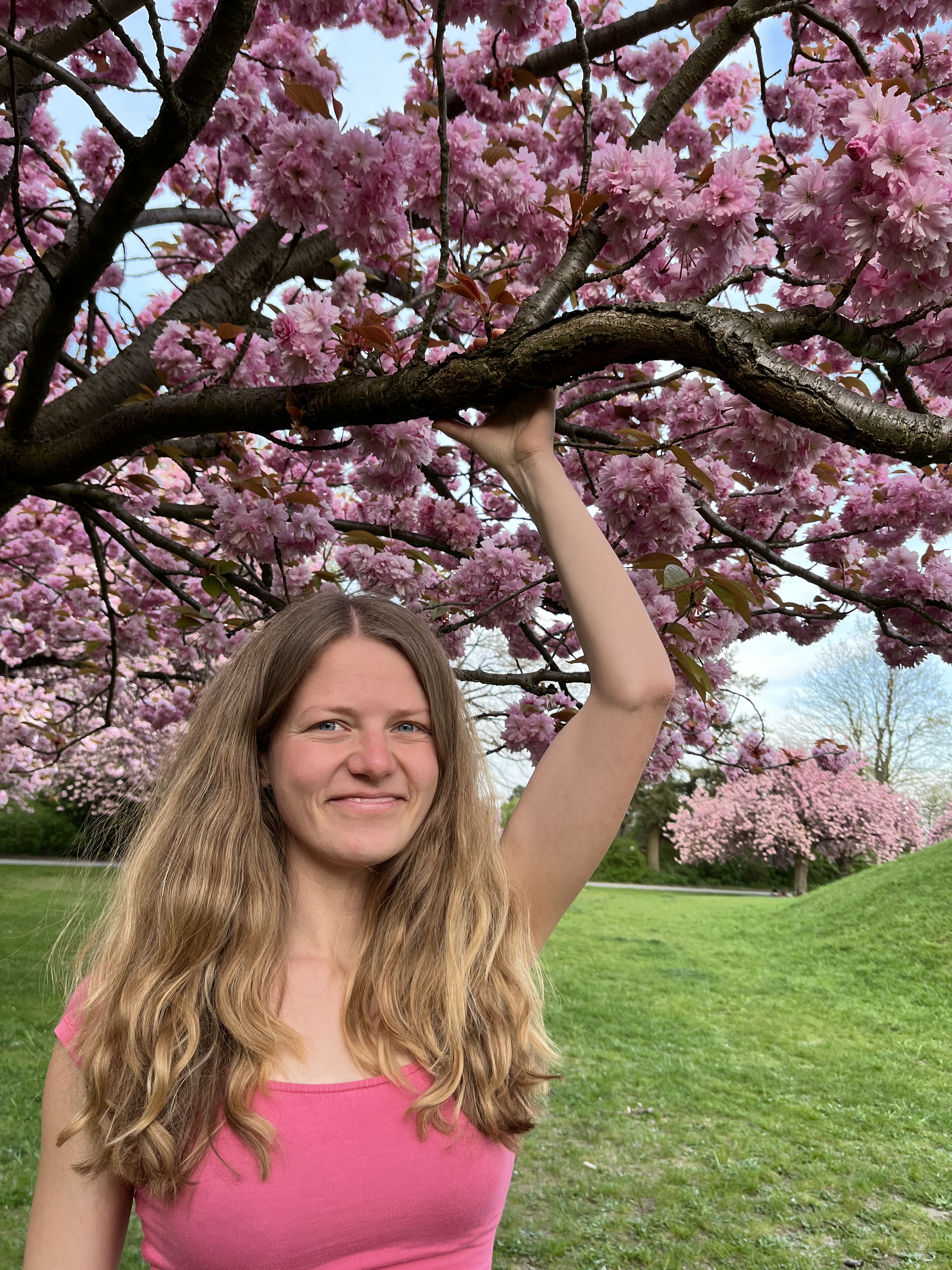
Leonna received the award for her paper, “Individual energetics scale up to community coexistence: Movement, metabolism and biodiversity dynamics in fragmented landscapes“. The award is given to the best article in the journal by an author at the start of their career and was picked from a shortlist of 9 articles.
Could you give us a bit of background about yourself and how you got into ecology?
I grew up in a small village near Berlin, Germany, where, as a child I spent most of my free time outside with my dog. This sparked my fascination with biodiversity and nature and led me to pursue a Bachelor’s in Biomathematics, where I gained a strong theoretical foundation in biological processes. To bridge the gap between theory and practice, I then completed a Master’s in Ecology, Evolution, and Nature Conservation. This combined academic experience enabled me to both analyse ecological processes and propose conservation strategies. Many of my research ideas are still born on long dog walks out in the nature.
Can you summarise the research in your paper and how it advances the field?
To preserve high biodiversity, species need to coexist. Therefore, understanding and fostering coexistence processes is key for biodiversity conservation. Contributing to an understanding of coexistence mechanisms and how they are influenced by global change, I developed a novel individual-based metabolic community model, which I used to study species coexistence in fragmented landscapes. This resulted in a correlation between similarity in energy balance and species coexistence, revealing the important role of individual energy dynamics for coexistence. Offering a new perspective of understanding coexistence, the integration of energy dynamics advances the field of community ecology, particularly considering ongoing environmental change. When simulating differently fragmented landscapes, we found highest diversity and coexistence at moderate habitat fragmentation levels, where species exhibited similar energy balances. Hence, besides advancing community theory, this research can contribute to the development of effective nature conservation strategies.
Have you continued this research and if so, where are you at now with it?
Using the same validated metabolic community model, I have continued by examining additional scenarios of multiple global change effects. Studying habitat fragmentation in combination with climate change-induced drought events revealed that intermediate habitat fragmentation buffered negative drought effects best, hence underlining the former results. Additionally, this study again proved the relevance of energetics for coexistence, and this motivated me to the development of a conceptual framework linking individual energetics, movement, and species coexistence. This framework reveals many linkages among individual energy and movement dynamics to coexistence and biodiversity, both from my own results and from literature examples, and may foster further research in this direction. I will continue my research by developing and testing coexistence theory based on individual-level processes using available literature, simulation modeling, and integrating experimental data.

What did you enjoy most about conducting this research?
What I really enjoy about my research is the high level of interdisciplinarity and diversity. I get to meet people from different disciplines, all related to my own research, for example when attending ecological modelling conferences or more specific ecology conferences. I also love my research for it’s conceptual nature, drawing higher level conclusions from my modelling results. It is really satisfying when, after long periods of algorithm development, coding and debugging, model outputs suddenly match real-world data and reveal surprising results that make sense and can be scaled up to ecological theory.
Were there any funny experiences or surprising discoveries from this research?
While implementing a model, sometimes frustrating, but also funny interim dynamics emerge, such as superhero voles with infinitive amounts of energy, or ghost individuals which are dead but still moving around. Implementing my energetic community model actually presented several challenges, but its outputs finally remarkably matched literature patterns. From the results, I was particularly surprised by the strong correlation between energy balance similarity and species coexistence, a key discovery of my research additionally to the benefit of intermediate habitat fragmentation for biodiversity. Although I was convinced that energetics play a role in community dynamics, I did not necessarily expect the strong mechanistic link of energy balances and coexistence, which can be very useful for future community ecology.
What does this award mean to you?
It is a great honour to be the winner of the Journal of Animal Ecology’s 2024 Elton Prize. I was already satisfied with the publication of my second PhD paper, which is actually my favourite one, in such a remarkable and prestigious journal. Now, the announcement of the prize coincided with the finalization of my PhD thesis and has given me some additional confidence and motivation for my defence and for my future academic career. Winning this award validates mine and my coauthors work and encourages me to continue my research with great passion.
 Animal Ecology in Focus