
Celebrating the best Review or Long-term Studies in Animal Ecology paper by an early career researcher, the Journal of Animal Ecology Editors are pleased to announce the winner of the fourth Sidnie Manton Award as Rebekah Oomen. You can find our Special Issue which includes Rebekah’s paper, alongside our other shortlisted candidates, here.
Rebekah’s winning paper, “genomic reaction norms inform predictions of plastic and adaptive responses to climate change”, explores how genomic reaction norms can be incorporated into a holistic framework to understand the eco-evolutionary dynamics of climate change responses from molecules to ecosystems.
The Journal of Animal Ecology Senior Editors felt Rebekah’s paper provides a clear framework for applying transcriptomics to ecological response predictions. Get to know the winner and the story behind their research in our Q&A below.
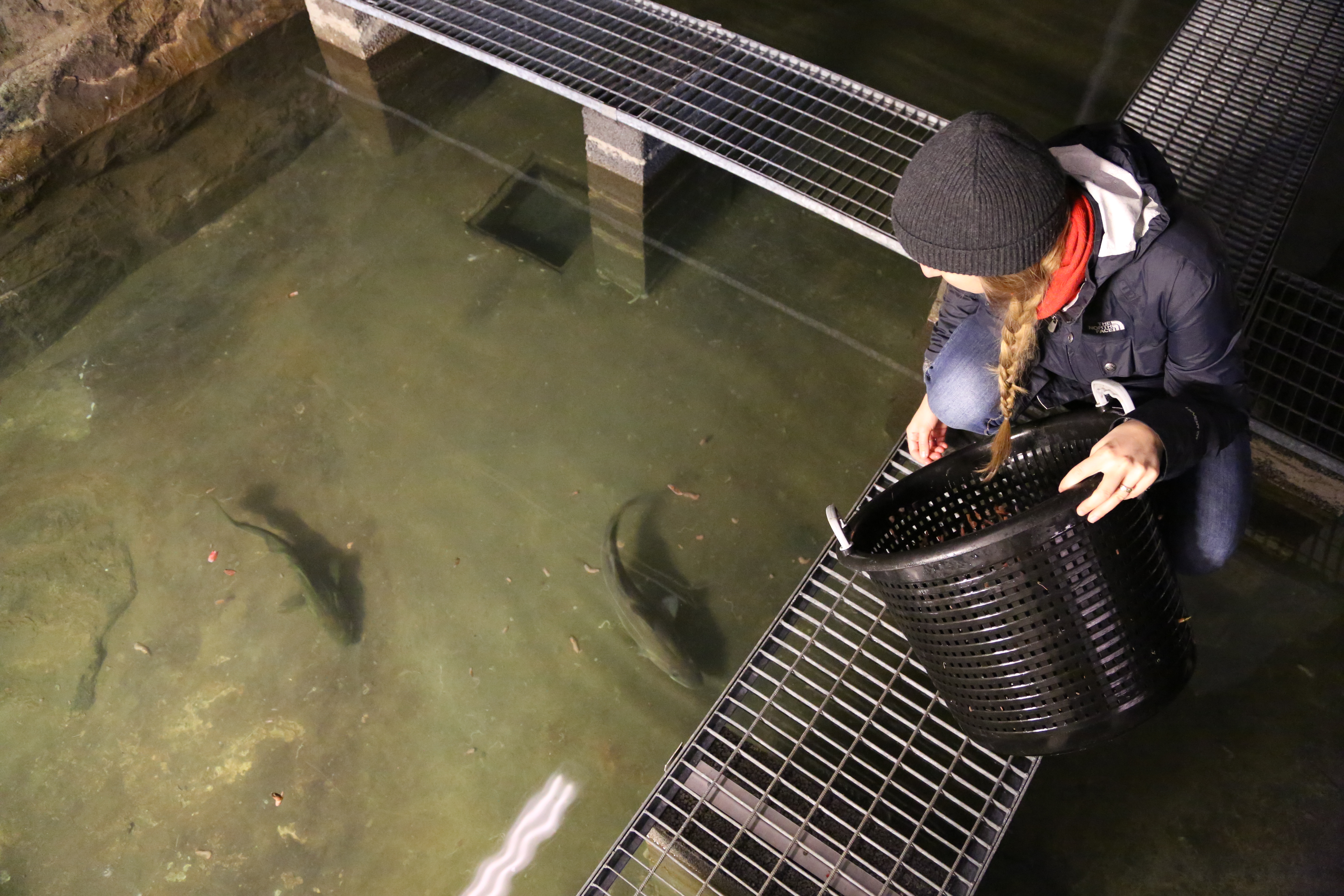
Congratulations on your award! Can you share a bit of background about yourself and how you got into ecology?
Thanks!! I’ve always been interested in non-humans, maybe because I had a pretty outdoorsy childhood growing up in rural Ontario and hiking and camping often. At the same time, I’ve always enjoyed quantitative subjects and problem solving, so I focused on math, chemistry, and physics in high school (biology was taught largely qualitatively at that point). It was in university while pursuing wildlife forensic science that I was introduced to quantitative and population genetics, then to evolutionary ecology, which married my interests in natural animal populations and computational biology.
What did you enjoy most about conducting this research?
This paper on how genomic reaction norms can inform climate change responses stems from the first chapter of my PhD thesis. It lays out the framework on which the rest of my PhD was based. First, I really enjoyed immersing myself in the literature, reading broadly and deeply. Second, I really enjoyed thinking deeply and exploring ideas. It’s a special time at the start of your PhD where you actually have time to think, because the time frame is relatively long compared to a masters and yet you have relatively few responsibilities compared to later in your career. Finally, perhaps my favourite part was sketching out the key figures that formed the basis for the framework. It got my wheels turning in a very satisfying way and I enjoyed the process of getting feedback from both ecologists and geneticists to help make the figures broadly interpretable.

Have you continued this research and if so, where are you at now with it?
The rest of my PhD and much of my work since has built on this genomic reaction norm framework to understand the response of Atlantic cod populations to climate change. I’ve found the framework useful for disentangling genes that are expressed differently across environments (plasticity), between populations (genetic differentiation), and in cases where the response to the environment differs between populations (gene X environment interaction; termed ‘differential plasticity’).
I found sets of genes belonging to each category, which tells us which factors drive innate differences in average thermal physiology among populations and which factors drive variation in thermal plasticity. Thermal plasticity in gene expression is ubiquitous and associated broadly with the universal stress response at higher temperatures that reflect near-term climate warming. Cod ecotypes exhibit differential expression in growth-related genes, but limited differences in thermal plasticity. Independently of ecotype, large chromosomal inversions affect differential expression and/or differential plasticity of specific biological pathways in response to temperature. Overall, the framework described in this paper revealed the disproportionate influence of chromosomal inversions on thermal adaptation and plasticity and showed that the main determinant of gene expression variation depends on the spatial scale examined: at broad spatial scales, the location and/or ecotype was the best predictor of gene expression responses to temperature, whereas at small spatial scales, chromosomal inversions were the best predictor. Inversions might therefore play a major role in (micro)climate adaptation!
 Animal Ecology in Focus