Ying Chi Chan (she/her) provides the story behind her paper, “Ontogeny of migration destination, route and timing in a partially migratory bird“, which was shortlisted for this year’s Elton Prize. We also hear a little about her journey into animal ecology.
About the paper
What is your shortlisted paper about, and what are you seeking to answer with your research?
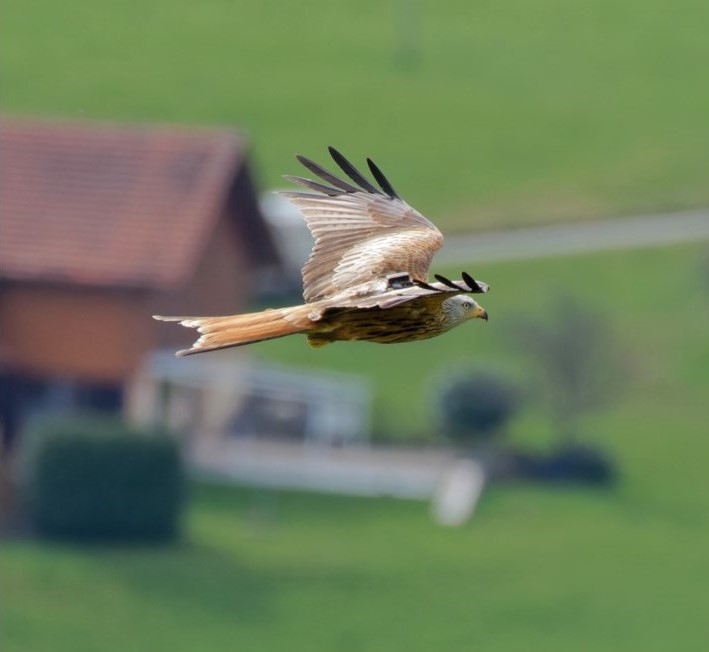
How do migration patterns come about? Part of the answer lies in studying the ‘ontogeny’ of migration, which is how it develops as a bird aged. This has been studied in some bird species, but the red kite (Milvus milvus) population in Switzerland is rather special: unlike a typical obligatory migratory population, it is a partial migrant, in which most juveniles are migratory and many of them become resident later in life1.
But migration is not just a ‘yes/no’ question – what about the route and timing? How do they change with age? The massive GPS tracking dataset collected by the Ecological Research Group at the Swiss Ornithological Institute, of over 330 individuals with 292 tracked since fledging, allows us to investigate this question. Specifically, we explored how migration destination, route, and timing change from age 1 to 5, i.e. from juvenile to breeding adulthood.
We showed a large gradual shift in migration timing as individuals grew older: birds spent less and less time in the wintering area in Iberia/France. We also found an effect of reproductive status: birds migrated later in southward migration in the year prior to territory acquirement, and they further delayed it after occupying a territory. However, they migrated similar distances as they grew older, as they were mostly faithful to their migration destination. Therefore, patterns in how migration timing and destination change with age differ considerably. This information helps us to understand what drives migration patterns in red kites, and to predict how they (and other partial migrants) might respond to environmental changes.
Were you surprised by anything when working on it?
A key question in migration ecology is how flexible species are, as that determines their ability to adapt to rapid environmental changes. It is often thought that ‘hard-wired’ migrants (often long-distance, obligate migrants) are much less flexible than ‘soft-wired’ species (short-distance or partial migrants), and therefore more susceptible to rapid environmental changes.
Coming from a PhD studying long-distance migratory shorebirds—often considered classic examples of ‘hard-wired’ species—I was intrigued by the partial migration system of red kites and excited to study their ontogeny in my first postdoc, expecting the red kites to have considerable variability in migration routes and timing during ontogeny. However, this did not seem to be the case: while we found gradual adjustment in timing with age, individuals consistently returned to the same migration destinations. This might reflect different mechanisms underlying the expression of plasticity in temporal and spatial characteristics. Overall, our study adds nuance to the concept of flexibility, and I look forward to more tracking studies of species of diverse ecological requirements to build a deeper understanding on this topic.
What is the next step in this field going to be?
The last sentence in our paper answered that: ‘To progress towards a better understanding of the mechanisms by which adaptation to rapid global environmental changes can occur, we encourage further investment in tracking migratory species and populations of diverse ecological requirements and life-history strategies from their first migration onwards.’
Tracking birds from their first year is challenging, but more and more researchers are studying it as there are increasing recognition of its importance. Also, advancements in tracking technologies could make it more affordable and feasible in the future. Beyond this, I think that our current knowledge on bird migration, shaped by what has been traditionally studied, has a strong Northern Hemisphere focus and geographic bias. At least for me, the next step is to study species from understudied regions, which could reveal unexpected patterns and offer new perspectives on the current paradigm.

About the author:
How did you get involved in ecology? What is your current position?
I did my Bachelor’s degree in ecology in the University of Hong Kong, and during my Bachelor’s I developed an interest in birds, which has eventually brought me to Europe for an MSc. My PhD at the University of Groningen was about migration of threatened shorebirds in East Asia. In my current postdoc in the Swiss Ornithological Institute, I study migration and dispersal of raptors. My main research interest is the ecology of animal movement and its applications in conservation and wildlife management.
What one piece of advice would you give to someone in your field?
My advice would be to make a conscious effort to step outside the ‘bubble’, whether in research topics, study systems and people. Engaging with people from different backgrounds has been invaluable to me—it has broadened my perspective and sparked new ideas, and it also make our work more accessible and relevant to society.
Ying-Chi’s website: chanyingchi.github.io
Cited Reference:
- Witczak, S., Kormann, U., Schaub, M., Oppel, S., & Grüebler, M. U. (2024). Sex and size shape the ontogeny of partial migration. Journal of Animal Ecology, 93, 406–416. https://doi.org/10.1111/1365-2656.14051
 Animal Ecology in Focus