At JAE we’re taking the opportunity to showcase our wonderful Editorial Board by chatting to our Editors about their research, experience as an editor, and their advice to prospective authors.
Associate Editor Profile
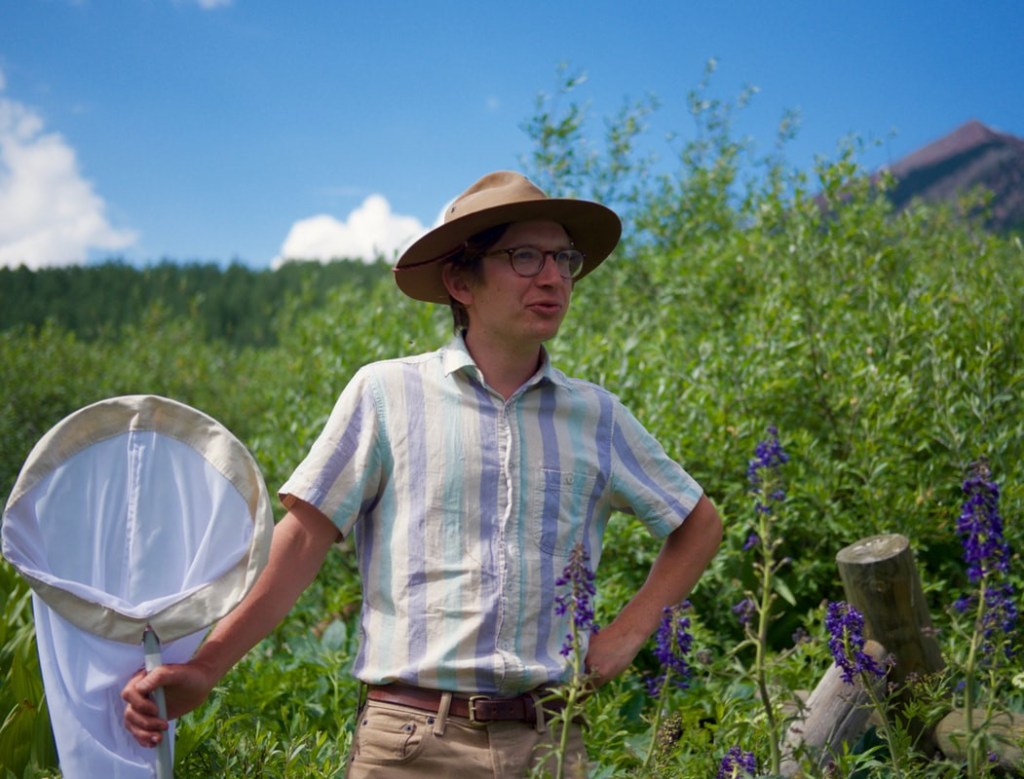
Name: Paul CaraDonna Location: Chicago Botanic Garden, United States Associate Editor since: January 2021 Keywords: bees, community ecology, ecological networks, phenology, plant-pollinator interactions, pollination Website: http://paulcaradonna.weebly.com/ Twitter: @paulcaradonna
Where are you based?
I’m based at the Chicago Botanic Garden, the Rocky Mountain Biological Laboratory, and also Northwestern University. The Chicago Botanic Garden is where my lab is based; I teach at Northwestern; and do my field research at the Rocky Mountain Biological Laboratory.
What do you research and what questions you are trying to address?
My research is aimed at understanding the importance of species interactions for the population and community ecology of plants and animals. We are really interested in exploring species interactions, and most of the time we are thinking about plant-pollinator interactions. But we’re not exclusively tied to mutualism, nor plants and pollinators—that’s just what most of our projects focus on.
Although I am trained as a botanist, I have ended up spending a lot of time thinking about animal pollinators. Some of our research questions are very plant-focused, but others are very animal-focused. For example, we have some cool projects exploring the nutritional ecology of plant-pollinator interactions from a pollinator health perspective. Usually, we want to understand the basic ecology and evolution of species interactions, but we’re asking these questions in the context of climate change, biodiversity declines, and the effects of urbanization. We like to think about these things across animal and plant life cycles, in a demographic context, and from an ecological network perspective. We are trying to understand when the interactions between these parties really have strong effects and when they might be less important. I think there is a lot that we still don’t know especially when we consider the combined effects of changes in abiotic and biotic environments that might really be shaking things up.
What do you think is the future direction for this area of research?
I think the future definitely needs to involve a more mechanistic understanding. Some of the work we are trying to do is to explicitly consider which parts of the life cycle are most sensitive to change and have the strongest effects on population trajectories. What is the predominant factor affecting each life stage? I think there are many things we can do to build up from the population level and connect that to a more community context. Related to that, a lot of my work has focused on ecological networks. Sometimes, I think that perspective can drift a little bit from the biology of the organisms in those networks. I think it is essential to connect the mechanisms operating at the population level to emergent network properties and move back and forth between the two. In my research group, we are trying to bridge the population-community interface and include mechanisms.
How does this research link to broader ecological issues?
What drives my interest in general is understanding how nature works, and these days, understanding how nature works involves comprehending significant perturbations like climate change and biodiversity loss. If we don’t understand the system in the first place, how can we expect to fix it or predict what will happen to it in the future? Filling in that knowledge gap will put us in a better position to understand, for example, the consequences of climate change. During some of our population level studies on wild bees, we’ve been trying to figure out which part of the life cycle might be most sensitive to disturbance. In general, we don’t tend to think about how different factors can influence different parts of the life cycle, but that might be essential for conserving species, if that’s our goal.
What’s working in the Rocky Mountains like?
Working in the Rockies is lovely! I’ve been working at the Rocky Mountain Biological Laboratory since I was a graduate student, almost 15 years now. What’s really nice about the field station is that there are mountains all around. I feel very fortunate that we get to live at the field station in the summer. Although my field sites aren’t right outside my front door, they’re pretty close by. When you live at the research station in this way, you get to observe what’s going on around you in a casual way, in addition to a rigorous scientific way. It’s really useful for unexpected findings that you might miss otherwise—and that might give you a clue to something interesting that is going on.
Why do you choose to be an Associate Editor?
I really like the editorial process. It’s a fun way to get a glimpse of cutting-edge research, how people are solving problems, and then to be able to mediate and help add value to papers that are to be published to a wider audience. It’s been a really rewarding process and a great learning experience.
What are some of the common mistakes that you see in papers?
There is a need to ensure that key messages are communicated clearly. The number one shortcoming is when a paper feels like it should have gone out to co-authors or a lab group one more time to achieve more clarity of the key ideas. I am of the opinion that a good science paper shouldn’t make a qualified reader work super hard to understand what is going on. The messages shouldn’t be buried throughout the paper. This links to problems with structure more broadly. If it’s not clear what the key takeaway message is, that often is because the question or perhaps the methods aren’t clear…it relates to a lot of other structural parts of the paper. Some papers don’t quite have the ingredients or the rigor to make it into publication at JAE. Rejecting papers is never fun, but hopefully the editorial process still adds value and makes the paper better wherever it ends up.
And is there anything you’d like to see more of in new submissions?
I love it when I get the Journal of Animal Ecology content alerts because I feel like there’s a lot of great papers coming out. One thing love to see a rich natural history component, or at least a rich appreciation or passion for the study organisms where possible. Don’t get me wrong, I love the more conceptual, more theoretical ecological stuff, but I also love it when the critters and their way of living get of some attention, and understanding them helps to unlock deeper ecological understanding.
The JAE aims and scope mentions ‘novel work’. What does the term “novel” mean to you?
I’ll start with what I think “novel” is not. Just because someone is the first to show something it doesn’t mean it was a good idea and I don’t really think that makes something novel in a lot of cases. For me, “novel” means taking a creative or innovative approach to answering questions in a new way that can really help advance the field. Of course, there are cases where the research really is something totally new and never been done. However, what is important is how this new thing in science helps advance the field and gets us to new or deeper insights. Science is incremental, especially ecology. New research should nudge us, at a minimum, into new territory and help us to understand things in new ways. As an author myself, I know that some journals don’t like even using the word “novelty,” while other journals seem to keep, or even emphasize those statements. That can make things confusing when it comes to the meaning of the word and I think focusing too much on the buzzword can get in the way of moving the field forward and just doing cool ecology.
What advice would you give to prospective authors?
Looking at the aims and scope of our journal and ensuring that your paper is a good fit in the first place is essential. I like to see an effort made to link research to broader conceptual ecology, instead of just a more niche audience. It’s easy to write papers targeted at people with the same specific interests as you, but our journal is broader than that, and I like to see papers that are making an effort to connect their specific study system to address a broader conceptual question. I also think it is important to pay attention to how you open your paper. Rather than say the same thing in the first few sentences of every other related paper, try to focus on the rigorous and exciting ecological ideas and then connect those ideas to current, or hot button issues. Identify the knowledge gap, describe the implications, and describe how you are going to answer this question.
Finally, questions and hypotheses must be clear! There are many ways to state hypotheses, but if the questions aren’t clear, then the reasoning behind other elements in the paper, such as analyses, are also going to be clear. As my PhD advisor always asked, “What’s the question?” Make sure that is clear.
Are there any challenges facing the broader ecological research community which you would like to highlight?
One problem is that I think it’s hard to fund long-term research. One of the great things about working at the Rocky Mountain Biological Laboratory is that we have a long history of long-term ecological studies. The more time I spend in the same ecosystem, the more I’m fascinated by how ecology is playing out over different time scales and in response to different perturbations. There’s so much yearly variation that it takes a long time to identify, for example, directional change in climate versus increasing variance. Agencies or funding panels are sometimes uncomfortable with long-term observational studies. Short-term experiments are hugely valuable, but we also need long-term records that capture various dimensions of the system. If, as a field, we don’t make it clear that we value those long-term exercises, I think we’re potentially missing a lot of projects that can give us an important glimpse of variation in the environment and how organisms are responding—things that might be a lot harder to achieve with only a short-term experiment. There are lots of ecological mysteries we can solve through quite straightforward natural history-based observational studies. Also, rigorously connecting ecological theory with field-based empirical data has always been a challenge, but I think it’s more important than ever to have a strong theoretical backing for making predictions. Ecology is a predictive science, but I think we’re still not the best at predicting things. People are starting to appreciate that we need to make more predictions as ecologists, even if some of our predictions aren’t very good, because then we can start to figure out how we can improve them.
You can browse Journal of Animal Ecology’s full editorial board here
 Animal Ecology in Focus