This blog post is provided by Duarte S. Viana, Francisco J. Oficialdegui, María del Carmen Soriano, Virgilio Hermoso and Miguel Clavero and tells the #StoryBehindthePaper for the paper “Niche dynamics along two centuries of multiple crayfish invasions“, which was recently published in Journal of Animal Ecology. In their study, they explore how using historical records of species can track their spread and distribution through time, revealing their niche dynamics, focusing on three non native crayfish species in Spain. The press release in Spanish is here.
Species thrive under particular environmental conditions that configure their ecological niche. However, the ecological conditions under which species live permanently change, and more so under ongoing, fast global environmental change. In response to environmental change, species often disperse towards more suitable areas, which often leads to niche shifts; or they remain in the same areas and try to adapt to the new conditions, which leads inevitably to niche changes and possible exposure to suboptimal conditions. To conserve biodiversity, we need to understand how species’ ecological niches change and how these changes affect their performance and conservation status.
However, niche change typically takes time and studying it has been hindered by the limited availability of long-term biodiversity data. As a result, the descriptions of dynamic ecological systems have used small time-windows, rarely expanding beyond a couple of decades. But there are ways to overcome this limitation.
Natural sciences researchers have traditionally ignored the vast amount of biodiversity information contained in diverse and abundant historical sources (e.g. land surveys, gazetteers, maps). The emerging field of historical ecology, fuelled by the discovery and growing exploitation of species records contained in historical written sources, is allowing an unprecedented long-term perspective on the distribution of biodiversity. Accessing and mining past biodiversity distribution data informs biodiversity and conservation baselines, and gives information about how biodiversity and its drivers change through time. In a study just published in the Journal of Animal Ecology, the authors used this approach to study the niche dynamics of freshwater crayfish introduced in the Iberian Peninsula.
Crayfish introductions
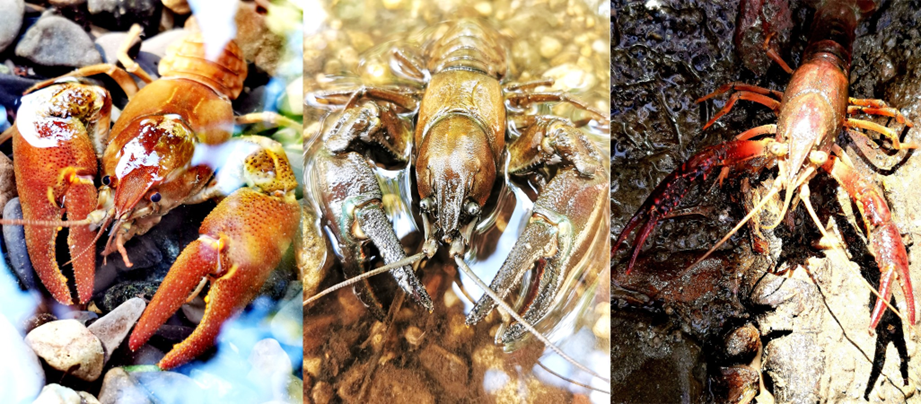
There are no native crayfish species in the Iberian Peninsula. The Italian crayfish (Austropotamobius fulcisianus), a species long thought to be native (and still often considered so), was introduced to Spain in 1588 by order of King Phillip II. Throughout the coming centuries, the Italian crayfish continuously expanded across Spain due to multiple secondary introductions, many of them promoted by the country’s administration (with particular enthusiasm by Franco’s dictatorship). In the 1970s, the popularity of crayfish harvesting and the declines observed in several populations prompted the introduction of two North American crayfish species, the red swamp crayfish (Procambarus clarkii) and the signal crayfish (Pacifastacus leniusculus). These species are (mostly) asymptomatic carriers of the fungus-like organism that cause the crayfish plague, a deadly disease for the Italian crayfish and all other European crayfish species. As a consequence, the rapid expansion of both North American species drove a collapse of the Italian crayfish, which disappeared from vast areas across the peninsula.

Crayfish niches
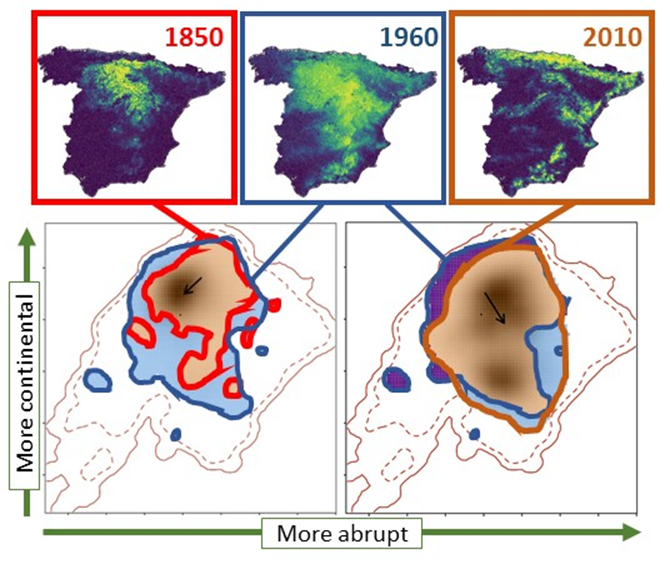
To address the dynamics of crayfish niches, the authors collated a comprehensive dataset of fine-grained crayfish records across Spain for three time periods within an unprecedented time window, spanning almost 200 years. Historical records of Italian crayfish presence were mined from two geographical dictionaries edited in the first half of the 19th century and from a monograph on the Italian crayfish published in the 1960s, while recent ones (2010) were derived from monitoring activities. For the North American crayfish species, we used different biodiversity information repositories and reviews of the available literature to describe their distribution, collecting records up to 2022.
By 1850 the Italian crayfish had occupied an overall similar environmental space to that used in the 1960s, despite the important increase in range between those two periods. In contrast, the drastic decline of the species after the arrival and expansion of the North American crayfish translated into important changes in the characteristics of its realised niche, which shifted towards abrupt and colder headwater environments. In line with their native niches, the red swamp crayfish has occupied warmer, lowland environments, whereas the signal crayfish has occupied colder environments towards the northern part of the peninsula.
The wide and complementary niche of the North American species has eventually occupied virtually the whole environmental space use of Italian crayfish in any historical period, leaving only upstream reaches, when still free of the North American species, as refuge habitats. But the story may continue changing as the North American species continue expanding and adapting, and the climate gets warmer.
Biological invasions have recently been estimated to be involved in 60% of the plant and animal extinctions worldwide (IPBES report), and many more impacts are expected to happen in the near future. Our study reveals the highly dynamic nature of the distribution and niche of invasive species, and how their biotic pressure can have far-reaching impacts on other species.
Read the paper
Read the full paper here: Viana, D. S., Oficialdegui, F. J., Soriano, M. d. C., Hermoso, V., & Clavero, M. (2023). Niche dynamics along two centuries of multiple crayfish invasions. Journal of Animal Ecology, 00, 1–13. https://doi.org/10.1111/1365-2656.14007
 Animal Ecology in Focus