Movement is fundamental to organismal life and constitutes the mechanistic link explaining the patterns observed in many ecological processes. Measures of animal movement, e.g. dispersal, residence time, home range size and overlap, form the basis of fundamental ecology theories and are essential for managing wildlife populations or predicting disease transmission rates. Hence research on the patterns, causes and consequences of the movement of organisms has pervaded … Continue reading Get the BES moving! BES Movement Ecology Special Interest Group Launch
There is only one month to go before the open call for papers for the special feature on animal host-microbe interactions closes. In this video Executive Editor Ken Wilson chats about what types of papers he is looking for and why he believes this topic is going to be a growth area in the future.
Showy ornaments used by the male of the species in competition for mates, such as the long tail of a peacock or shaggy mane of a lion, could indicate a species’ risk of decline in a changing climate, according to a new study from Queen Mary University of London (QMUL). Continue reading “Competitive males are a blessing and a curse”
In late September, as the UK was enjoying the last vestiges of summer I was lucky enough to head to Orlando in Florida where the 25th International Congress of Entomology was being held under the banner of “Entomology without borders”. This year, Orlando welcomed over 7000 delegates working in all areas of entomology; the largest gathering of entomologists at any one time – as far as we know! I first attended this enormous event, held every 4 years, as a young PhD student in 2000, in the beautiful city of Iguassu Falls in southern Brazil. I have been able to attend 3 of the 4 subsequent meetings, and co-hosted a session on Ecological immunology of Insects in each one, first in Brisbane, Australia (2004), then in Durban, South Africa (2008), and finally in Orlando. Much as I would like to have a clean sweep, maternity leave put paid to my plans to attend the 2012 meeting in Seoul, South Korea.
The number of hits for the terms “ecological immunology” or “eco-immunology” in Web of Science from 2000 to 2015. The red dots represent the percentage of papers with the word “ecology” that also used the word “immunology”.
Ecological immunology aims to understand how ecological pressures have shaped the evolution and expression of the immune system. In 2000, this was a very new concept that was just gaining ground in the ecological literature. Over the last 16 years this has grown into an established field. A quick search on Web of Science for the terms “Ecological immunology” or “Eco-immunology” shows a steady increase in publications over time. Of course, this does not find all of the papers in the field of eco-immunology, just those that specifically use that term, but it is indicative of how the field has rapidly grown. Continue reading “Ecology meets immunology at the biggest insect conference in the world”
Increasingly frequent extreme weather events could threaten butterfly populations in the UK and could be the cause of recently reported butterfly population crashes, according to research from the University of East Anglia (UEA).
Researchers investigated the impact of Extreme Climatic Events (ECEs) on butterfly populations. The study shows that the impact can be significantly positive and negative, but questions remain as to whether the benefits outweigh the negative effects.
Issue 85:6 is now online and for the first time we have two In Focus papers in the issue as we no longer want to limit ourselves to championing only one great paper!
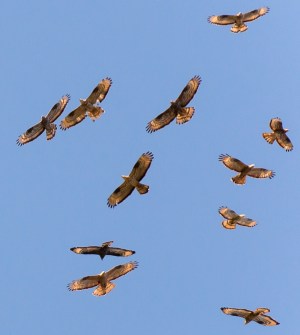
Birds of prey let themselves be carried by predictable winds
At the start of autumn, several billion migratory birds take flight for a long, adventurous journey to Africa. How do they manage to complete this difficult journey successfully year after year? To find out, a team of researchers from the University of Amsterdam (UvA) tracked the behaviour of migrating European honey buzzards using small GPS backpacks. They combined GPS data with meteorological models to show how these migratory birds travel via complicated detours to make use of predictable weather patterns. They do so especially over the Sahara Desert, an inhospitable landscape they need to cross as quickly as possible. Continue reading “Drifting birds of prey use predictable winds during migration”

 This post is a press release from the authors of Journal of Animal Ecology paper “
 This post is a press release from the authors of Journal of Animal Ecology paper “



 Animal Ecology in Focus