Studying aquatic animals has never been easy. Hidden from view beneath the water surface, they can be hard to find let-alone study in terms of their long-range movements. A recent paper published in the Journal of Animal Ecology investigated migratory behaviour in lake sturgeon. Lead author Steven Kessel from the Daniel P. Haerther Center for Conservation and Research at the John G. Shedd Aquarium is here to … Continue reading Divergent Migration in Lake Sturgeon
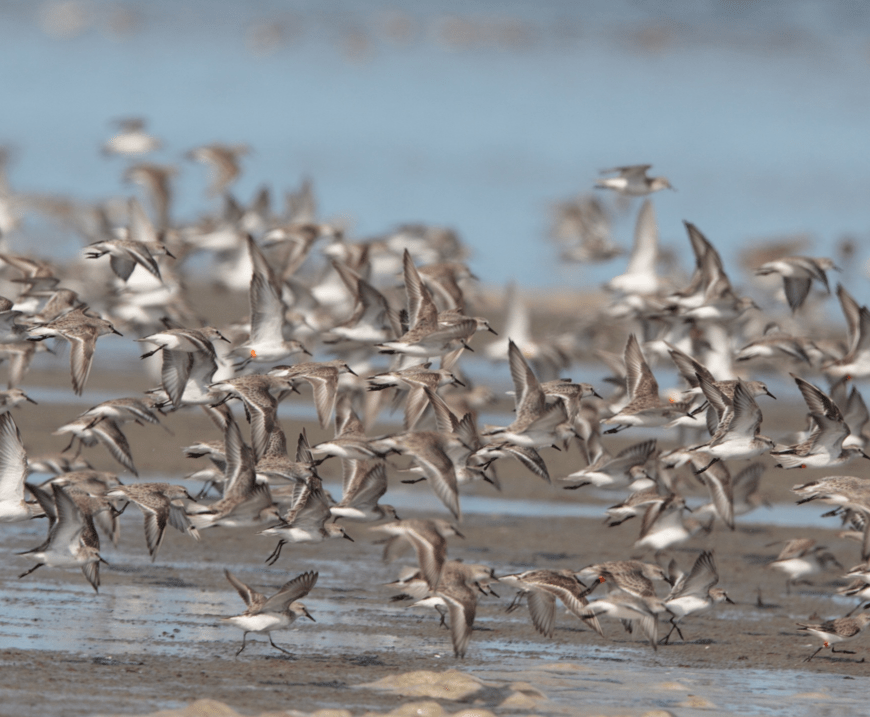
Animals move around. A lot. Migratory animals are widely assumed to play an important role in the long-distance dispersal of parasites and pathogens. But how does this affect the migratory animals themselves? PhD student Alice Risely, Deakin University, explains how infections might alter animal migration. Migratory animals spread pathogens. But how frequently? And how far? Is it super common for migratory birds to spread pathogens … Continue reading How does infection alter animal migration performance? It’s complicated.
Birds of prey let themselves be carried by predictable winds
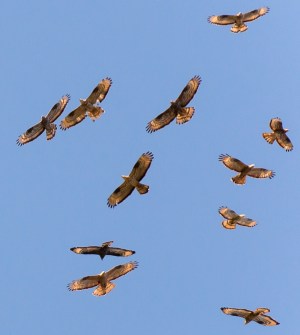
At the start of autumn, several billion migratory birds take flight for a long, adventurous journey to Africa. How do they manage to complete this difficult journey successfully year after year? To find out, a team of researchers from the University of Amsterdam (UvA) tracked the behaviour of migrating European honey buzzards using small GPS backpacks. They combined GPS data with meteorological models to show how these migratory birds travel via complicated detours to make use of predictable weather patterns. They do so especially over the Sahara Desert, an inhospitable landscape they need to cross as quickly as possible. Continue reading “Drifting birds of prey use predictable winds during migration”
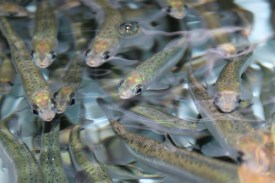
Using tags surgically implanted into thousands of juvenile salmon, University of British Colombia researchers have discovered that many fish die within the first few days of migration from their birthplace to the ocean. Continue reading “Salmon smolts find safety in numbers”
Animal migration is a spectacular phenomenon that has fascinated humans for a long time. It is widely assumed that appropriate timing of migratory events is crucial for survival, but the causes and consequences of individual variation in timing are poorly understood. New research based on migrating pike in the Baltic Sea and published in the British Ecological Society’s Journal of Animal Ecology reveals how behaviours such as punctuality, flexibility and fine-tuning influence life expectancy in fish. Continue reading “Accurate timing of migration prolongs life expectancy in pike”



 This post is a press release from the authors of Journal of Animal Ecology paper “
 Animal Ecology in Focus