Bugs collected on rooftop for 18 years reveal climate change effects

This blog post is a press release from the authors of the Journal of Animal Ecology paper “Resource specialists lead local insect community turnover associated with temperature – analysis of an 18-year full-seasonal record of moths and beetles” by Thomsen et al. Press release issued by University of Copenhagen

Horse-chestnut leaf miner (Cameraria ohridella) and acorn weevil (Curculio glandium) Photo credit: Jens Kirkeby (above) and Klaus Bek Nielsen.
Horse-chestnut leaf miner (Cameraria ohridella) and acorn weevil (Curculio glandium) Photo credit: Jens Kirkeby (top) and Klaus Bek Nielsen (bottom).

A volunteer registration of insects for 18 consecutive years on the Copenhagen roof of the Natural History Museum of Denmark has revealed local insect community turnover due to climate change. The research suggests a pattern of specialised species being more sensitive to climate change.1543 different species of moths and beetles and more than 250,000 individuals have been registered on a single urban rooftop in Copenhagen over 18 years of monitoring. That corresponds to 42 % of all the species of moths in Denmark and 12 % of the beetles. More interestingly, the insect community has changed significantly during that period. The results are published in the Journal of Animal Ecology led by researchers from the Center for Geogenetics and the Center for Macroecology, Evolution and Climate at the Natural History Museum of Denmark at the University of Copenhagen.

“As temperature increases we see a corresponding change in the insect community, specifically for the resource specialists – the insects that feed on only one species of plant. Earlier studies have confirmed that specialist species also respond rapidly to destruction of their habitats, so we are dealing with a very sensitive group of animals” says one of the lead authors postdoc Philip Francis Thomsen from the Center for Geogenetics. Continue reading “Bugs collected on rooftop for 18 years reveal climate change effects”

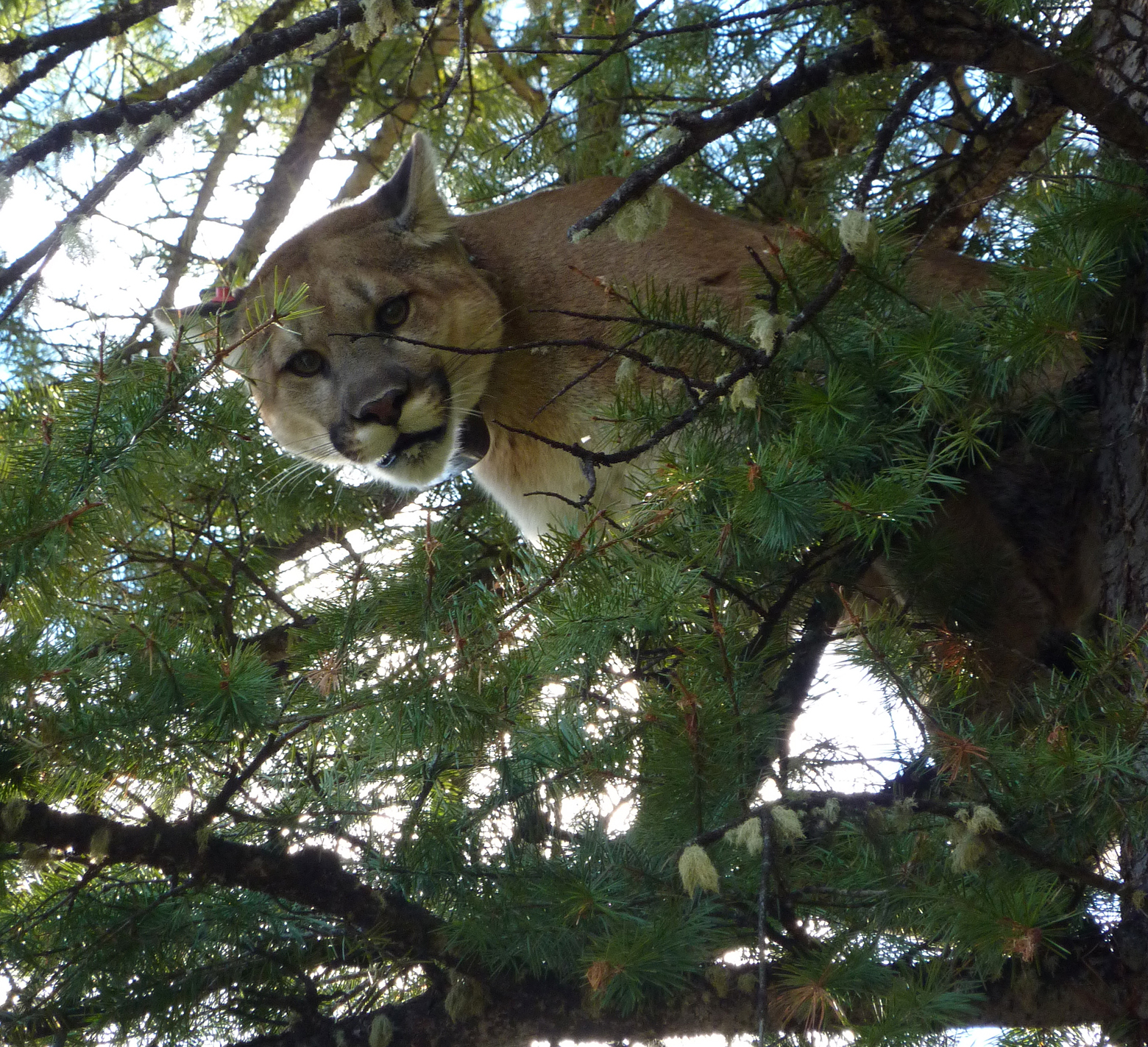
Spatial overlap in a solitary predator

F97, a subadult female raised by F61. Photograph by Patrick Lendrum / Panthera.

F61 and F51, adult female cougars (Puma concolor), also called mountain lions, were very nearly the same age when they gave birth to their first litters of kittens within a month of each other in 2011. The pair of big cats were neighbors in adjacent and overlapping home ranges in the Bridger-Teton National Forest, east of Grand Teton National Park in northwest Wyoming, USA.

A well-placed motion-triggered camera caught a fortuitous image of F61 and F51 spending time together in early 2012, accompanied by their four kittens (1 from F61, 3 from F51). It sparked great discussion among our team, many of whom were convinced they must be close relatives, perhaps sisters. Indeed, prevailing theory supported the idea that close kin were more likely to be close to each other and tolerant of one other. Thus, it just made sense that the two cats would be kin. At the time, however, we did not know the genetic relatedness of cougars in our study, except of course, kittens born to females we were tracking. Continue reading “Spatial overlap in a solitary predator”

Accurate timing of migration prolongs life expectancy in pike

This blog post is a press release from the authors of the Journal of Animal Ecology paper “Causes and consequences of repeatability, flexibility and individual fine-tuning of migratory timing in pike” by Petter Tibblin published today. Press release issued by Linnaeus University

Animal migration is a spectacular phenomenon that has fascinated humans for a long time. It is widely assumed that appropriate timing of migratory events is crucial for survival, but the causes and consequences of individual variation in timing are poorly understood. New research based on migrating pike in the Baltic Sea and published in the British Ecological Society’s Journal of Animal Ecology reveals how behaviours such as punctuality, flexibility and fine-tuning influence life expectancy in fish. Continue reading “Accurate timing of migration prolongs life expectancy in pike”

From social network analysis to speciation in the Neotropics: exciting research by early career ornithologists.

As I mentioned in my earlier post, the joint American Ornithologists Union (AOU) and Cooper Ornithological Society (COS) conference this year emphasized a renewed focus on early career professionals.  Such a practice is key in supporting early careers folks in a time when the job market is tight and funding rates are very low.  Many of us may receive quality one-on-one mentoring at our home … Continue reading From social network analysis to speciation in the Neotropics: exciting research by early career ornithologists.

East Africa’s Elephant Architects

I can see elephants in my backyard—at least fifteen of them, youngsters and grownups. They are a few hundred meters off, but distinctive amongst the thorn trees, and my eyes drift to them every time I look up from the computer screen. In the 12 years that I’ve been working here at the Mpala Research Centre in central Kenya’s Laikipia Highlands, elephants have grown both … Continue reading East Africa’s Elephant Architects

American Ornithologists Union focuses on fledging early career professionals

It is a hot Friday morning, the second to last day of an intimate AOU-COS meeting on the University of Oklahoma campus, and a big day for my lab. A number of my students are giving their first conference talks and have the jitters. I’ve listened to renditions between sessions and late into the night. I remember the not too distant past when I stood … Continue reading American Ornithologists Union focuses on fledging early career professionals

Life on the edge: celebrating a successful long-term ecological study

The Scottish isles of St Kilda, off the west coast of the Outer Hebrides, have an important place in my heart. It was on St Kilda where I first realised that not all sheep are boring, where I sustained my first fieldwork-related injury (a broken hip caused by an impact during a sheep-chasing incident!), where I successfully ran my first Research Council grant, and where … Continue reading Life on the edge: celebrating a successful long-term ecological study

Penguins on Parade: Conflict in South Georgia – A Slideshow

The Sub-Antarctic island of South Georgia is home to some of the world’s largest breeding aggregations of penguins. Long-term monitoring studies reveal that the local population trends are complex. Some species and colonies have rapidly declined, but others have increased or remained stable. For example, the local population of macaroni penguins rapidly declined between the 1970s and early 2000s. During the same period of time, the local king penguin population increased. Within each of these species, individual colonies changed at different rates and a small number changed in opposite directions. Thus, it appears that the penguin species and colonies of South Georgia have responded differently to climate change and anthropogenic pressures such as fisheries, and historic sealing and whaling activities that changed the community structure. Unravelling these processes is considered an important challenge and has been the focus of extensive research [1][2][3]. Recent work [4] on the macaroni penguin indicated that their survival rates are controlled by trophic levels both above and below them, highlighting the need to consider multiple drivers simultaneously. The population of penguins on South Georgia currently represents around 15% of the global macaroni penguin population, 26% of the global gentoo penguin population, 28% of the global king penguin population, and less than 1% of the global chinstrap penguin population. Continue reading “Penguins on Parade: Conflict in South Georgia – A Slideshow”

VIDEO In hot and cold water: Life-history biology of the Antarctic Kiwaidae

In 2010, a UK-led expedition to the Southern Ocean revealed a community of deep-sea animals thriving around volcanic vents on the ocean floor near Antarctica. Among the many new species discovered, was the visually abundant yeti crab, Kiwa tyleri. As a result of local thermal conditions at the vents, these crabs are not restricted by the physiological limits that otherwise exclude reptant decapods from the … Continue reading VIDEO In hot and cold water: Life-history biology of the Antarctic Kiwaidae

Chi square I’ve met you before. A belated Valentine’s blog

For those readers who have met me, it will come as no surprise that I was a bit of a geek when I was doing my undergraduate studies.  And that was long before geek was in any way sexy.  Sheldon (from ‘The Big Bang Theory’ and not @ben_sheldon_EGI) probably hadn’t been born.  However, one day one of the cool gang of undergraduates did talk to me.  She wondered whether she could use my results from a practical she had been ‘unable’ to attend.  I wanted to help but I was also concerned she’d copy my data and I’d end up being the one hauled over the coals for plagiarism.  So I came up with a cunning plan.  I wrote some code on the VAX (look it up online if you’re under 45) that took my data and generated a pseudo random dataset with many of the same statistical properties as the dataset I had collected.  It took me most of the night.  Nicole seemed happy, but not sufficiently so to come for a drink with me. Continue reading “Chi square I’ve met you before. A belated Valentine’s blog”