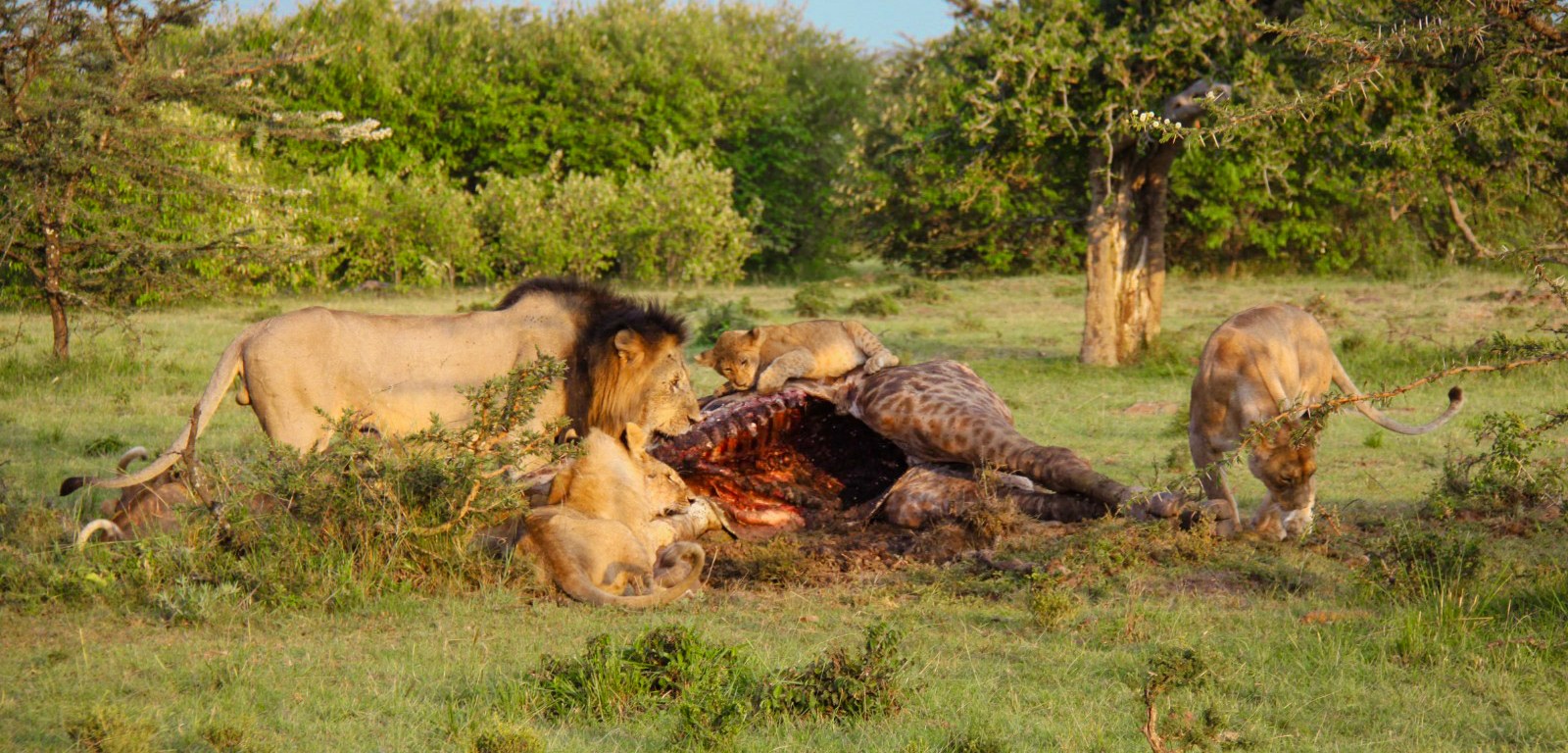
This blog post is provided by Solange Alexandra Batista-Nunes and tells the #StoryBehindThePaper for the article, “Contrasting properties of predation and scavenging networks governed by megaherbivores in an African savannah”, which was recently published in the Journal of Animal Ecology. In their study, Batista-Nunes and colleagues conduct the first comparison of predation and scavenging networks within a Kenyan ecosystem, revealing the value of scavenging in maintaining ecosystem health.
From the tiniest insects to giants like the African elephant (Loxodonta africana), life on Earth is connected through a web of interactions. Who eats whom, what ecologists call a food web, shapes how energy flows through ecosystems and ultimately determines how stable those systems are.
But here is the catch: most of what we know about food webs comes from studying predation. And that leaves out a big piece of the puzzle.
The role of body mass
In mammalian predation networks, body size is one of the main rules organising who interacts with whom, as predation involves energy constraints.
Large predators tend to eat a wide range of prey, while smaller predators are limited to smaller animals. At the same time, megaherbivores, like elephants or giraffes (Giraffa camelopardalis), are rarely hunted as adults. These patterns create structured food webs, where species cluster into groups based on size.
There is also an energetic trade-off: very small prey are often not worth the effort for large predators. As a result, food webs tend to show predictable patterns, such as:
- Modularity: groups of species interacting mostly within their size class
- Nestedness: specialists feeding on a subset of what generalists consume
But these patterns are built on one assumption: that feeding means hunting.
What happens when animals do not kill their prey… but eat them anyway?
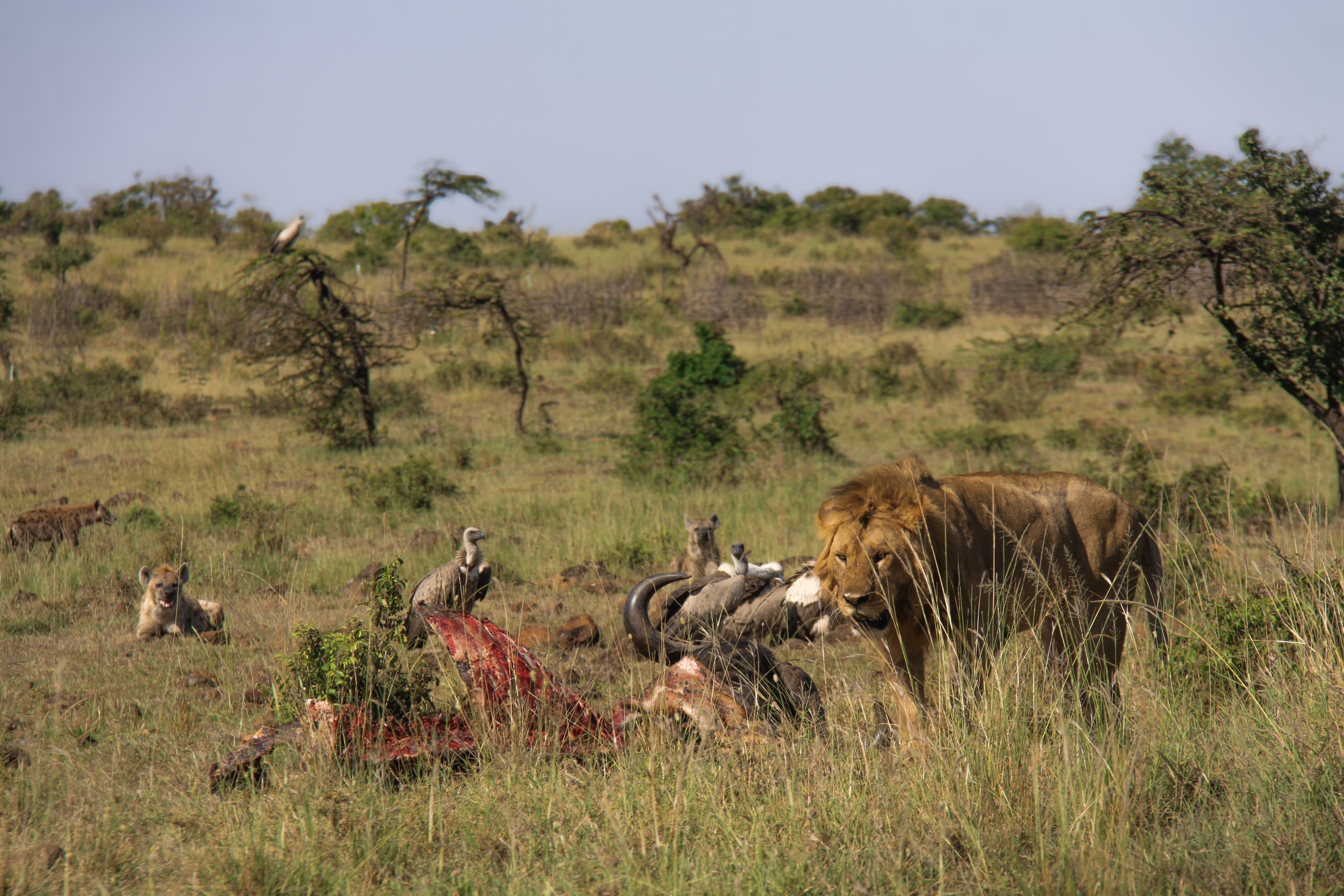
Scavenging: breaking the rules
Most carnivores do not just hunt, they also scavenge.
Scavenging plays a crucial role in ecosystems. It helps recycle nutrients, removes carcasses, and can even prevent the spread of disease. Yet it is often overlooked in food web studies.
Why does that matter?
Scavenging can connect species that would never interact through predation. For instance, a black-backed jackal (Lupulella mesomelas) cannot kill a giraffe, but it can feed on its carcass. Suddenly, the usual body-size rules start to break down.
In our study, we conducted the first comparison of predation and scavenging networks within the same ecosystem. We used an 8-year dataset from the Maasai Mara in Kenya, including predation and scavenging events among carnivores feeding on a community of medium- to large-sized herbivores, including megaherbivores.
We asked three main questions:
- Do predation and scavenging networks differ structurally?
- Does body size influence them in the same way?
- Do megaherbivores play unique roles in each network?
Two networks, two different structures
Predation networks followed the expected rules: they were tightly structured by body size. Larger predators hunted larger prey, and interactions were relatively predictable.
Scavenging networks, however, told a completely different story:
- Body mass mattered much less
- Smaller carnivores could access very large carcasses
- Larger carcasses attracted more species
In other words, while predation is selective and constrained, scavenging is flexible and opportunistic.
Key players in the ecosystem
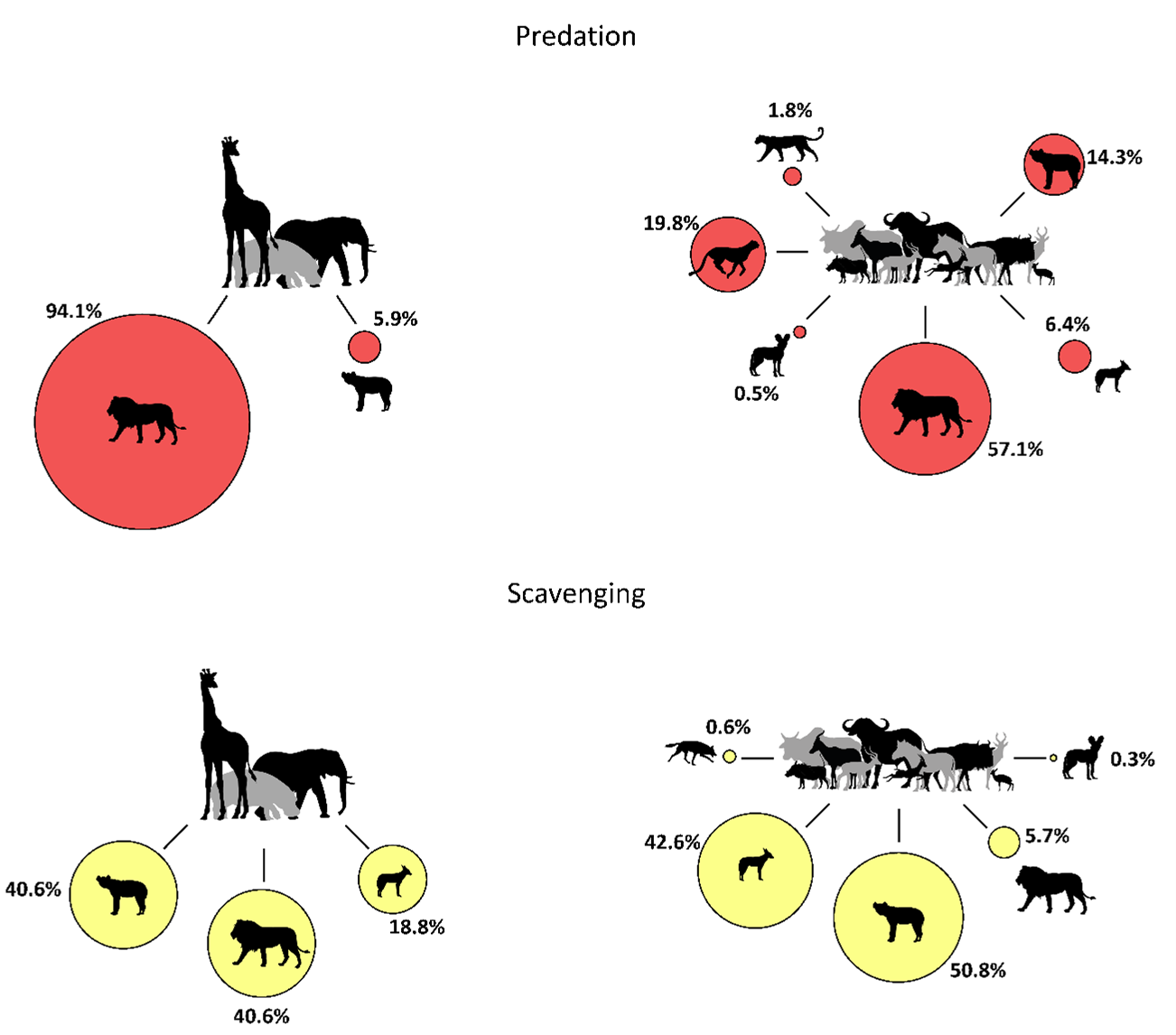
Some species turned out to be especially important. Regarding prey, the wildebeest (Connochaetes taurinus) played a central role in both networks. For carnivores, lions (Panthera leo) were key contributors in predation, while spotted hyenas (Crocuta crocuta) dominated the scavenging network.
These species act as highly connected nodes, meaning that changes affecting them can ripple across the entire ecosystem.
Why this matters for conservation
Species that are highly connected in food webs are also more vulnerable. Disruptions such as poaching, disease, or habitat fragmentation can affect not just one interaction, but the entire network.
Megaherbivores are especially important here. As their populations decline globally, ecosystems may lose critical scavenging opportunities. Their carcasses provide large, nutrient-rich resources that sustain entire communities of scavengers.
Without them, the structure of these networks could fundamentally change.
A missing piece of the ecological puzzle
By looking at both predation and scavenging together, our study highlights something simple but powerful:
Not all feeding interactions follow the same rules.
To fully understand how ecosystems function, and how they may respond to change, we need to consider both the living and the dead.
Read the paper
Read the full paper here: https://doi.org/10.1111/1365-2656.70264

