
This blog post is provided by Meng Xu and Ignasi Arranz and tells the #StoryBehindThePaper for the article “Season and human footprint weaken the negative effect of temperature on the intraspecific metabolic scaling exponent of wild brown trout populations“, which was recently published in Journal of Animal Ecology. This study examined how temperature and other environmental variables affect metabolic scaling in wild brown trout.
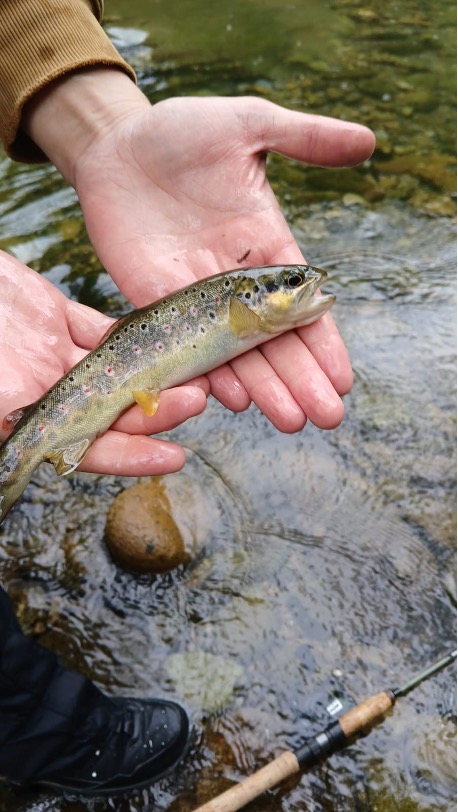
Brown trout (Salmo trutta, [Linnaeus 1758]) is one of the most iconic fish species in European rivers. Beyond its cultural and economic importance for recreational fishing, it also plays a crucial ecological role in riverine food webs. Healthy trout populations are often a sign of good ecological status in freshwater ecosystems, as this species typically inhabits clean, cold, and well-oxygenated waters. Trout are ectothermic animals and their metabolic activity depend directly on the surrounding environment, particularly the water temperature. Metabolism — the process through which organisms transform energy to growth, movement, and reproduction — is strongly influenced by temperature. As a result, trout are often considered bioindicators of environmental change: when rivers get warm or become degraded, trout populations are among the first species to be affected.
Climate change is increasing the temperature of many rivers. Warmer water can alter the physiology of cold-water species such as trout by increasing their energetic demands and pushing them closer to their physiological limits. For this reason, understanding how temperature affects trout metabolism is key to predicting how populations may respond to environmental change. However, natural ecosystems are complex. Temperature rarely acts alone, and many other environmental factors influence the biology of organisms in the wild. In this study, we asked a simple but important question: is temperature really the main driver of metabolic constraints in wild trout populations, or do other factors also play a significant role?
Specifically, we investigated how temperature influences metabolic scaling within populations of wild brown trout. Metabolic scaling describes how energy use changes with body size, since larger individuals consume more energy overall. Understanding how this relationship varies in nature can provide insights into how energy is distributed within populations and ecosystems. To explore this question, we analyzed an exceptionally large dataset of wild brown trout populations from streams and rivers across France. The dataset included more than 300,000 individual trout sampled from over 2,000 river locations over several decades. For each fish individual, body length measurements were available, which allowed us to estimate body mass and construct the size distribution of individuals within each trout population.
Measuring metabolic rates directly in the field is extremely difficult, especially across such large spatial scales. We applied a new theoretical ecological model called parameterized maximum entropy theory of ecology (pMETE) to infer how energy is distributed among individuals of different sizes. Our model allows us to estimate metabolic patterns indirectly from body size data, which are much easier to collect from the field than metabolic rate data. In addition, we applied a causal inference framework based on directed acyclic graphs (DAGs). This approach is increasingly used in ecology because it helps distinguish between simple correlations and true causal relationships. We could therefore evaluate the influence of water temperature while simultaneously accounting for other important environmental factors, including the season of the year, water velocity, and the human footprint — an index that captures the cumulative impacts of human activities such as land use change and habitat fragmentation.
Our results revealed that when temperature was analyzed alone, warmer waters appeared to constrain the energetic balance of larger trout individuals. In other words, the relationship between body size and energy use suggested that larger fish might become energetically constrained as temperatures increase. However, the picture changed when other environmental variables were included in the analysis. Once seasonality and human footprint were accounted for, the apparent effect of temperature weakened dramatically — by between 54% and 62% — and was no longer statistically significant. This finding suggests that temperature alone may not be the dominant factor shaping metabolic scaling in natural trout populations.
Taken together, our findings highlight the importance of considering multiple environmental drivers simultaneously when studying the effects of climate change in natural ecosystems. While rising temperatures are undoubtedly a major global change factor, their effects on biological systems may be strongly mediated by local ecological conditions and human pressures. Understanding how metabolism varies across natural populations is essential for predicting how species will respond to climate change. Our study also demonstrates the value of combining theoretical ecological models with modern causal inference tools. By integrating large-scale monitoring data with robust analytical frameworks, researchers can gain deeper insights into how complex environmental drivers interact to shape biological systems.
Read the paper here:

