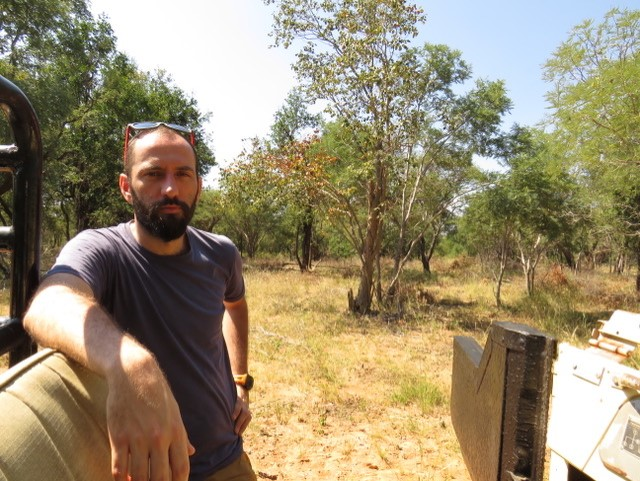
Meet the Associate Editor: Pol Capdevila

At JAE we’re taking the opportunity to showcase our wonderful Editorial Board by chatting to our Editors about their research, experience as an editor, and their advice to prospective authors. Associate Editor Profile Name: Pol Capdevila Location: University of Barcelona, Spain Keywords: conservation, demography, extinctions, life history theory, macroecology, phylogenetic analyses, population ecology, regime shifts, resilience.  Twitter: @PolCapdevila90 Website: https://polcapdevila.weebly.com/ What area of ecology do … Continue reading Meet the Associate Editor: Pol Capdevila

Sticky post

What makes a bird important for plants’ seed dispersal?

This blog post is provided by Gabriel Moulatlet, Wesley Dáttilo and Fabricio Villalobos and tells the #StoryBehindthePaper for the paper “Species-level drivers of avian centrality within seed-dispersal networks across different levels of organization“, which was recently published in Journal of Animal Ecology. In their study, they investigate the factors that influence birds relationships with plants for seed dispersal, in a network context, at both local … Continue reading What makes a bird important for plants’ seed dispersal?

Sticky post

¿Qué hace que un ave sea más (o menos) importante para la dispersión de semillas?

Esta entrada de blog proviene de Gabriel Moulatlet, Wesley Dáttilo y Fabricio Villalobos, y nos cuenta la #HistoriaDetrásdelArtículo del artículo “Species-level drivers of avian centrality within seed-dispersal networks across different levels of organization” (“Impulsores de la centralidad de las especies de aves en redes de dispersión de semillas en diferentes niveles de organización”), que fue recientemente publicado en el Journal of Animal Ecology. En su … Continue reading ¿Qué hace que un ave sea más (o menos) importante para la dispersión de semillas?

Meet the Associate Editor: Garrett Street

At JAE we’re taking the opportunity to showcase our wonderful Editorial Board by chatting to our Editors about their research, experience as an editor, and their advice to prospective authors. Editor Profile Name: Garret Street Associate Editor Since: January 2017 Location: Wildlife, Fisheries & Aquaculture, Mississippi State University, USA Keywords: behaviour, Cervidae, habitats, landscape, mammals, modeling, movement, production, resource selection, space use, Suidae Can you … Continue reading Meet the Associate Editor: Garrett Street

Sticky post

Unveiling Seasonal Risk Landscapes: How Ecological Disturbance and Human Recreation Shape Panther and Deer Responses

This blog post is provided by Heather N. Abernathy and tells the #StoryBehindthePaper for the paper ‘Rain, recreation and risk: Human activity and ecological disturbance create seasonal risk landscapes for the prey of an ambush predator’, which was recently published in Journal of Animal Ecology. In their study, they show how panthers’ avoidance of human recreation and flooding create distinct schedules of risk for deer, … Continue reading Unveiling Seasonal Risk Landscapes: How Ecological Disturbance and Human Recreation Shape Panther and Deer Responses

Meet the Associate Editor – Jacob Allgeier

At JAE we’re taking the opportunity to showcase our wonderful Editorial Board by chatting to our Editors about their research, experience as an editor, and their advice to prospective authors. Associate Editor Profile Name: Jacob Allgeier Location: University of Michigan Website: https://www.jacoballgeier.com/  Keywords: Ecosystem ecology, community ecology, Experimentation, field ecology, statistics, movement studies, isotope ecology, aquatic, marine, coastal, coral reefs, mangroves, seagrass beds Can you … Continue reading Meet the Associate Editor – Jacob Allgeier

Sticky post

Billfish use an oxygen minimum zone boundary to hunt

This blog post is provided by Ryan Logan and tells the #StoryBehindthePaper for the paper “Patrolling the border: billfish exploit the hypoxic boundary created by the world’s largest oxygen minimum zone”, which was recently published in Journal of Animal Ecology. Blue marlin and sailfish are top predators in the pelagic environment, but little is known about their hunting behavior. Ryan Logan, the lead author of the … Continue reading Billfish use an oxygen minimum zone boundary to hunt

What’s so great about macroecology?

Hi! I’m Tom, a lecturer at Cardiff University, assistant editor at Journal of Animal Ecology, and a self-described macroecologist. I’m writing on the JAE blog to promote the wonderful subfield of macroecology. JAE is packed with a wealth of great animal macroecology studies. In addition, there is a British Ecological Society Macroecology Special Interest Group Annual Meeting (that’s a serious mouthful) coming up in July. … Continue reading What’s so great about macroecology?

Sticky post

Human land-uses homogenize stream assemblages and reduce animal biomass production

This blog post is provided by Dieison André Moi and tells the #StoryBehindthePaper for the paper ‘Human land-uses homogenize stream assemblages and reduce animal biomass production’, which was recently published in Journal of Animal Ecology. In their study, Dieison and colleagues evaluated the effects of four land-uses on taxonomic richness, functional and trait diversityof fishes, arthropods, and macrophytesbased on data from 61 stream sites in … Continue reading Human land-uses homogenize stream assemblages and reduce animal biomass production