This blog post is provided by Lucy Johanson and Heloise Gibb and tells the #StoryBehindThePaper for the article, “Digging into dirt: rewilding with threatened mammals shapes soil insect assemblages”, which was recently published in the Journal of Animal Ecology. In their study, Johanson, Gibb and colleagues explore the insect communities of the Australian desert and how they are impacted as ecosystem engineers are reintroduced.
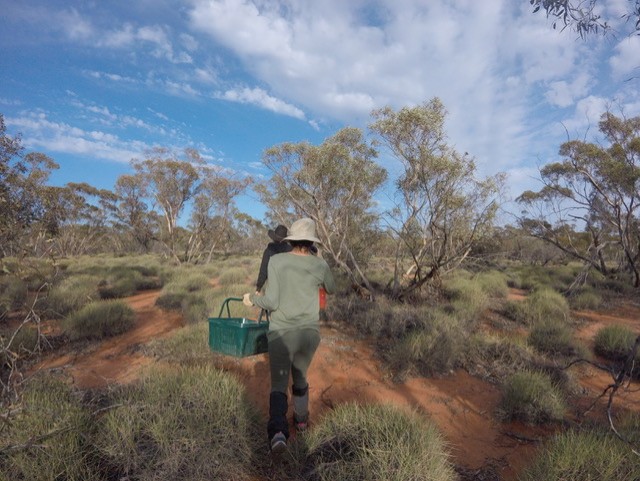
In Australia, the deserts are not as full of life as they once were. Standing on a red dune, looking out to a horizon free of people as ancient grass stabs your calves with silica, the multi-stemmed gums rustling as emerald parrots screech in their branches, it is hard to imagine that these landscapes once had more animals than they do now.
Historical accounts describe colonists’ dogs as being “completely distracted” by wallabies, paddymelons and kangaroo rats as they bounded away on all sides, and sandy soils so full of burrows and pits that horses struggled to walk. Many of those native mammals are now gone from the deserts, pushed to extinction or near-extinction on the mainland by introduced predators, often surviving only behind predator-proof fences.
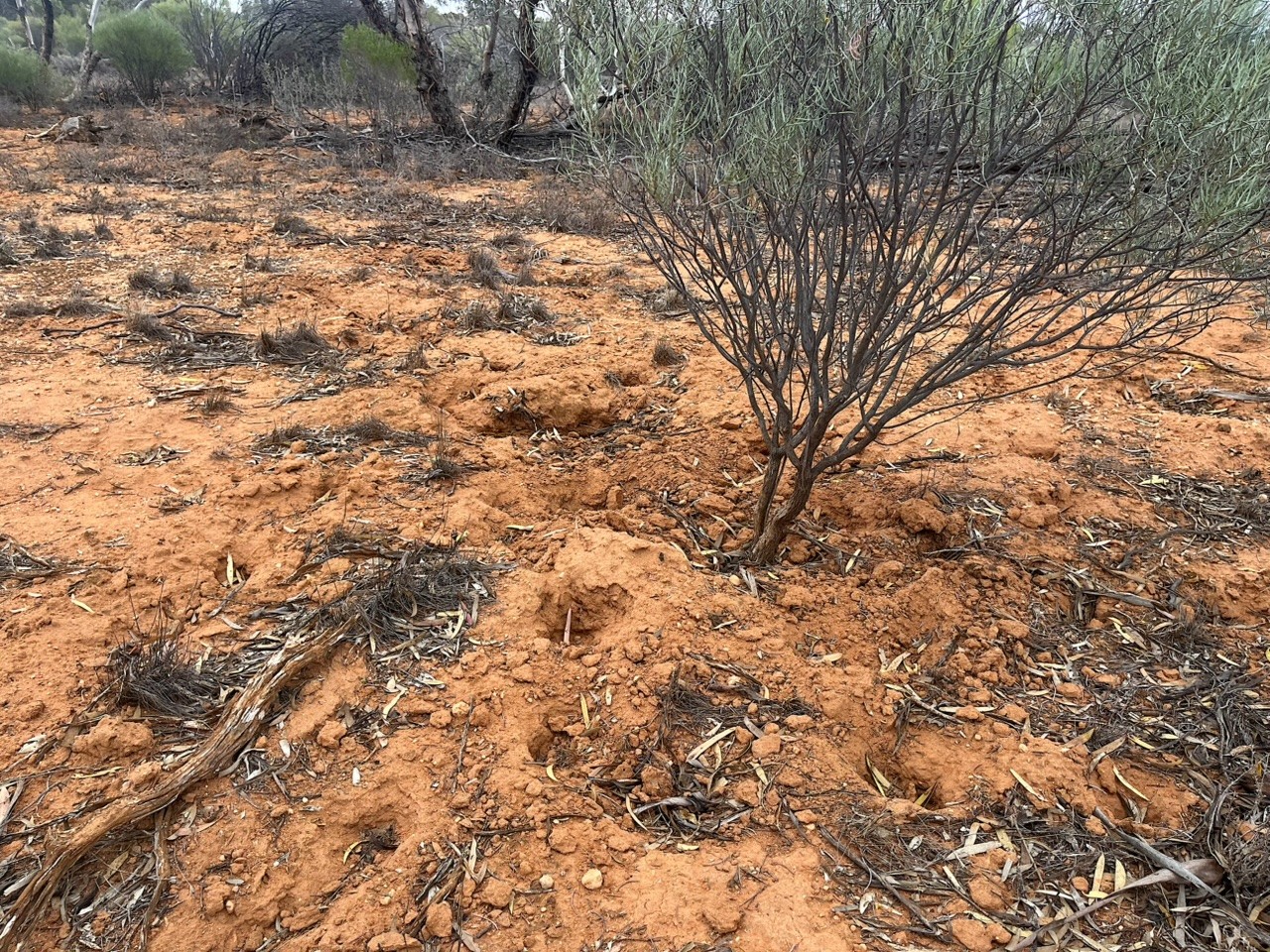
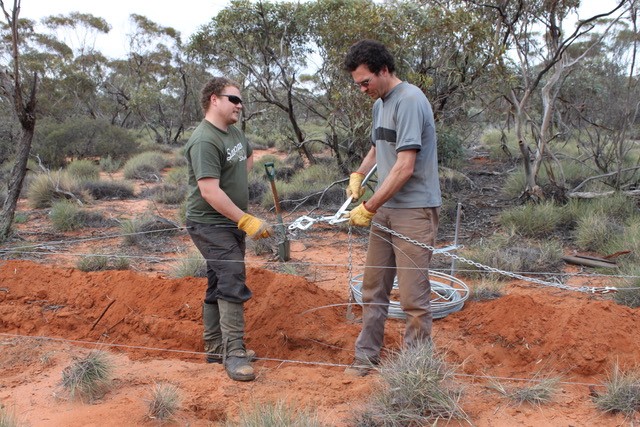
At Scotia Wildlife Sanctuary, where this study took place, reintroduced mammals live inside an 8,000-hectare fenced reserve. These marsupials include the weird and wonderful bilbies, bettongs and bandicoots, which are all roughly rabbit-sized, with compact bodies and tiny pouches for their joeys. But don’t let their diminutive size fool you. In a single year, one bandicoot can move several tonnes of soil, an amount comparable to the weight of an African elephant. These millions of small disturbances accumulate night after night as marsupials search for food. This soil movement is a form of ecosystem engineering: animals physically altering their environment in ways that ripple through whole systems. When digging mammals are lost from a landscape, the millions of pits and burrows they create are lost with them.
Perhaps the best glimpse of this once-teeming desert diversity is when you come across a mallee gum in bloom. These multi-stemmed, grey-barked eucalyptus trees stand above the other plants in soft, open domes, casting dappled shade below. The tree hums with life. Insects dart to the creamy flowers in such numbers that you can hear and see the swarm from a distance, like smoke flickering around the canopy. But the flying insects we notice are only part of the story. Many insects begin their lives underground, developing in the soil as larvae before emerging as adults after rain, warmth or seasonal change.
The mammals turning the soil and the insects emerging from it are therefore connected through the soil. What remains less clear is how insects respond to those disturbances, and what that means for birds, mammals, and the wider systems connected to them.
My supervisor and coauthor, Heloise Gibb, has been going into the Australian desert for over 10 years to examine how reintroducing ecosystem engineers affects insect communities. As a PhD student, I was lucky enough to use some of this extraordinary data for a thesis chapter.
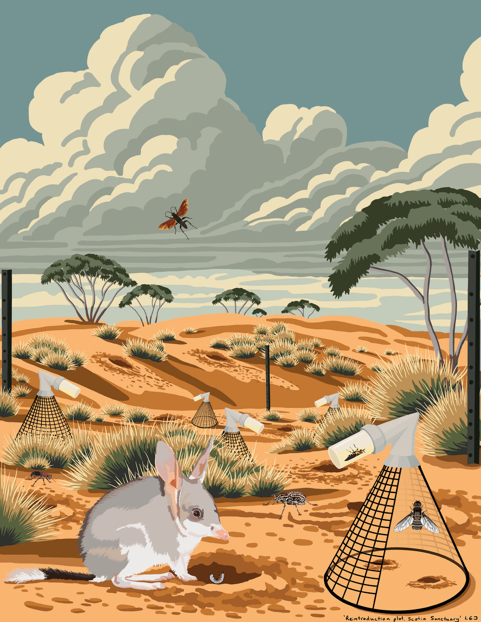
We focused on two years: insects collected in 2010, near the beginning of the mammal exclusion experiment, and insects collected again in 2018, eight years after the treatments were established. Within the sanctuary, experimental plots differed in whether reintroduced mammals could access them fully, partially, or not at all. We caught the insects with emergence traps: cone traps that sit open on the ground and collect insects as they emerge from the soil.
What we found was not a simple story. In plots where reintroduced digging mammals had full access, fewer insects emerged from the soil. Richness and biomass, however, did not show the same clear decline. This suggested that mammals were not simply reducing the number of soil-emerging insects through predation and nest disturbance, but also changing which species were most associated with each treatment.
That complexity makes sense. “Insects” are not one kind of animal. Asking how insects respond to digging mammals is a bit like asking how birds respond to a forest fire: the answer depends on whether you mean wrens, parrots, emus or penguins. Insects differ enormously in how they feed, where they live, how they develop, and how vulnerable they are to disturbance or predation.
In our study, parasitoid wasps and predatory flies were more strongly associated with mammal-free plots, while some plant-feeding beetles showed weaker negative responses to mammal presence. That suggests digging mammals were not simply decreasing “insects” as a whole. They were changing the balance of the insect community, or perhaps we should say, rebalancing it.
Studies like ours matter because rewilding is often framed as the return of mammals to a landscape, with the rest of the ecosystem assumed to follow. But ecosystems are rarely that simple. Returning ecosystem engineers can also restructure insect communities, with consequences for the animals and plants connected to them. And insects should not be as ignored as they often are. They recycle nutrients, break down organic matter, turn and aerate soil, feed larger animals, and help keep ecosystems functioning. In the desert, some of the most important responses may not be the ones we see moving across the sand at dusk, but the ones emerging quietly from the soil beneath our feet.
Read the paper
Read the full paper here: https://doi.org/10.1111/1365-2656.70274

