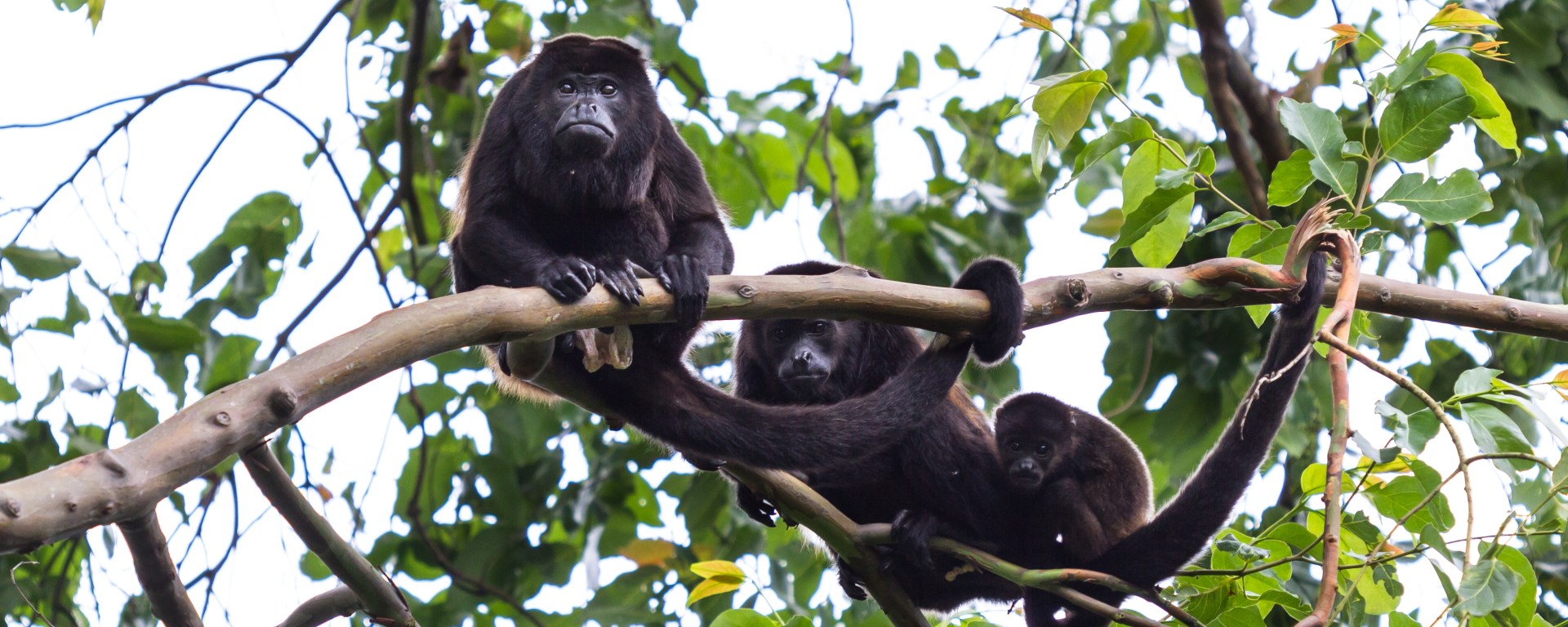
This blog post is provided by Pedro A. D. Dias and Ariadna Rangel-Negrín from the Primate Behavioral Ecology Lab, Universidad Veracruzana, México, and tells the #StoryBehindThePaper for the article “Does energy minimisation constrain behavioural plasticity? Long-term activity budgets of a model folivore–frugivore“, which was recently published in Journal of Animal Ecology. This study examined how activity budgets of mantled howler monkeys in Los Tuxtlas, México, responded to environmental factors such as leaf and fruit availability, as well as age and reproductive state.
Are you an energy maximiser or a minimiser?
Picture two very different approaches to getting through your working day. The first: work as hard as you possibly can for as long as possible, cramming in as much as the day allows. The second: do just enough to meet your obligations, then spend the rest of the day with your feet up. Ecologists recognise these as two fundamental strategies that animals use to manage their energy budgets, and they go by the names of energy maximisation and energy minimisation.
Energy maximisers forage as intensively as possible, pushing intake rates to the limit. Energy minimisers, by contrast, meet their needs in minimum time and then rest, reducing exposure to predators, heat, and the costs of unnecessary movement. These two strategies generate opposing predictions about how an animal should behave: if resources suddenly become more abundant, a maximiser should eat even more, while a minimiser should simply rest more.
Most animals sit somewhere on this spectrum, but howler monkeys (Alouatta spp.) are striking outliers at the minimising extreme. They spend 60–80% of their day resting. They have among the shortest daily travel distances of any primate. They have lower basal metabolic rates than you would expect for their body size. Everything about them, from their slow gut passage rates to their preference for sitting still in the forest canopy, screams energy conservation.
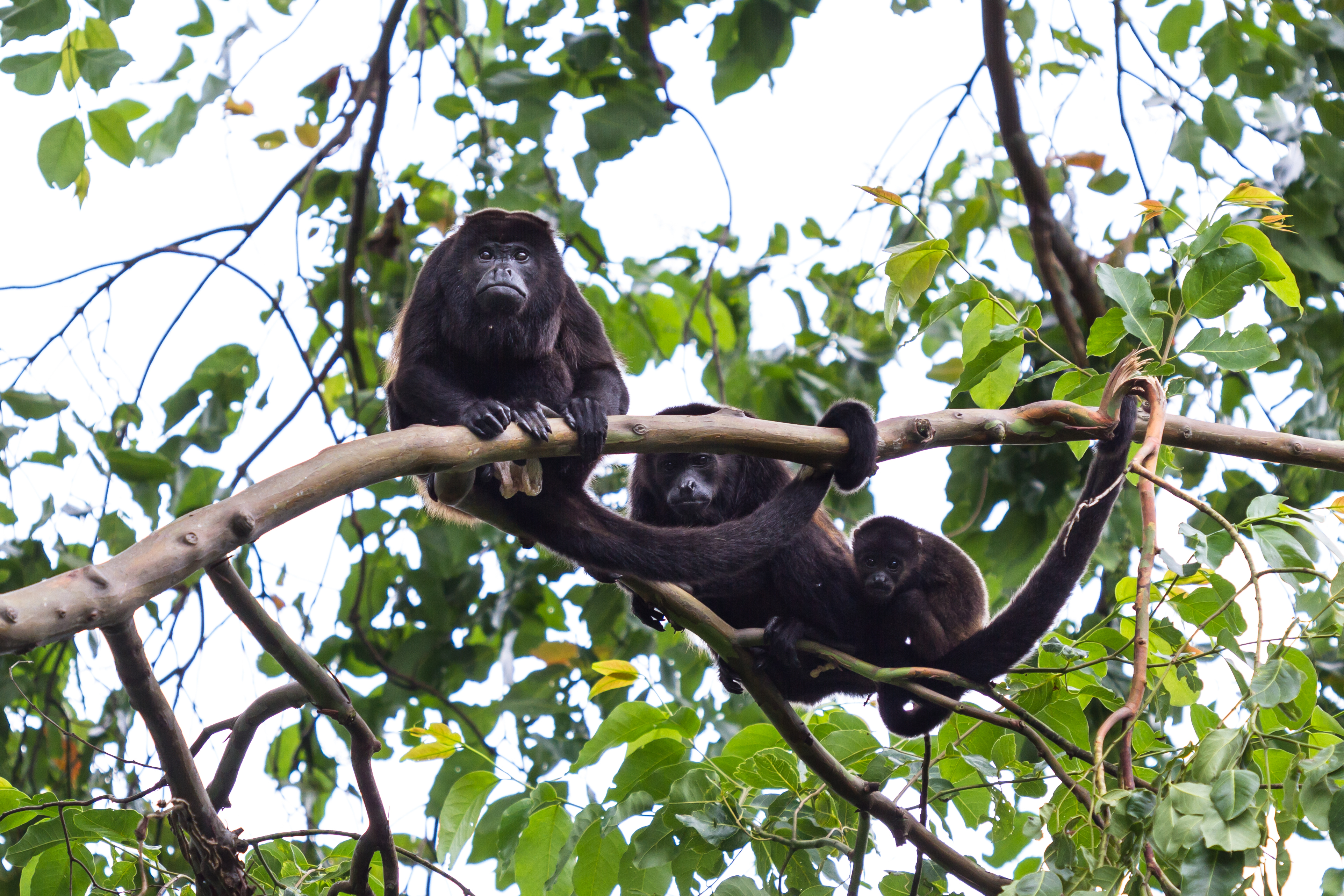
Why howlers are so interesting… and so tricky
Part of what makes howlers fascinating is that they are not committed folivores (leaf-eaters) in the way that colobine monkeys are. They are dietary generalists, shifting between fruit and young leaves depending on what the forest offers. This flexibility introduces a complication: does a minimising strategy operate the same way regardless of whether the animal is eating high-quality fruit or low-quality, hard-to-digest leaves? Theory suggests that the answer should be no, that is, the energetic logic of resting versus feeding should shift depending on which food is driving the diet.
Testing this properly requires something most studies lack: long-term, individual-level data that captures animals across the full range of ecological conditions they encounter. Short-term snapshots can tell you that howlers rest a lot, but they cannot tell you whether that resting time stays stable, increases, or decreases predictably as the forest changes around them.

Ten years watching monkeys rest
In our study published in the Journal of Animal Ecology, we analysed over 6,600 hours of focal observations collected across a decade from 21 individually identified wild howlers at La Flor de Catemaco, in the Los Tuxtlas region of Veracruz, México. We tracked how their activity budgets (the proportion of time spent resting, feeding, and moving) responded to young leaf availability, fruit availability, temperature, rainfall, humidity, age, and reproductive state.
The results confirmed howlers as committed energy minimisers, but with some revealing twists. Young leaf availability drove activity budgets far more powerfully than fruit, nearly 40 times more strongly, in fact. When young leaves were abundant, howlers rested more and fed less: exactly what minimisation theory predicts for a fallback food that, paradoxically, allows animals to rest more by providing a reliable if modest energy source without requiring extra foraging effort.
Perhaps our most striking finding concerned temperature. Above approximately 31.6 °C, resting time increased sharply, a clear threshold effect rather than a gradual response. Below that temperature, howlers seemed to have genuine freedom to adjust their behaviour; above it, inactivity appeared to be enforced by thermal physiology rather than chosen. Given that temperatures at our site occasionally exceed this threshold already, and that climate projections for Mesoamerican forests predict more frequent extreme heat events, this finding has direct implications for how resilient these animals will be in a warming world.
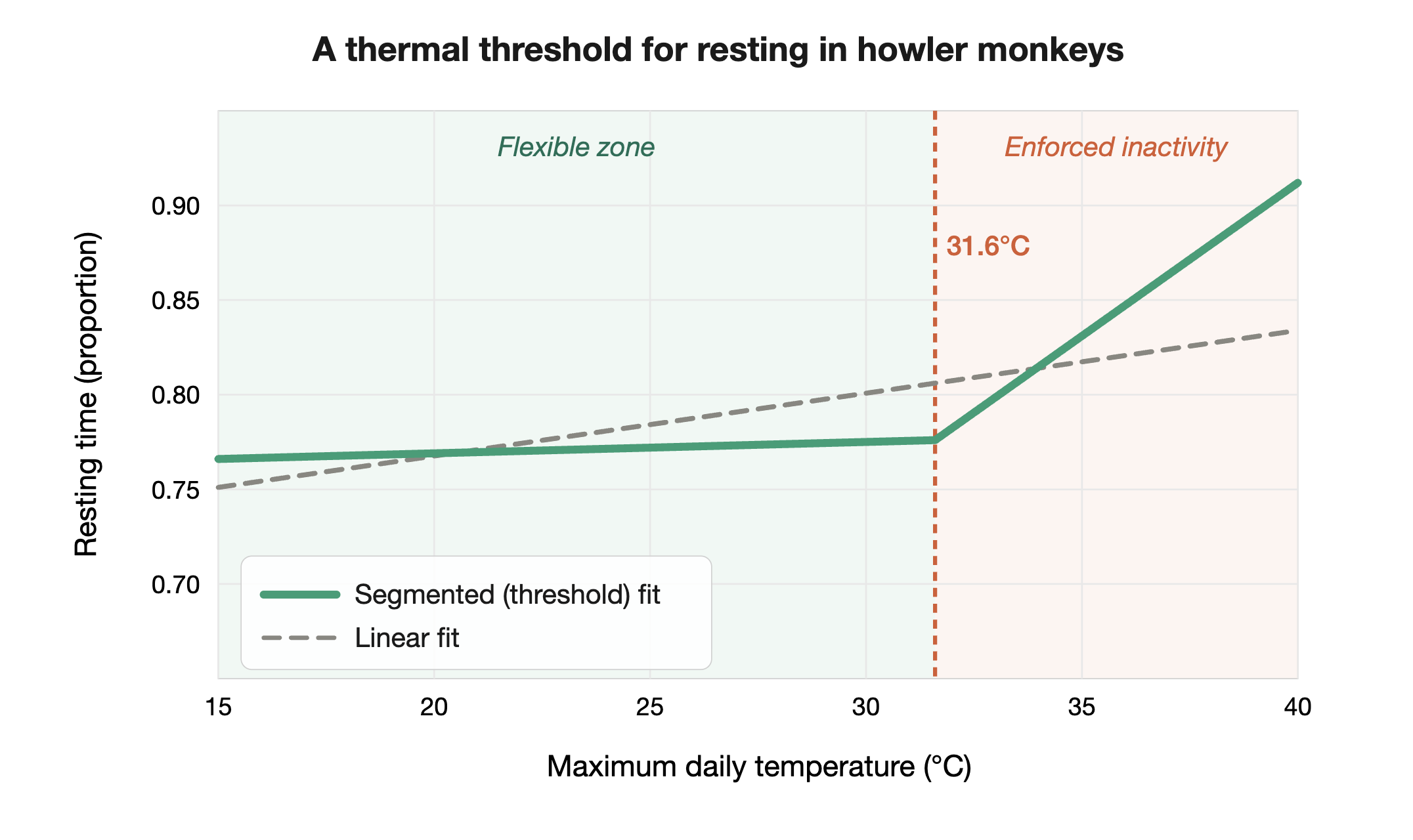
Resting as a buffer, not a floor
Perhaps the most conceptually important result was this: resting time was not the stable, invariant baseline that strict energy minimisation would predict. Instead, it was the most responsive component of the activity budget, absorbing fluctuations in food availability and temperature like a behavioural shock absorber. Howlers do not rest because they have nothing better to do, they rest strategically, and the amount they rest tells us a great deal about the pressures they are under.
That strategic flexibility, however, has limits. Identifying where those limits lie, and how climate change may erode them, is now one of the most pressing questions for the conservation of Neotropical primates.
About the authors:
We are behavioural ecologists based in Xalapa, México, where we have been studying wild mantled howler monkeys at the Los Tuxtlas rainforest for over two decades. Our work focuses on how primates manage energy under the demands of a challenging diet, a hot climate, and the costs of reproduction.
Read the paper here:

