
In this blog post, Matia Haïm Muller tells the #StoryBehindThePaper for the article “Assessment of large-scale spatial variation in age-specific survival and age at first breeding in a long-lived species”, recently published in the Journal of Animal Ecology. The study uses long-term ringing, resighting and dead-recovery data from more than 90,000 white storks across Germany to reveal how survival and age at first breeding differ across regions.
Different places, different population dynamics
A species’ overall population trend can hide very different regional stories. Across its range, some populations may increase rapidly, while others remain stable or decline. These contrasts in population trends reflect spatial differences in the demographic processes that determine whether populations grow or shrink. Among these processes, survival is often the main contributor to population growth. Age at first breeding is also important because individuals that start breeding earlier can contribute offspring earlier, speeding up population growth.
Yet we often know surprisingly little about how such processes vary across large areas. This is especially true for long-lived species, where survival is often strongly age-dependent and individuals may enter the breeding population at different ages, making their life cycles more complex.
The lucky case of a very visible, long-lived bird
White storks in Germany were an ideal system to address this knowledge gap for two reasons. First, data were available from over 90,000 birds ringed across the entire country over more than two decades and subsequently resighted as breeders or recovered dead, allowing us to estimate the probabilities of surviving and starting to breed across space, time and age. Second, populations showed contrasting regional trends, with strong increases in western Germany and slight declines further east, suggesting that survival, age at first breeding, or both, might vary substantially across Germany.

Turning rings into maps
To investigate this, we divided Germany into 12 spatial units, corresponding to the German federal states, and then fitted three capture–recapture–recovery models to the white stork data, allowing for both spatial and temporal variation. The models differed in how they structured spatial variation in survival and age at first breeding. In the first model, spatial units were treated as independent from each other. In the second model, we assumed that neighbouring units should be demographically more similar, by accounting for spatial autocorrelation between units sharing a border. Finally, in the third model, we also accounted for spatial autocorrelation, but only between neighbouring spatial units belonging to the same migratory flyway. This last approach was motivated by the biology of white storks: individuals from different parts of Germany follow different migration routes and winter in different regions, which may strongly influence demographic processes.
Our results: a demographic divide shaped by migration?
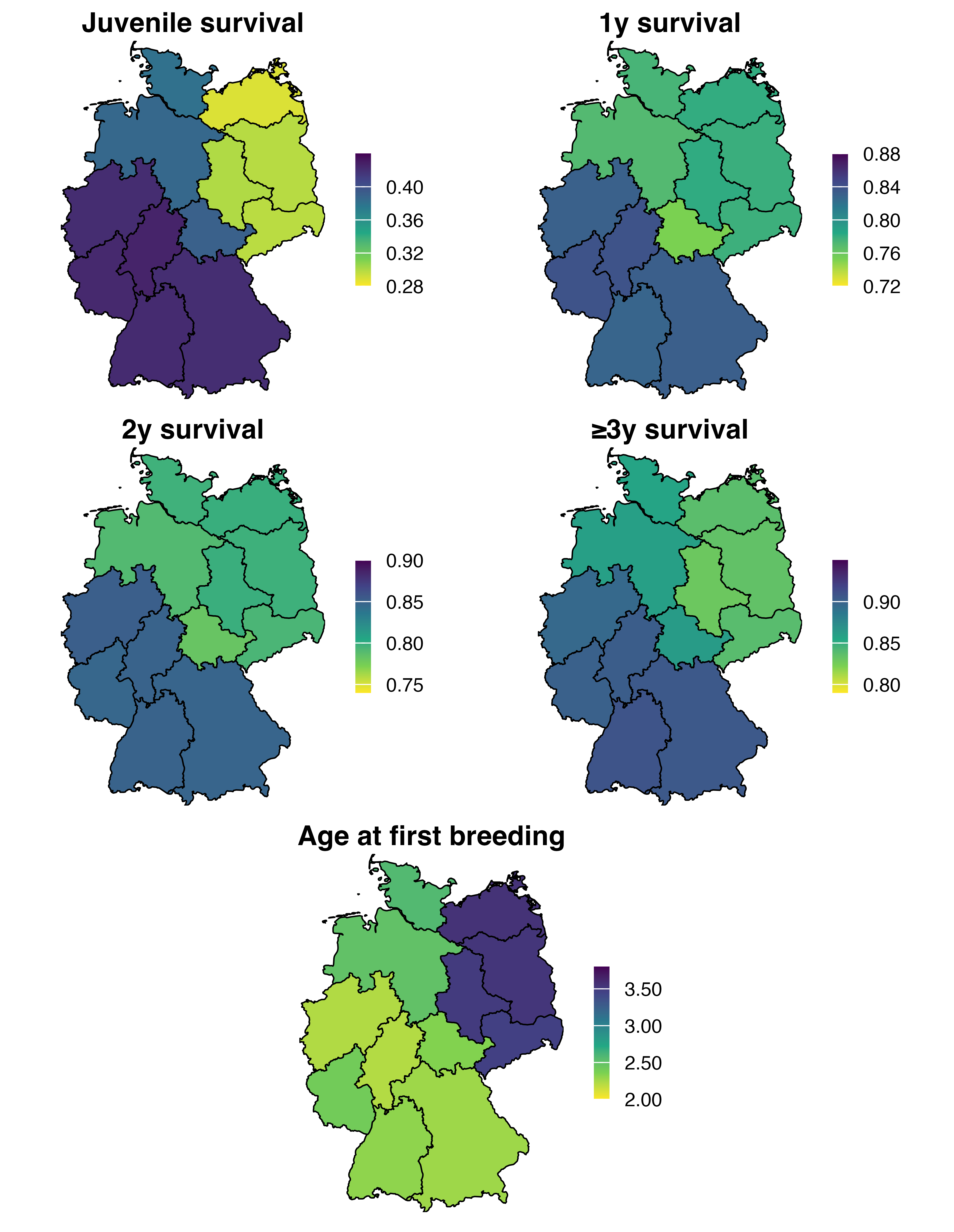
The contrasting population trends across Germany were mirrored by clear spatial differences in survival and age at first breeding. Across all three models, survival was lower in eastern than in western Germany, and storks in the east started breeding later. Because higher survival and earlier first breeding both favour population growth, these patterns suggest that spatial variation in these two demographic processes likely contributes substantially to the higher growth rate observed in western Germany.
A likely explanation for spatial differences in survival and age at first breeding lies in migration. White storks from western Germany generally migrate along the western flyway, with many individuals now wintering in southern Europe or North Africa, whereas eastern birds usually follow a longer route towards eastern and southern Africa. Longer migrations may expose individuals to higher risks, reducing survival, and to greater energetic costs, delaying age at first breeding. Our comparison between the three models supported this interpretation. The best-performing model was the one in which spatial autocorrelation was structured by migratory flyway. This suggests that neighbouring regions are not necessarily demographically similar just because they share a border. What matters is also whether their storks follow similar migratory routes. This highlights the importance of incorporating species biology when modelling spatial variation in demographic processes.
Juveniles: the age class that feels everything?
Juvenile survival was both more temporally and more spatially variable than survival of older individuals. For temporal variation, this pattern is consistent with the demographic buffering hypothesis, which suggests that natural selection reduces variation in the demographic rates that contribute most to population growth, typically adult survival in long-lived species. Our results suggest that a similar pattern may also occur across space and therefore point to a form of spatial demographic buffering.
We also found that juvenile survival, unlike survival in older age classes, was synchronised among neighbouring regions. This suggests that large-scale environmental factors such as climate play an important role in shaping juvenile survival, whereas older individuals appear less sensitive to them.
What’s next?
This study mapped two key pieces of the demographic puzzle: survival and age at first breeding. The next step is to understand how dispersal connects regions and shapes population growth rates across space, bringing us closer to a full picture of spatial population dynamics.
Read the paper:
https://besjournals.onlinelibrary.wiley.com/doi/full/10.1111/1365-2656.70291

