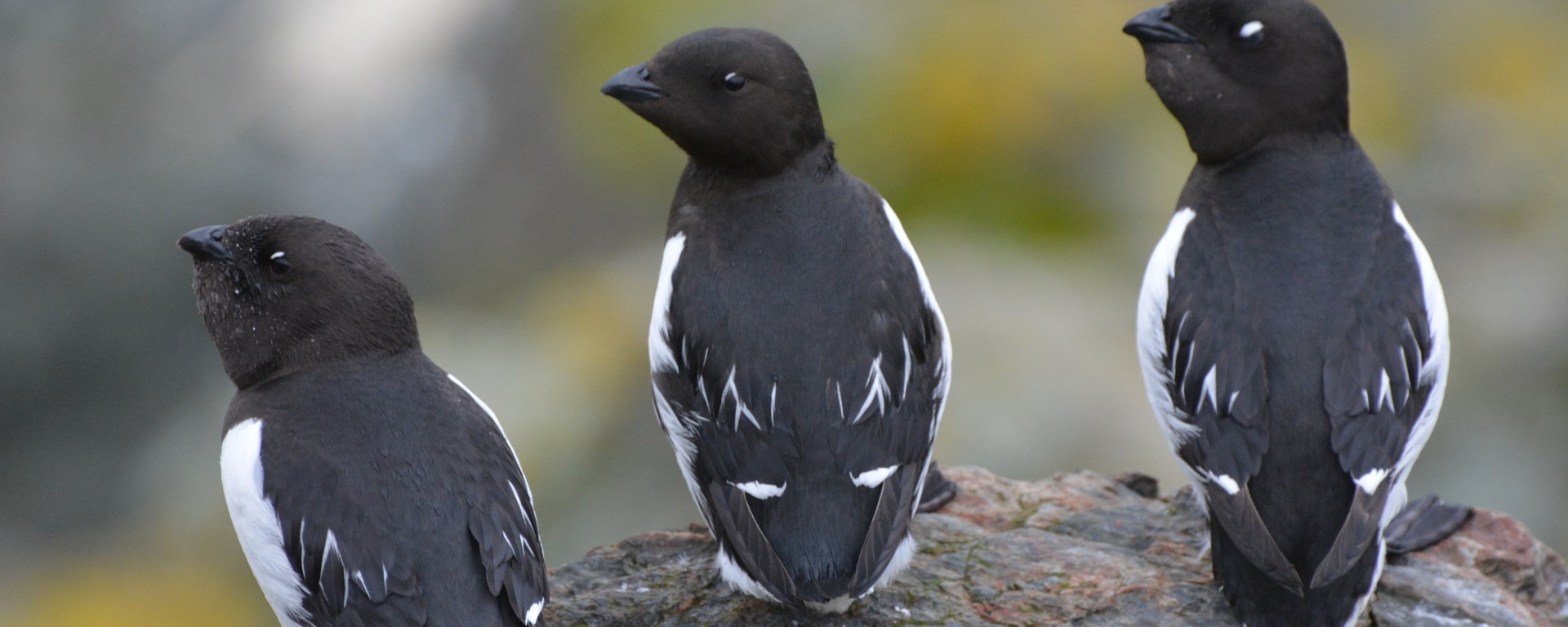
This blog post is provided by Martyna Syposz and tells the #StoryBehindThePaper for the article “Snowmelt predicts earlier breeding across the latitudinal range of an Arctic nesting seabird, the Little Auk (Alle alle)“, which was recently published in Journal of Animal Ecology. This study examined how snowmelt timing is linked to breeding onset in several little auk colonies over time.
The High Arctic is not like anywhere else on Earth. No trees, no shrubs — just vast, open expanses of rock, ice, and tundra stretching to the horizon. But in some sites, “oases of life”, you can spot myriads of seabird circling above their breeding colonies. In this hostile environment, for animals, that means nowhere to hide. Predators — Arctic foxes, glaucous gulls, polar bears — can spot you from far away, and there is little you can do but run or fly.
Unless, of course, you are a Little Auk.
These small, charismatic seabirds — barely bigger than a starling — adapted to this problem long ago by squeezing their nests deep into the gaps between rocks and boulders on steep Arctic slopes. No predator can easily reach them there. It is the perfect hiding spot. The only catch? To get inside, you first need the snow to melt.
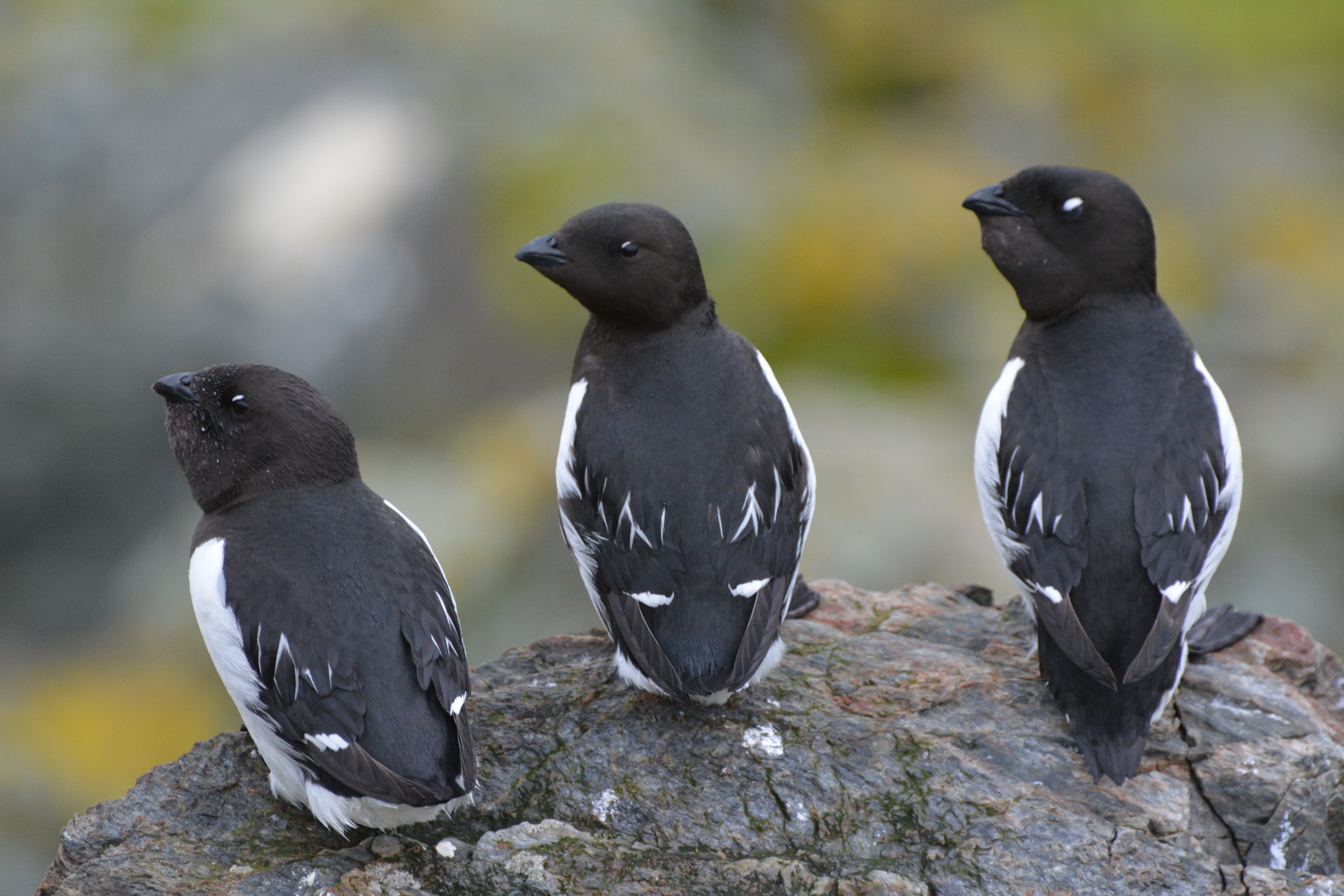
Getting there in the first place
Before we could study any of this, we had to actually get to where the birds breed — and that is no small feat. Little Auk colonies are scattered across some of the most remote corners of the High Arctic: Svalbard, Greenland, Franz Josef Land, places that most people have never heard of. Reaching them is a logistical puzzle involving planes, boats, amphibia, and sometimes helicopter flights to shores that are only accessible for a narrow time window each year. When the weather turns — and in the Arctic, it often does — strong winds can make it impossible to come ashore at all, leaving scientists waiting on a boat, watching the colony through binoculars.
When you are already there, stay alert! Keep your eyes open! The polar bears can be around! Every scientist working in these colonies ensures that they are accompanied by a rifle — because a bear encounter in the field can be fatal, and there is no room for complacency. You learn quickly to scan the landscape constantly, to never get so absorbed in your data collection that you forget to look up. The King of Arctic is ruling here!
Getting funding for all of this — year after year, for 25 years across four locations — is its own kind of expedition. Grants, permits, logistics, recruitment of field assistants willing to spend their summer scraping their arms between boulders to get into nests. Blood and sweat! The data behind this paper represent an extraordinary collective effort by many people over many years, and we are deeply grateful to all of them.
What scientists actually do there (it involves a lot of rocks)
Once you arrive, the work is physical and painstaking. Little Auk nests are tucked so far into rock crevices that finding them requires patience and a willingness to wedge your arm — sometimes up to the shoulder — into their stone fortress with narrow gaps between boulders to feel for eggs or chicks. You build up a map of nest locations over the years, returning to the same spots each season to check for eggs, then hatching, then chick growth.
The key constraint is time. The Arctic field season is short, logistics are expensive and weather-dependent, and scientists are typically present only during the most critical window — when hatching is already underway and some chicks are growing. The earlier part of the breeding season — when birds arrive, court, defend territories, and wait — often goes unobserved, not least because the ocean is frequently still ice-covered at that time, complicating logistics further.
Where satellites come in
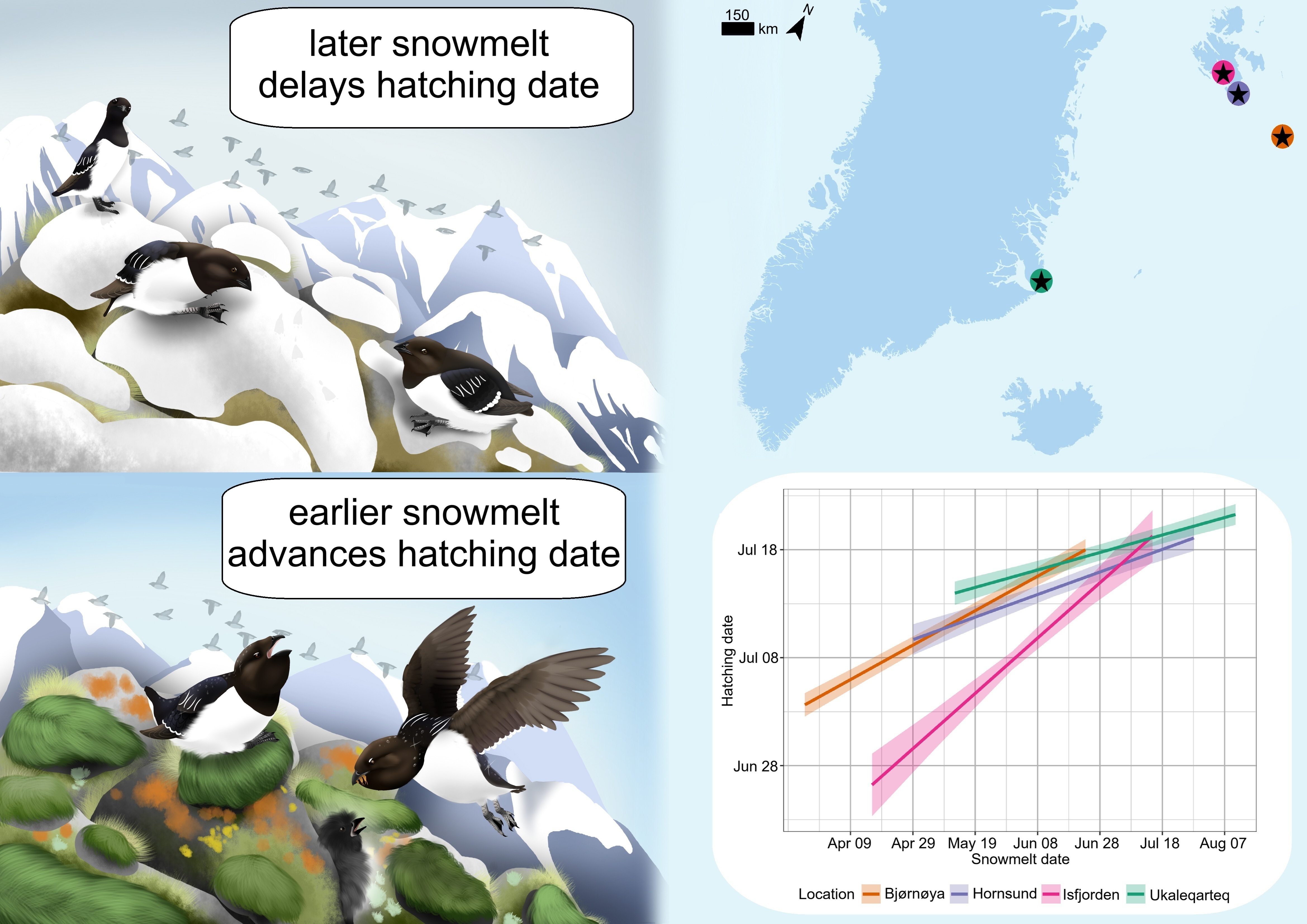
To understand when breeding starts, we needed a way to measure conditions at the colonies even when no one was there. That is where satellite imagery came in. Using data from the satellite-based sensor Moderate Resolution Imaging Spectroradiometer (MODIS), we tracked, for each colony and each year, the date when snow cover dropped below the threshold at which nest crevices typically become accessible.
Meanwhile, from our long-term nest monitoring, we had hatching dates going back up to 25 years across four colonies. Combining these two independent datasets — satellite-derived snowmelt dates and field-recorded hatching dates — allowed us to test whether the two were statistically linked.
Across all four colonies — Hornsund, Isfjorden, Bjørnøya in Svalbard archipelago, and Ukaleqarteq in East Greenland — we found the same pattern: earlier snowmelt was associated with earlier hatching. The strength of this relationship varied by location: a 10-day advance in snowmelt corresponded to a 3.7-day advance in hatching in Isfjorden, Svalbard, compared to just 0.9 days in East Greenland. This is consistent with the idea that snow cover at the colony limits when birds can access their nest crevices and begin breeding.
What has been happening — and what comes next
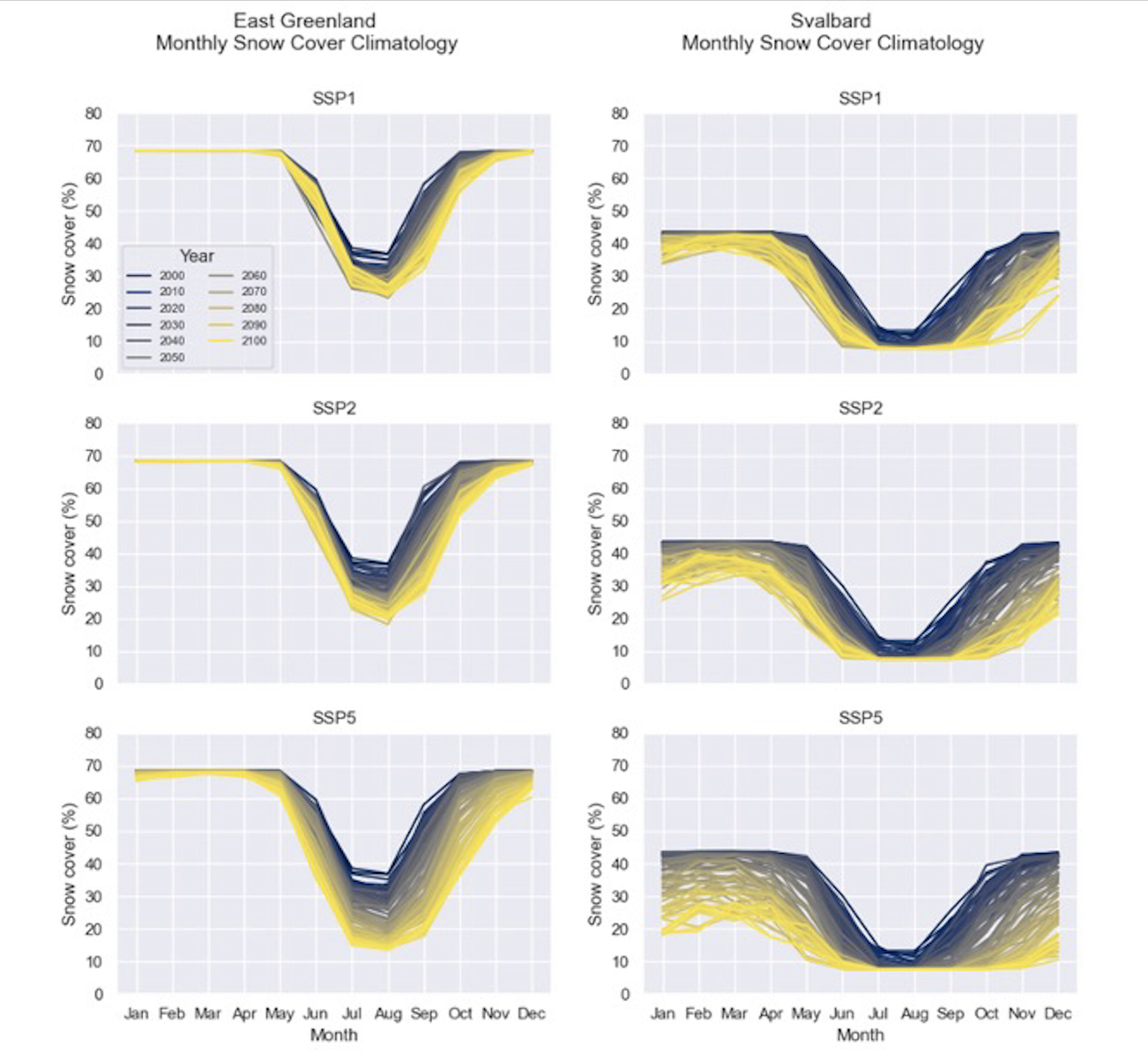
Over the 25 years of our dataset, snowmelt timing has been variable — some years early, some years late — but without a consistent directional trend at any of our four study sites. That means the relationship we detected is driven by year-to-year variability, not by a steady march toward earlier springs. At least not yet.
The future, however, tells a more consistent story. Climate projections suggest that spring snowmelt will advance across Arctic breeding regions, with Svalbard showing particularly marked changes under all three emissions scenarios — ranging from an optimistic low-emissions future to a high-emissions trajectory where fossil fuel use continues largely unchecked throughout this century. The most pronounced reduction in snow cover is projected to occur in autumn, reflecting a delayed return of snow and an overall extension of the snow-free season.
Will earlier snowmelt benefit the Little Auks?
This is the question we most wanted to answer — and the answer, it turns out, is: it depends.
Within any given year, earlier-hatching chicks do better. In Hornsund, Svalbard chicks hatching later than the annual mean grew more slowly and had lower survival to day 15; the same within-year penalty on growth was found in Ukaleqarteq, East Greenland and on survival in Isfjorden, Svalbard. This consistent pattern across colonies suggests directional selection favouring earlier breeding within seasons.
But when we look across years, the picture is more mixed. In most of the studied colonies, years with earlier mean hatching dates did not produce obviously better outcomes for chicks. The exception was Isfjorden, Svalbard, where earlier mean hatching dates were associated with higher chick survival — though this pattern across years may reflect individual quality rather than a direct benefit of early breeding itself: in good years, higher-quality birds may both breed earlier and raise more successful chicks. So the relationship between breeding timing and chick outcomes at the population level is real in some places, but its interpretation is not straightforward.
Meanwhile, other threats are accumulating. The “borealization” of Arctic zooplankton communities — whereby the large, lipid-rich copepods that Little Auks depend on are being replaced by smaller, less nutritious species — poses a separate and serious challenge. Earlier snowmelt may shift the timing of breeding, but it cannot buffer the birds against changes happening dozen or hundreds of kilometres away, out at sea. Multiple stressors, as any ecologist will tell you, are no fun.
Read the paper here:
https://besjournals.onlinelibrary.wiley.com/doi/full/10.1111/1365-2656.70287

