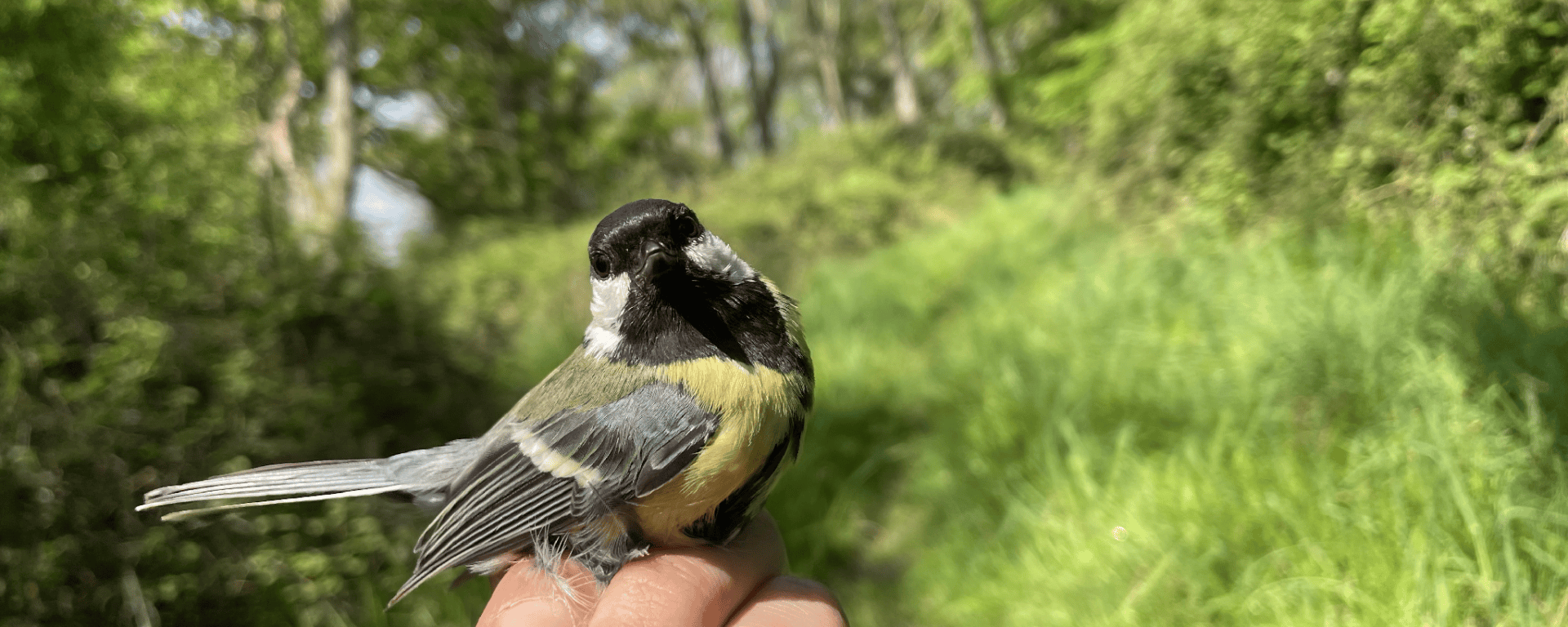
This blog post is provided by David López-Idiáquez and tells the #StoryBehindThePaper for the article “Early-life environment drives long-term decrease in adult body mass in a wild bird population“, which was recently published in Journal of Animal Ecology. This study explored temporal changes in body mass of adult and nestling great tits, as well as the effect of several environmental variables.
Change is inherent to nature, and understanding phenotypic change has long interested the scientific community. This interest has grown in recent decades, as many traits have shown marked shifts in expression in response to anthropogenic environmental change. For instance, studies across taxa have reported phenological (timing of life-history events such as egg-laying dates or arrival from wintering grounds) and ornamental changes in response to rapid global warming.
These changes are not limited to phenology or ornamentation, and other traits are also responding to the environmental alterations imposed by climate change. One such trait is animal morphology (e.g. body mass and size). In the last few years, several studies have reported temporal declines in body mass and size, linking these changes to rapid warming. This link has been based upon an intraspecific version of Bergmann’s rule, as individuals in warmer areas are expected to be smaller due to the heightened thermoregulatory benefits associated with smaller sizes.
Although temporal declines in morphology seem to be a general response to rapid warming evidenced, for instance, by a recent study reporting size declines across 105 species in North America, the role of thermoregulation as a driver of these trends has recently been challenged. New research has shown that the magnitude of the changes reported in this study, and in others, is not expected to significantly impact heat production or dissipation abilities. Therefore, this suggests that environmental factors other than temperature may be behind the reported declines in body mass or size.
Changes in resource availability are a potential candidate to explain the trends. Although under moderate to strong genetic control, body mass and size are also inherently plastic. Thus, changes in resource availability could also explain temporal trends in body mass. Still, there is little information on how environmental variables other than temperature modulate temporal trends in body mass and size.
A final question that remains to be elucidated is the life stage at which environmental change impacts morphology. To date, nearly all studies analysing temporal trends have linked environmental variables to focal traits measured at the adult stage, overlooking the well-known fact that the early-life environment can carry over to adulthood to explain trait variation.
In this context, we wanted to study body mass trends and analyse the potential roles of temperature and resource availability in explaining them. We used the long-term dataset on great tits Parus major at Wytham Woods (near Oxford, UK). This population has been under intense monitoring since 1947, when David Lack started studying great tits there. Previous work by Gosler and collaborators already reported mass declines in Wytham. Specifically, they showed that great tit mass declined between the 1940’s and the end of the 1970’s, as a result of increased predation intensity by sparrowhawks returning to Wytham. Given that the predation effects on mass plateaued after 1978, we restricted our analyses to the period between 1978 and 2024.
Despite this data truncation, and thanks to the tireless work of more than 250 field assistants, PhD students and postdocs, I was able to use more than 17,000 and 77,000 observations for adult and nestling great tits respectively (Fig. 1). In addition to these phenotypic data, the Wytham great tit dataset includes a social pedigree describing the relatedness of all breeding individuals across 38 generations. Thanks to this pedigree, I was able to look beyond phenotypic patterns and obtain information about the trends and associations at the genetic level.
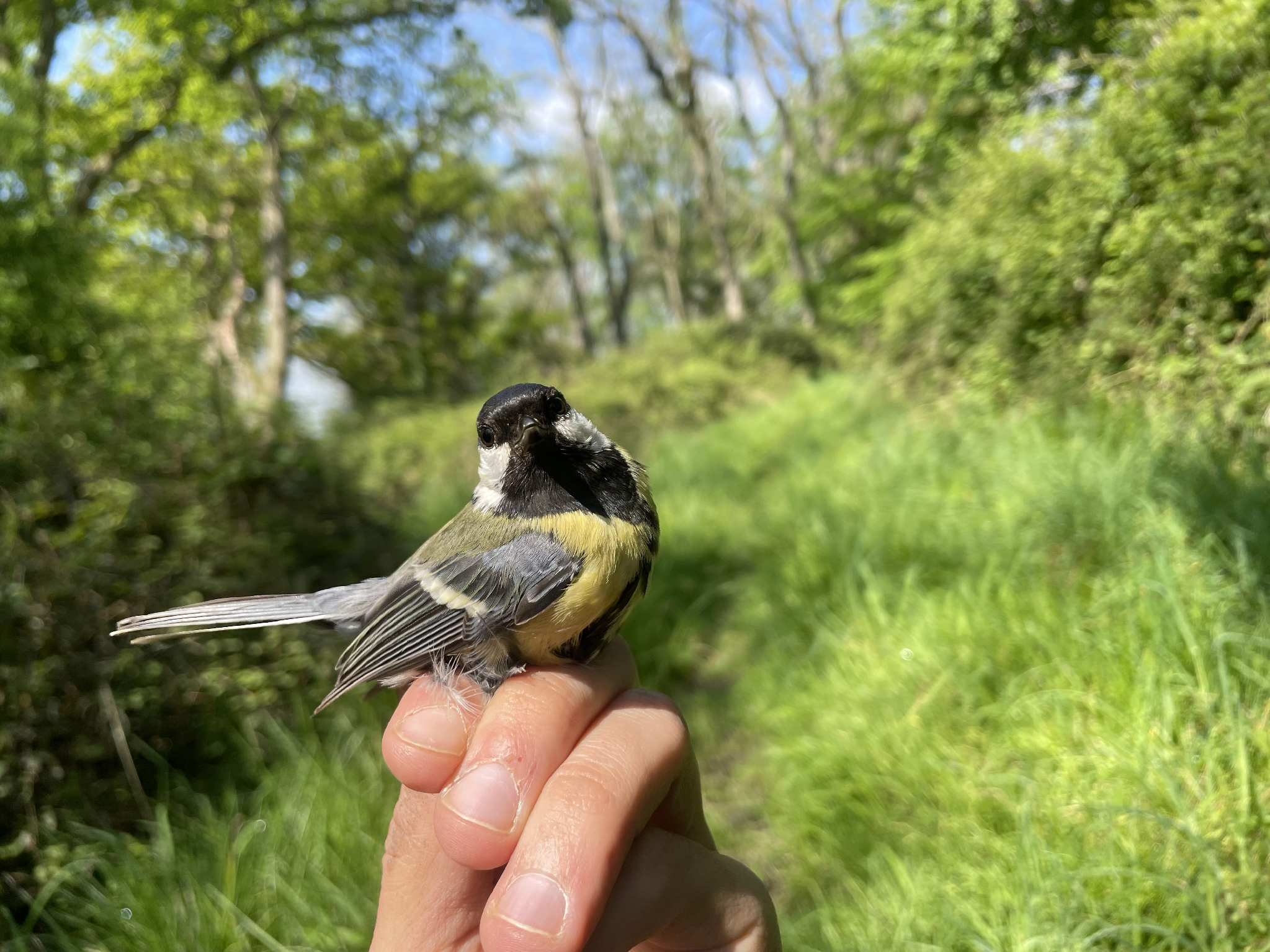
We complemented this data on great tits with information on temperature and resource availability in Wytham, both of which have changed during the study period. For temperature, we followed two complementary approaches, considering both temperatures over broad and fixed time windows (i.e. temperature in Spring and in the previous Winter) and over shorter, relative time windows to each breeding attempt (i.e. temperature in the 10 days before capture). As proxies of resource availability, we used the mismatch with a key food resource, and breeding density, including great tits and blue tits Cyanistes caeruleus (a confamilial species with an overlapping ecological niche).
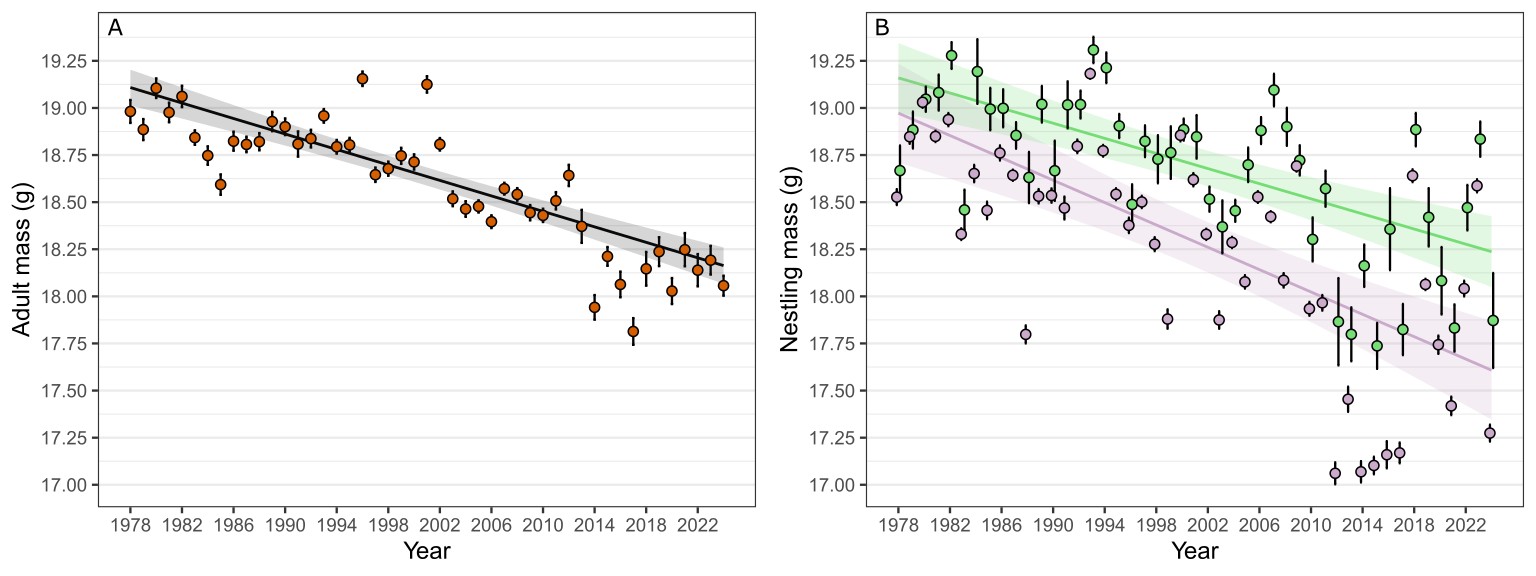
Using this amazing dataset, we found that great tit body mass is declining in Wytham, both in adults and in nestlings (Fig. 2). Adult mass has declined by about 1 gram and nestling mass by about 1.4 grams, representing a change of approximately 1 standard deviation in both. In addition, using the pedigree, we were able to look at whether this change at the phenotypic level was paralleled by a change at the genetic level. As this was not the case, it suggests that the trends we report represent a plastic, rather than a genetic, response to environmental variation.
Linking the changes in mass to the environmental variables showed that the trends in adult mass were not explained by neither the temperature increase nor the changes in resource availability. In contrast, the trends in nestling mass were linked to breeding density (but not temperature), as great tit nestlings that experienced higher blue and great tit densities while growing developed into lighter fledglings. Thus, given that great and blue tit numbers have notably increased in Wytham since 1978, the trends in nestlings were, at least to a certain extent, explained by the changes in breeding density.
What then explains the temporal trends in adult mass? To answer this question, we ran slightly more complex models. First, we analysed the temporal trends in adult mass at two different levels: between- and within-cohorts. The results for this model showed that the temporal trends in mass represented a two-level process. While at the between-cohort level (Fig. 3 – black line) there was a negative trend of a similar magnitude to that shown above (Fig. 2), the trends within-cohorts were positive (Fig. 3 – coloured lines).
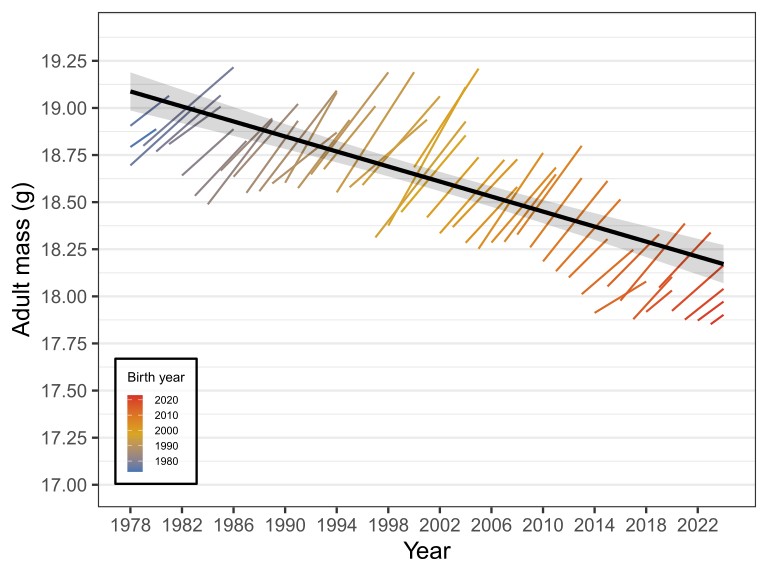
This means that individuals from cohorts closer to 2024 are consistently lighter than those at the beginning of the study. Then, within each cohort, we found an increase in mass that probably represents an age-dependent pattern. This result aligns with the idea of early-life effects carrying over to adulthood and explaining the trends in mass I report.
To further test this, we fitted a bivariate animal model to analyse the correlation between adult and nestling mass at the year-of-birth level, while controlling for the genetic correlation between adult and nestling mass. Our results show that even after controlling for this positive genetic correlation, heavier fledgling cohorts develop into heavier adults, strongly aligning with the idea of early-life effects explaining the adult trend. In addition, the presence of a negative association between adult mass and the breeding density those adults experienced as fledglings strongly suggests that, at least to a certain extent, the trend we find in great tit adults is the product of changes in density early in life. Thus, changes in breeding density are making great tits, named “great” after being the largest member of the Paridae family in Europe, a bit less great.
Finally, beyond the insights on temporal trends in bird mass revealed by our study, this work also highlights the relevance of looking beyond temperature when analysing the ecological drivers of temporal phenotypic changes in a world under climate change, and the importance of considering carry-over effects across life stages.
Read the paper here:
https://besjournals.onlinelibrary.wiley.com/doi/full/10.1111/1365-2656.70352

