
This blog post is provided by Nicolas Bekka and tells the #StoryBehindThePaper for the article “Paler within the city: carotenoid-based colouration covaries negatively with the proportion of impervious surface in great tit (Parus major) territories across Europe”, which was recently published in Journal of Animal Ecology. In their study, Bekka and colleagues explore how fine-scale urbanisation shapes plumage colour in great tits across six European cities, finding that birds in more built-up neighbourhoods have paler carotenoid-based plumage.
Not all “urban” birds experience the same city
Urban ecology often relies on simple comparisons of “urban” versus “rural” habitats, with increasing use of intermediate categories such as “suburban”. These categorical distinctions have taught us a lot, including that animals living in cities tend to differ from their rural counterparts in behaviour, reproduction, physiology, and appearance, such as plumage colour. But there is an elephant in the room with these kinds of approaches: cities are not homogeneous. They differ from one another, and even within a single city, wildlife individuals of the same species can encounter and exploit very different microhabitats.
A great tit breeding in a leafy park and another nesting a few hundred metres away among roads and buildings can both be labelled “urban”, despite experiencing very different environments. This led us to ask a rather simple question: instead of comparing urban and rural populations, could we detect changes in plumage colour along the fine-scale urbanisation gradients that individual birds experience within cities? And because previous studies have repeatedly reported differences in colouration between urban and rural populations, we also wanted to see whether the same environment-colouration relationship would emerge consistently in different cities across Europe.
Great tits (Parus major) offered a particularly interesting system for testing this. Great tit populations are monitored across many urban and rural European sites using broadly standardised protocols, making comparisons among populations relatively straightforward. Moreover, their yellow breast plumage contains carotenoid pigments, which birds cannot synthesise themselves and must ultimately obtain through their diet. Previous studies have repeatedly found that urban great tits tend to have paler carotenoid-based plumage than rural birds, and our aim was to see whether this pattern also emerged continuously within cities, and whether it was consistent across Europe.
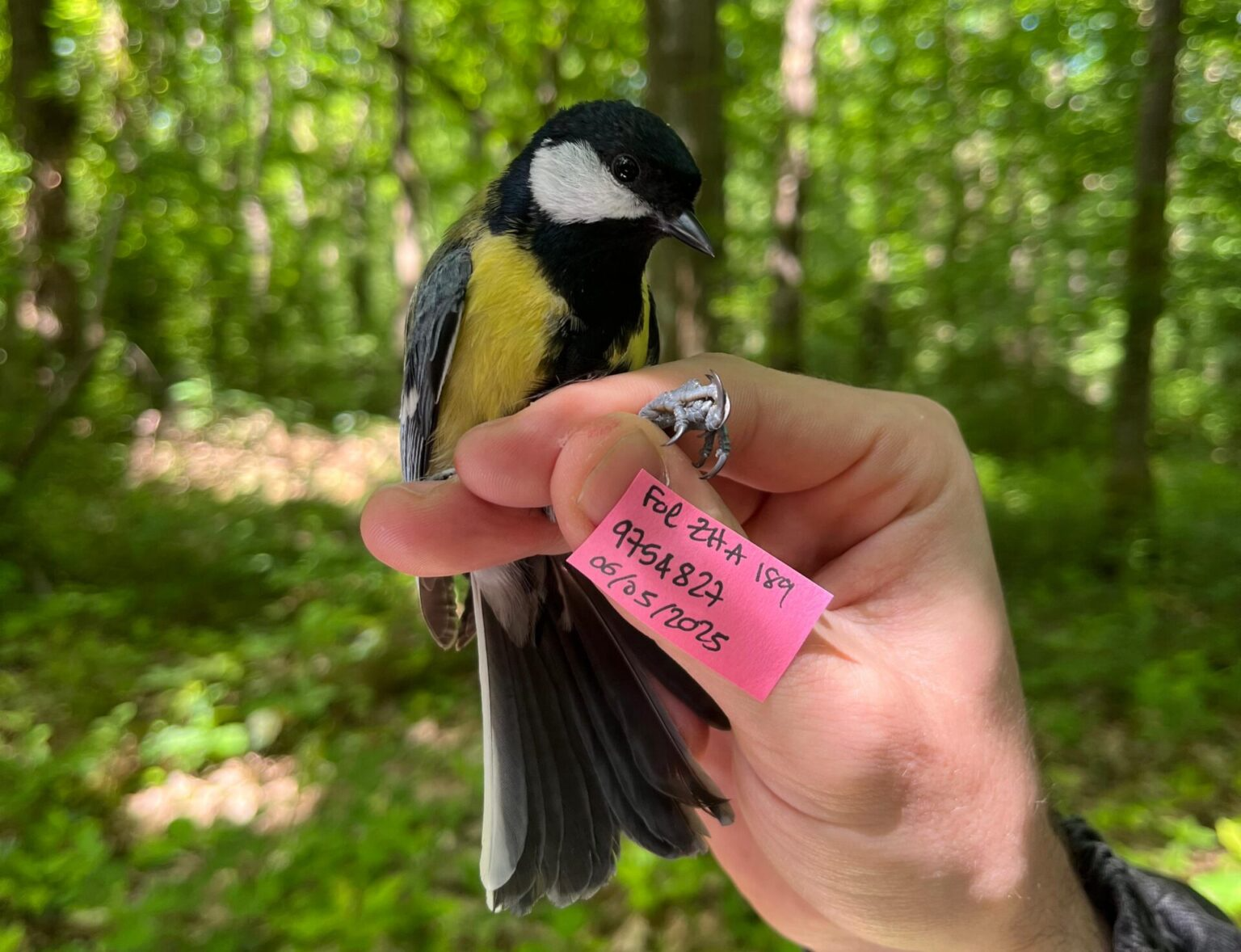
Great tits have yellow breast plumage, which contains carotenoid pigments obtained through their diet. Credit: Nicolas Bekka.
Six cities, 838 birds and a lot of pixels
To do this, we brought together 838 observations of adult great tits from six European cities: Paris, Montpellier, Antwerp, Warsaw, Malmö and Harjavalta. The biological data came from long-term monitoring programs spanning multiple years between 2005 and 2024. During the breeding season, adults were captured at nest boxes and a few yellow breast feathers were collected. We later measured the light reflected by these feathers using spectrophotometry, allowing us to quantify different components of their colour.
We then turned to the birds’ surroundings.
Using high-resolution imagery, we measured the proportion of impervious surfaces (buildings, roads and other hard surfaces) within 100 metres of each nest box, which roughly corresponds to the spatial scale of a great tit breeding territory. To do so, we classified the imagery into two broad categories, vegetation and impervious surface, using the spectral information contained in the pixels. Rather than assigning an entire city a single “urban” label, each breeding observation could therefore be associated with its own measure of local imperviousness at the territory scale.
The more built-up the territory, the paler the birds
Across the six cities, great tits occupying territories with more impervious surfaces had lower carotenoid chroma, a measure of feather reflectance associated with carotenoid pigment deposition in the feathers. In plain English: their yellow plumage was paler. We tested the robustness of this pattern in several ways. We balanced sample sizes among cities, removed each city from the analysis in turn, and accounted for average colour differences between populations. The relationship consistently remained negative.
Importantly, the pattern was specific to carotenoid chroma. Two other properties of the feathers, brightness and ultraviolet chroma, did not vary with imperviousness. This makes our result more consistent with processes affecting carotenoid acquisition or deposition than with broader changes in the feather structure and overall quality.
Concrete does not simply “make birds pale”
Impervious surface is especially relevant in urban ecological studies because it captures one important dimension of urbanisation and provides a relatively straightforward continuous measure of urbanisation intensity. More built-up territories may differ in vegetation, caterpillar and other prey availability, supplementary food, pollution, artificial light, noise and many other characteristics. However, because impervious surface remains a broad descriptor of urban habitats, our study cannot determine which of these factors ultimately drives the colour pattern. Future studies will need to dig deeper into fine-scale environmental characteristics underlying this continental-scale pattern of colouration.
There is also an interesting timing issue: the feathers we measured during spring breeding had actually grown during the previous post-breeding moult. We therefore found an association between plumage colour and breeding territory, rather than demonstrating that the current territory directly caused the feathers to become paler.
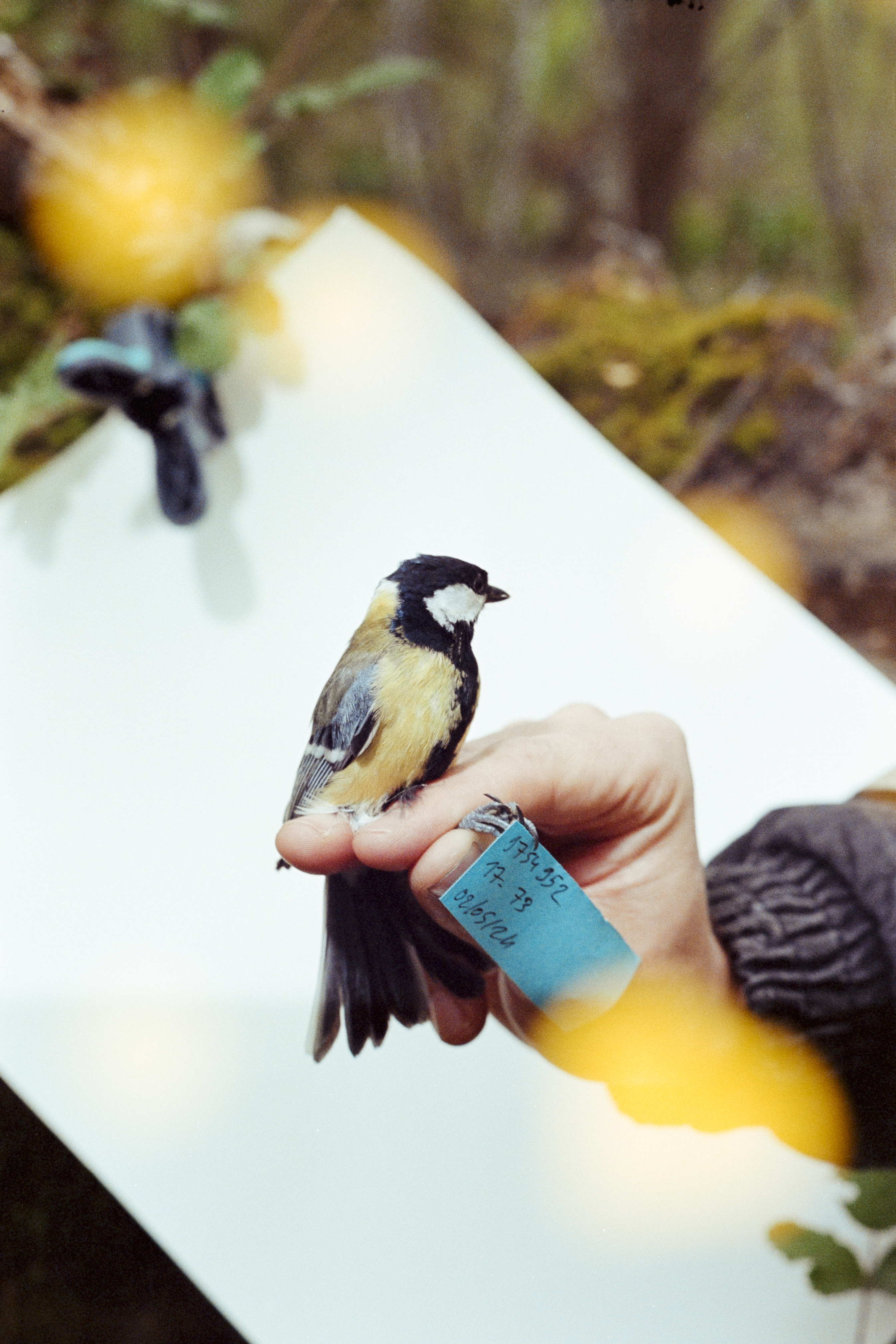
Great tit during field monitoring. Credit: Grégoire Delanos, Recherche sans filtre, Sorbonne Université, 2024.
From urban ecology to urban evolution
Nonetheless, this broad pattern in colouration allows us to hypothesise about several processes that could explain why paler birds occur more often in highly built-up territories. Urban fragmentation could restrict movement; birds with different competitive abilities or feeding strategies might settle in different habitats; similar environmental pressures could generate plastic responses across cities, and/or, over longer timescales, natural selection could favour different phenotypes under different urban conditions. As highlighted in a previous study, paler carotenoid-based plumage in urban environments can also be associated with higher reproductive performance, at least for some components, in Paris. This suggests that natural selection could contribute, at least partly, to the colouration patterns observed in urban populations. Distinguishing between these hypotheses is the next challenge, but it will require following birds between breeding and moult, studying their diet and movements, and asking whether natural selection itself changes along fine-scale urbanisation gradients.
More broadly, our study is a reminder that wildlife does not experience “the city” as a single category. A growing body of literature in urban ecology is already moving towards measuring continuous characteristics of urban environments, and this study adds another piece to that shift. Urban–rural comparisons are essential first steps, but they can only take us so far. Cities are messy, heterogeneous places, and labelling entire populations as “urban” or “rural” can miss part of that complexity. Especially for animals occupying small territories, ecological differences across relatively short distances may matter. Combining long-term monitoring with environmental data at that same biological scale can help us understand not only how animals live in cities, but also how ecological and evolutionary processes may unfold within them over time.
Feature image credit: Grégoire Delanos, Recherche sans filtre, Sorbonne Université, 2024.
Read the paper here:
https://besjournals.onlinelibrary.wiley.com/doi/10.1111/1365-2656.70355

