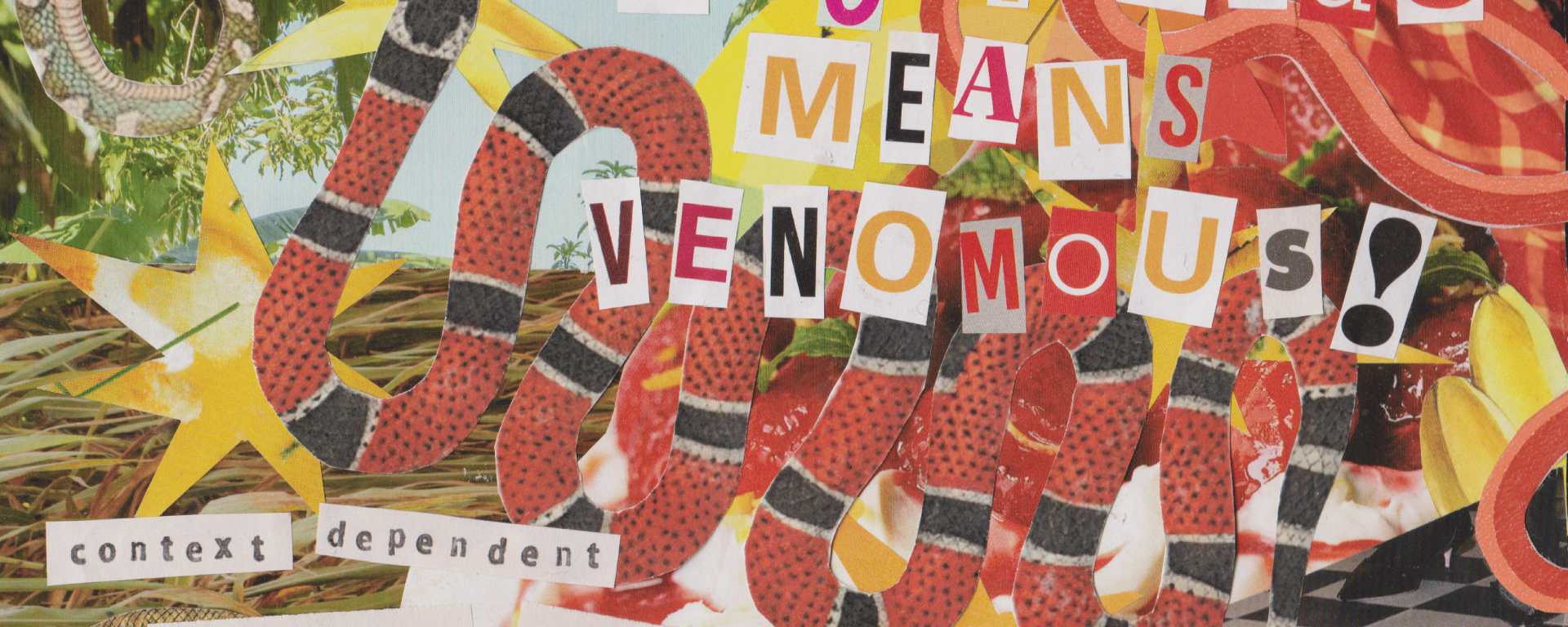
This blog post is provided by Amy Duclaux and tells the #StoryBehindThePaper for the article, “Contextually conspicuous species are more likely to be venomous: Habitat-dependent aposematic colouration found throughout snakes”, co-authored with Michel Dugon and Kevin Healy. This study explored whether venomous snakes are more likely to stand out from their natural environments, finding links between venom, conspicuous colouration, red colouration and banded patterns.
Born to Stand Out: What is Aposematism?
Animals use colours for all sorts of purposes, but broadly speaking, they fall into one of two categories: to stay hidden or be seen. Bright, bold, conspicuous colours are either used as sexual signals to attract a mate, famously seen in birds where males “dress to impress” in order to get the female’s attention, or as warning signals to advertise a species’ unpleasant nature. These warning signals, known as aposematism, are widespread in the animal kingdom, with well-known examples including the distinctive yellow and black banding of venomous wasps, the vibrant colours of poison dart frogs, and the conspicuous black and orange patterning of the distasteful monarch butterfly. These bold signals warn potential predators to “stay back” and warn them that these individuals are more trouble than they are worth.
Coral snakes are another great example of a group that displays bright, conspicuous signalling to warn of its undesirable nature, which in this case is its venomous nature. However, despite this widely held expectation, it remains unclear whether conspicuous colouration is generally linked to being venomous.
Why Snakes?
Snakes are a large, charismatic group which have a vast diversity in venomous nature, colourful traits and ecological factors making them an ideal group to test aposematic signalling on a large taxonomic scale. Their photogenic appeal has also resulted in widespread coverage in citizen science applications such as iNaturalist, making image data for various snake species from around the globe readily accessible.
While venom is synonymous with snakes, whether it be from the more advanced venom systems found in viper and elapid species or the analogous Duvernoy’s glands found in colubrids, there are snake species such as rat snakes (Elaphe) which are non-venomous. This raises the question: are venomous snakes more likely to advertise their venomous nature to potential predators? Although venom is primarily used for subduing prey in snakes, it is secondarily used for defensive purposes. For instance, species such as spitting cobras (Naja and Hemachatus) have specific compounds in their venom which cause excruciating, fast-acting pain. These properties would be expected to be linked to warning signals.
In order to understand the potential drivers of warning signalling throughout snakes, we first need to be able to quantify how conspicuously coloured they are in relation to their environment.
Quantifying Contextual Conspicuousness
In order for warning signals to be effective, they need to be conspicuous within the context of a species’ natural environment. To quantify a species’ contextual conspicuousness, we collected image data from citizen science initiative iNaturalist for 458 different globally distributed Colubroidae snake species. For each species, we collected five images in order to capture the diversity of colouration across snake species and their microhabitats.
Each individual image was manually edited in order to split it into two images: one containing the snake, and the other containing its environment. Using the “colourdistance” package in R, we could then see how different the colours of the snake were from those of its natural habitat, giving us a single value representing an individual’s contextual conspicuousness, with larger values representing snakes which stood out in their natural environment. We also quantified the percentage coverage of known aposematic colours, red and yellow, to see whether increased degrees of these colours were linked with a venomous nature or if they were related to increased conspicuousness.
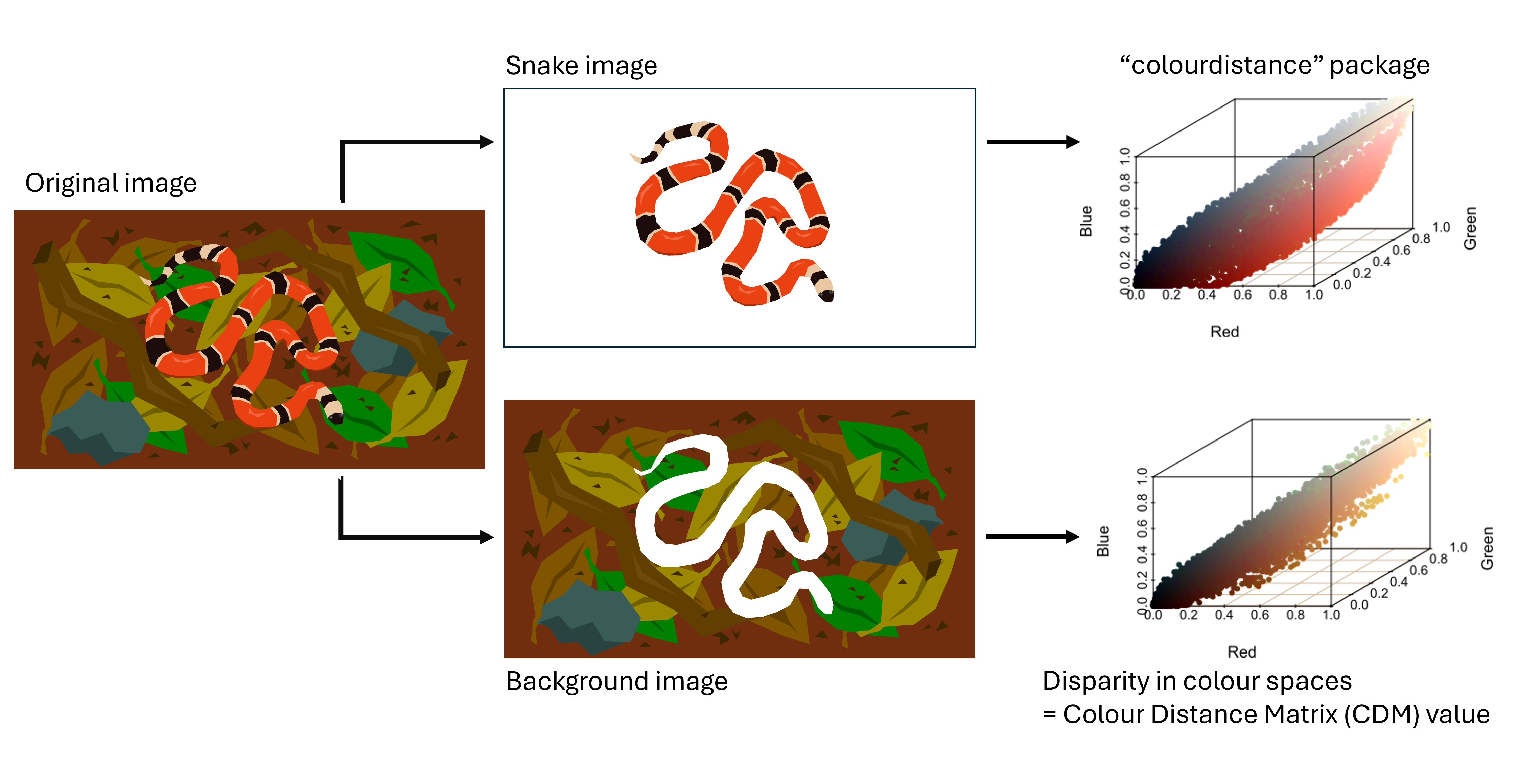
Quantifying contextual conspicuousness using citizen science photographs. From the original image, we split it into two: one with just the snake and the other with its natural habitat. From there, we use the “colourdistance” package in R to compare how different the RGB colour spaces are between the snake and its environment, with bigger values representing snakes which stand out greatly from their natural habitat. Image credit: Amy Duclaux.
Should I Avoid Conspicuously Coloured Snakes?
Our results suggest that venomous snakes are more likely to stand out from their natural habitat, have higher degrees of red in their colouring and have banded patterning. So, while I would advise avoiding any snakes you might encounter in the wild, based on the findings of this study, I suggest you at least avoid ones with these bold characteristics!
This study helped establish the elusive link between the presence of venom and conspicuous colours in snakes using a novel methodology to quantify contextual conspicuousness with a large, citizen-science image database.
So, What’s Next?
Future studies could potentially use similar readily available image databases and the above methodology to test possible group-wide aposematic signals in other animal groups, or investigate other bold visual traits, such as sexual dichromatism, in relation to animals’ natural environments.
Read the paper here:
https://besjournals.onlinelibrary.wiley.com/doi/10.1111/1365-2656.70351

