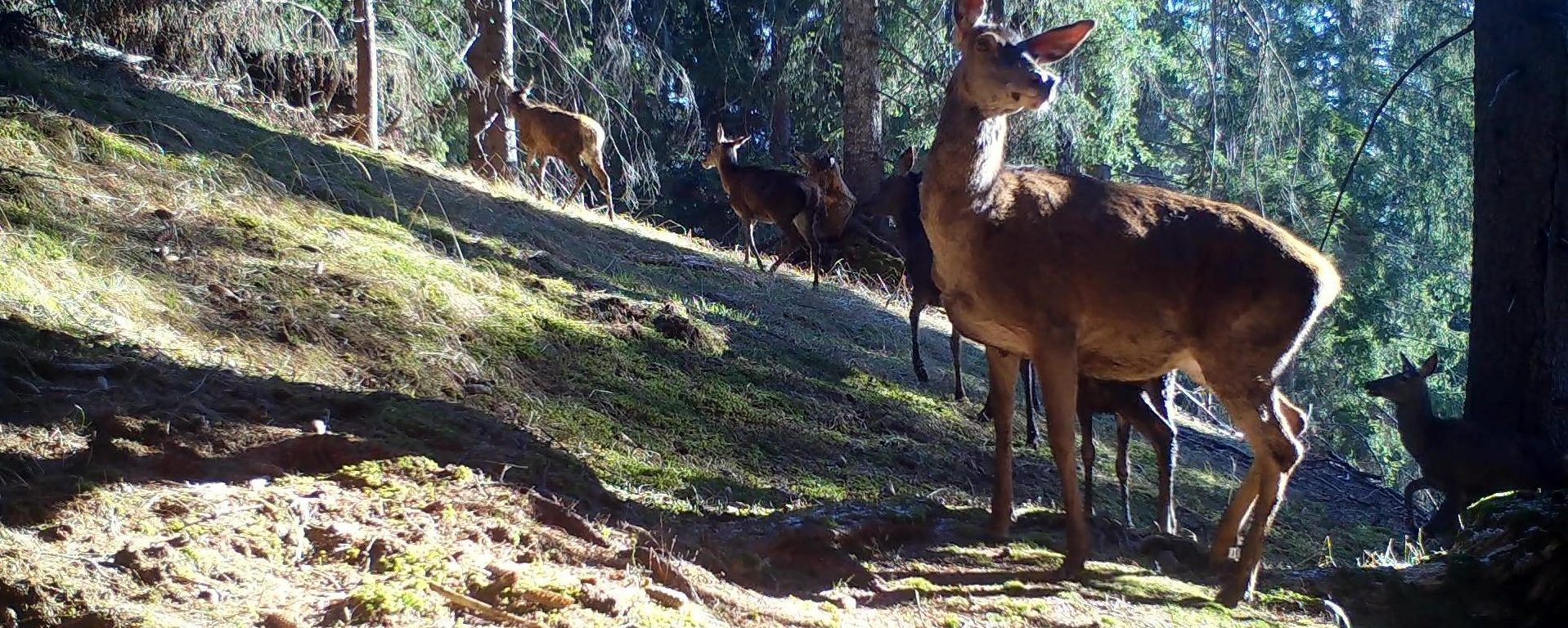
In this blog post, Kristy Ferraro tell the #StoryBehindThePaper for the article “Elements on the move: How ungulate migration expands Alpine biogeochemical footprints“, recently published in the Journal of Animal Ecology. This study explored how local- and landscape-scale movement of migratory vs. resident red deer influenced nitrogen distribution across an alpine landscape.
Animal migration is one of the most fascinating aspects of animal life. When we think of migration, we usually picture the epic journeys of wildebeests crossing the Serengeti, caribou trekking through the high Arctic, or Monarch butterflies flying across North America. Research on migration has therefore traditionally focused on the animals that undertake these journeys themselves: their navigation, the physical cost of their travels, and the many dangers they encounter along the way. But there is another side to migration that receives far less attention. As animals move, they transport something beyond their own bodies: as they feed, travel, and release waste, animals carry precious nutrients across the landscape. Despite this transport forming the backbone of ecosystem functioning, we know surprisingly little about its scale—or what happens when migration disappears. To answer this, our multi-disciplinary team set out to measure this living transport system and simulate how landscapes might change if animals stopped migrating.
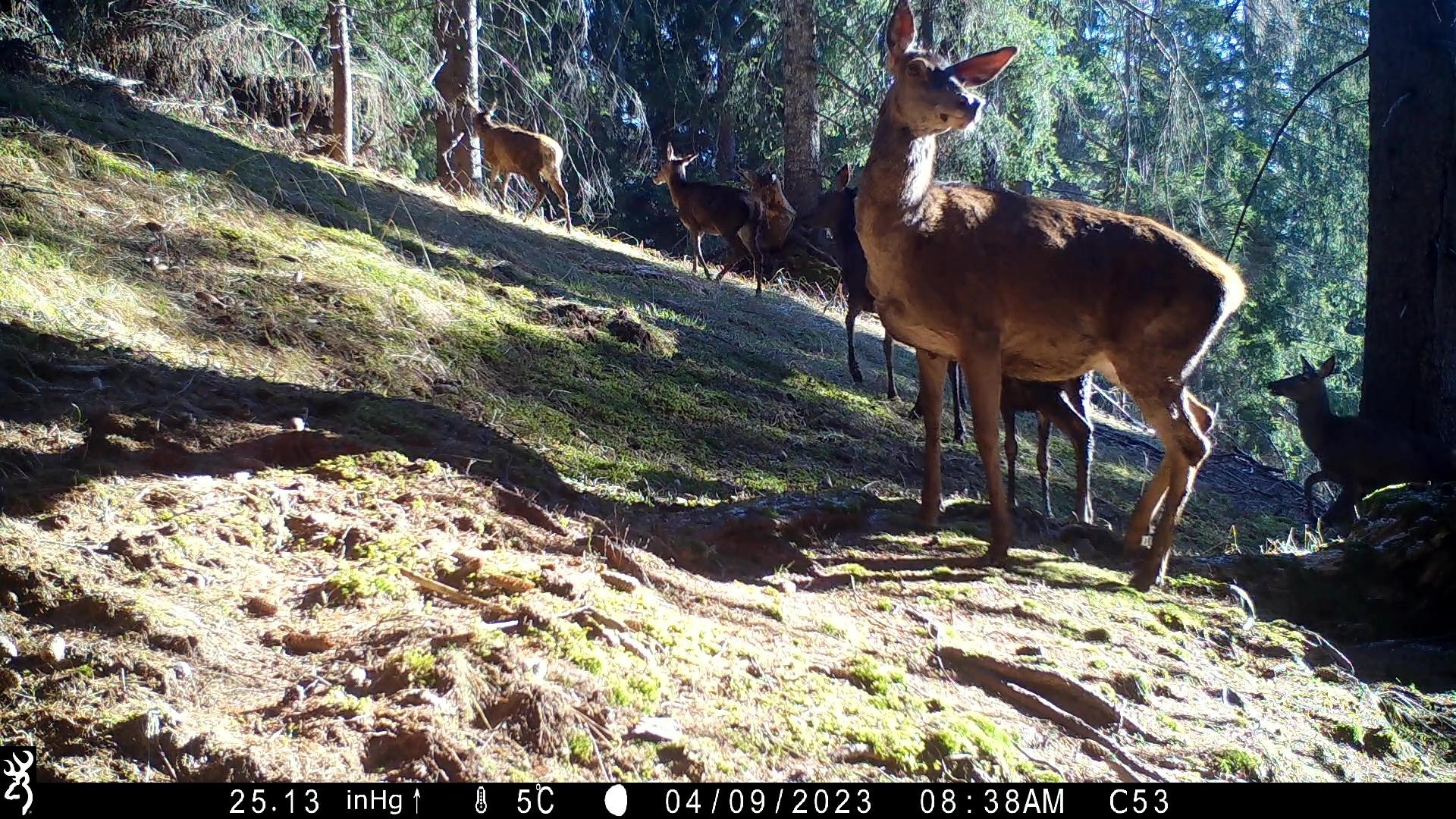
In the Central-Eastern Italian Alps lives a partially migratory population of red deer (Cervus elaphus). Some individuals are resident all year long, while others roam from low valley bottoms in winter to high alpine zones during the summer. But historical routes for ungulate migration worldwide are increasingly threatened by human development and infrastructure, the loss of which carries demographic, ecosystemic, and cultural consequences. This led us to a critical question: if these animals stopped moving, how exactly would the flow of nutrients be affected?
From GPS data to nutrient maps
We set out to understand how different migratory tactics, as well as the potential loss of migration, shape the transport of a specific nutrient: nitrogen. We chose nitrogen because it is a fundamental building block of animal bodies and an essential nutrient that often limits plant growth, making its movement across the landscape especially important for both animal life and ecosystem productivity.
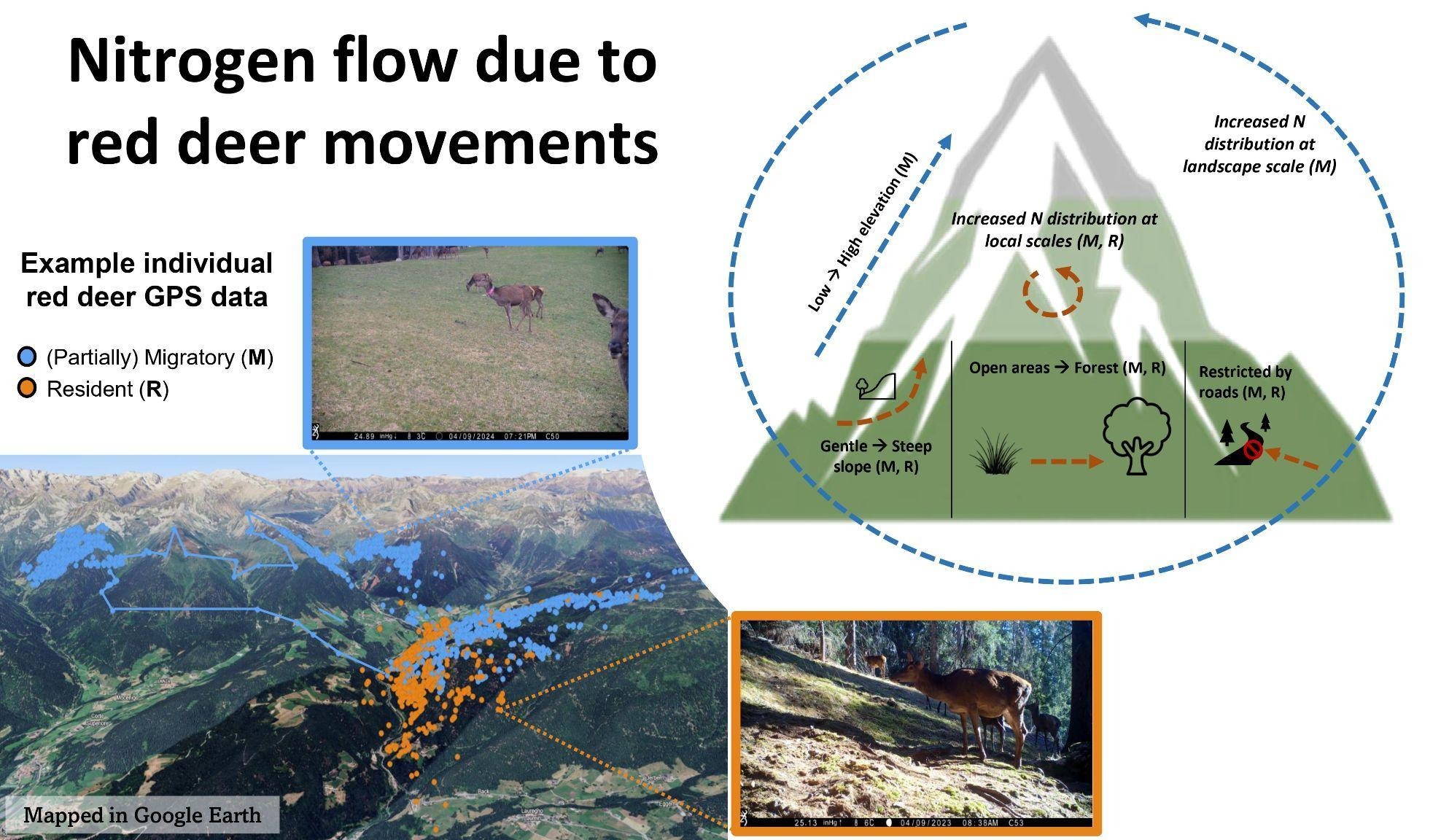
Between 2021 and 2024, we fitted red deer with GPS collars, giving us a high-resolution map of exactly where they spent their time. We combined these GPS tracks with high-resolution satellite data, specifically land cover classifications, vegetation productivity (NDVI), and digital elevation models to map the terrain. Then, we paired this spatial data with extensive on-the-ground measurements of the actual nitrogen content of the plants that deer eat in different habitats. By factoring in population parameters like basal metabolism, average body mass, and daily defecation rates, we could calculate the daily nitrogen intake and output of the animals. We then used this integrated dataset to build a spatially explicit simulation using NetLogo and derive high-resolution net nitrogen maps (gN/100m²), showing us the total, spatiotemporal footprint of nitrogen consumed and deposited by deer over a full year. Finally, we tested four different ecological scenarios: one where the red deer population remains a mix of residents and migrants (‘business as usual’), one where we lose the migratory red deer individuals, one where we lose red deer migrants alongside a general population decline, and finally, a scenario consisting only of the red deer that migrate.
Cross-habitat, topographic, and elevational nutrient transfers
Interestingly, all individuals in our study (both residents and migrants) consistently move nitrogen from open, nutrient-rich foraging areas into closed, nutrient-poorer forests, and they both move nitrogen from flatter onto steeper terrain. However, migration supercharges this process: on average, migratory deer exported 33.7% more nitrogen towards steep terrain (>25° slope) compared to their resident counterparts.
Even more fascinating is a flow of nutrients that completely defies gravity. Physical elements like rain and melting snow constantly wash nutrients down to lower elevations. Migratory deer reverse this process. By eating in the lower valleys and moving upward, they carry nitrogen into higher elevations. In our simulations, the seasonal migratory population exported a staggering 278.4% more nitrogen to habitats above 1,200 meters compared to a resident-only population. In effect, red deer act as nutrient escalators, bringing nitrogen up one mouthful at a time.
We also investigated how human activity is altering the movement of nutrients by deer. As human infrastructure rapidly fragments mountain habitats, we quantified the effect of physical barriers like roads and trails. These features significantly influence nitrogen patterns, confining deer to smaller areas and cutting off their historic migration routes. When we simulated the complete loss of migration in our models, the results were clear: the total spatial area receiving nitrogen redistribution shrank by 33.35%. Furthermore, the transport of nitrogen to high elevations dropped by nearly 60%, and when the loss of migration was compounded by a population decline, transport into closed forests plummeted by nearly 50%.
Preserving migration to preserve ecosystem functioning
Our study highlights a critical reality: the loss of animal migration due to infrastructure development does not just alter animal behavior and distribution; it also shuts down the invisible biogeochemical processes that sustain landscapes. For example, our findings raise the possibility that forest regeneration and growth is actually subsidized by the daily and seasonal movements of animals. As human activities continue to fragment habitats in the Anthropocene, understanding the intersection of movement ecology and biogeochemistry is more urgent than ever. Our models show that even modest contractions in a migratory range can severely diminish the spatial reach of nutrient transport across the landscape. Protecting migration routes, therefore, is about much more than saving a natural phenomenon or a single species—it is vital for maintaining the invisible flow of elements that keeps our ecosystems functioning, connected, and thriving.
Read the paper here:
https://besjournals.onlinelibrary.wiley.com/doi/full/10.1111/1365-2656.70340

